
Cannabis Strains for Short Seasons: How to Choose
Cannabis strains for short seasons are autoflowers and fast flowering photoperiod strains that finish before autumn frost. Photoperiod plants start flowering as days shorten, and day length changes faster at northern latitudes, which NOAA’s solar calculator shows for any location. Matching flowering time to your frost date matters more than strain name.
What Makes a Strain Good for a Short Season?
A short season strain is one that can finish flowering before your first fall frost. Two kinds of plant fit. Autoflowers flower on their own schedule rather than waiting for shorter days. Fast flowering photoperiod strains respond to shortening days but have a short listed flowering time. Flowering times on seed listings are the breeder’s estimates under good conditions, not promises, so leave a margin. Our guide to seeds for your climate covers other climate traits.
Which Seeds Fit a Northern Season?
In the north, the season is short at both ends. Growers often look at autoflowers, which can be sown once frost passes and finish on their own timeline, and at photoperiod strains with short listed flowering times. Our autoflower seeds 101 guide explains how autoflowers work. Some growers also shade plants to trigger flowering early, a method our post on light deps describes.
How Does Day Length Change by Latitude?
Day length peaks at the summer solstice and then shrinks, and it shrinks faster the farther north you are. The table below gives sunrise to sunset day length in 2026 for three US cities, calculated with the equations behind NOAA’s solar calculator (NOAA solar calculator). Minneapolis starts summer with more than an hour of extra daylight over Albuquerque, then loses it quickly. By October 1, all three are close to 12 hours.
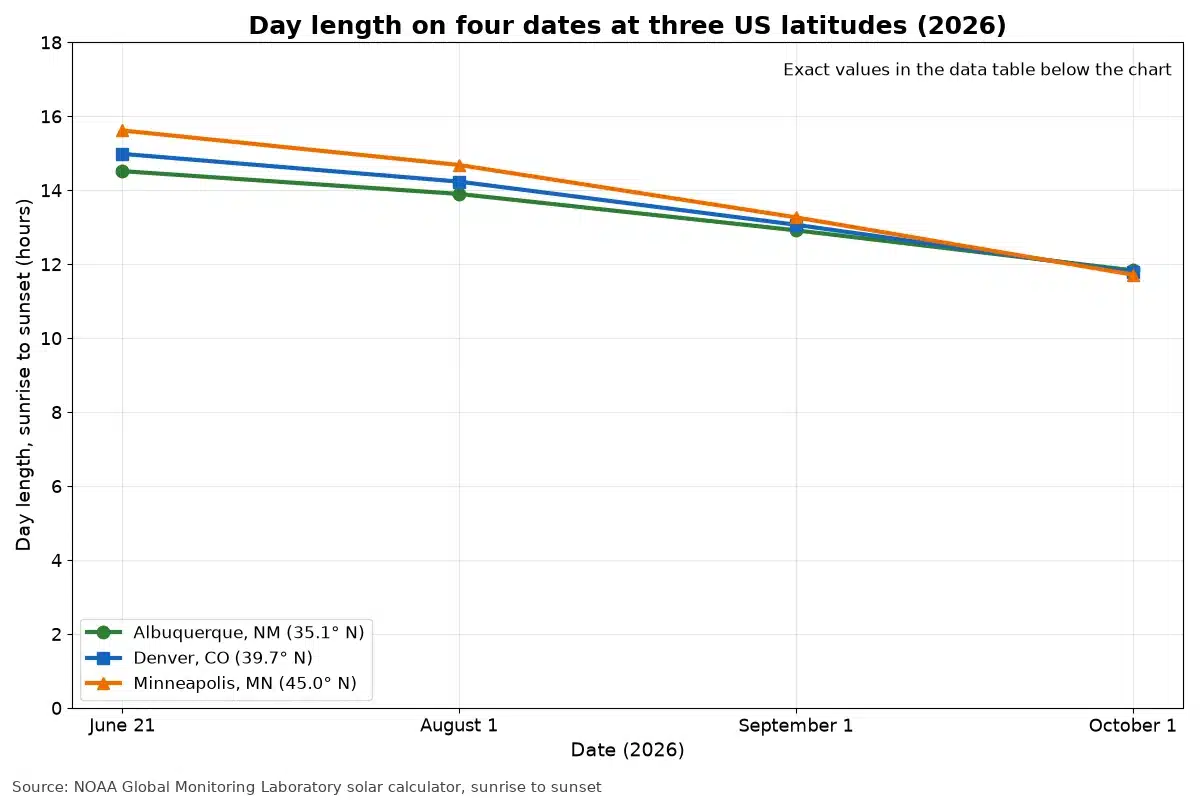
Day length on four 2026 dates at three US latitudes
Source: NOAA Global Monitoring Laboratory solar calculator equations, sunrise to sunset, calculated 2026-10-12 for each city. Chart y axis starts at 0 hours.
| Location (latitude) | June 21 | August 1 | September 1 | October 1 |
|---|---|---|---|---|
| Albuquerque, NM (35.1 N) | 14 h 31 min | 13 h 54 min | 12 h 55 min | 11 h 50 min |
| Denver, CO (39.7 N) | 14 h 59 min | 14 h 14 min | 13 h 4 min | 11 h 47 min |
| Minneapolis, MN (45.0 N) | 15 h 37 min | 14 h 41 min | 13 h 16 min | 11 h 43 min |
How Do You Match Flowering Time to Your Frost Date?
Work backward from your first fall frost. NOAA’s U.S. Climate Normals give typical freeze dates by weather station (NOAA NCEI). For a photoperiod strain, add the listed flowering weeks to the time your plants usually start flowering, then compare that with your frost date and leave a buffer. Outdoor flowering start varies by strain and location, so treat the result as a rough estimate. For an autoflower, count the listed seed to harvest time from your planting date. Our post on faster flowering outdoors covers ways growers speed things up.
Shopping for a short season? See our autoflower seeds, 45-day autoflower seeds and feminized high yielding strains.
Sources
The sources below are federal sun and climate data, not cannabis studies. Day length values were calculated from NOAA’s published equations.
Expect no finish date promise from Kind Seed Co here: the short season notes use NOAA sun and frost data as general information.
FAQ
What is an early finishing strain?
An early finishing strain is a photoperiod plant with a short listed flowering time, so it can finish sooner once days shorten. The listed time is the breeder's estimate under good conditions, not a promise. In a short season, growers compare that estimate with their first fall frost date and leave a few weeks of margin.
Can photoperiod strains finish before frost up north?
Some can. It depends on when the plant starts flowering, how long its listed flowering time is and when your first frost usually arrives. Northern days stay long into summer, then shorten fast. Pick strains with short listed flowering times, check your frost data from NOAA climate normals and plan for weather that comes early.
Can I speed up flowering in a short season?
Some growers do, using autoflowers or by shading plants to shorten their day. Our post on faster flowering outdoors covers the options, and our guide to light deps explains shading. Each method has trade-offs in work and plant size, so read both before changing your plan for the season.
Where do I find my first fall frost date?
NOAA's National Centers for Environmental Information publish U.S. Climate Normals with freeze and frost data for weather stations across the country. Find the station closest to your garden and note the typical first fall freeze. It is an average, so an early cold snap can still arrive before that date, and a margin helps.


