Feeding Schedule for Cannabis in Soil
A feeding schedule is a plan for what to give your plants and when. In soil, it is less about exact numbers and more about matching nutrients to what the plant is doing at each stage, then watching how it responds. This guide explains how to start with a soil test, how to read fertilizer numbers, and how to adjust feeding from seedling to harvest. It draws on Utah State University Extension and Clemson Cooperative Extension. Check your state’s home grow law before starting any grow.
Start with what is already in the soil
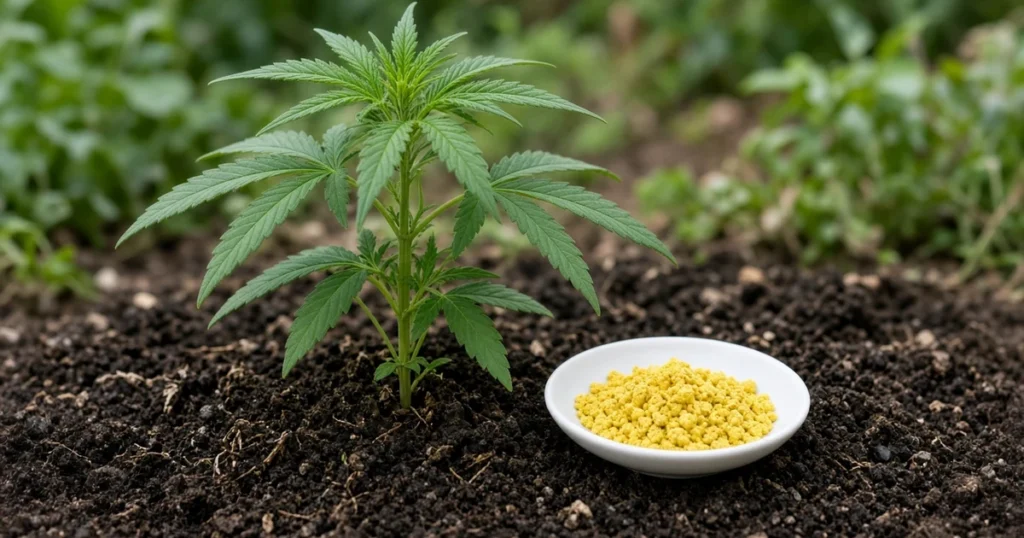
Many bagged potting soils already contain fertilizer that can carry young plants for a few weeks. Garden soil varies even more. Clemson Cooperative Extension explains that a soil test report “will make a recommendation for the amount and type of fertilizer and/or lime you need to add,” and that following it “will help prevent problems with nutrient deficiencies” or over fertilization problems “such as excessive vegetative growth, delayed maturity, salt burn, and wasted money.”
For outdoor beds, a soil test is the single best first step. Clemson recommends collecting “8 to 10 or more core samples, which will be combined as one composite sample,” taken “from the surface to a depth of 6 inches.” For bagged potting mix, read the bag to see whether it is pre fertilized and for how long.
How to read fertilizer numbers
Utah State University Extension explains that the three numbers on a label are the percent of nitrogen (N), phosphate (P2O5) and potash (K2O). USU uses bone meal as its example: a 6-12-0 product contains 6% nitrogen, 12% phosphate and no potash.
USU’s table of organic materials shows how different they are. It lists blood meal at about 12% nitrogen with “rapid” availability, bone meal at 1 to 6% nitrogen and 11 to 30% phosphate with “moderate” availability, and composts at 1 to 3% nitrogen. In general grower experience, fast materials act quickly but can burn roots if overused, and slow ones feed over weeks. That part is grower practice, not a USU finding.
What cannabis needs at each stage
| Stage | Main need | What to watch |
|---|---|---|
| Seedling (about weeks 1 to 3) | Very little feed. Many pre fertilized mixes carry them | Burned tips mean too strong |
| Vegetative | More nitrogen for leaves and stems | Pale lower leaves can mean low nitrogen |
| Early flower | Balanced feed as buds set | Stretch. Keep feed steady |
| Mid to late flower | Less nitrogen, steady phosphorus and potassium | Dark, clawing leaves can mean too much |
| Final 1 to 2 weeks | Little or no extra feed for most growers | Natural fading of older leaves |
The stage ranges above are common grower practice, not Extension figures. Strain, pot size and soil change the picture.
Building your schedule: step by step
- Check your starting soil. Test garden soil, or read the potting mix bag to see if it is pre fertilized.
- Hold off on feeding seedlings. If the mix is pre fertilized, plain water is often enough for the first few weeks.
- Start light in veg. When lower leaves start to pale or growth slows, begin feeding at a quarter to half of the label rate.
- Raise the feed slowly. Increase strength only if plants look hungry and show no tip burn.
- Ease into flower feeding. Keep a balanced feed as buds set in early flower, then move to a formula with less nitrogen as flowering reaches the middle weeks, matching the table above.
- Water to light runoff. In containers, a little drainage out the bottom helps avoid salt build up.
- Taper near the end. Cut back on nitrogen in the last weeks and let older leaves fade.
- Keep a simple log. Write down every feed, strength and how plants looked a few days later.
Water, pot size and feeding go together
How you water changes how much feed reaches the roots. In a small pot, soil dries fast and salts build up quickly, so plants show both hunger and burn sooner. In a large pot or raised bed, the soil holds more nutrients and water, and changes show up more slowly. A few habits help:
- Water when the top inch or so of soil is dry and the pot feels light, not on a fixed calendar.
- Feed into moist soil rather than bone dry soil, which can be harsh on roots.
- Give enough volume that a little drains out the bottom of containers.
- Check runoff pH now and then. Many soil growers aim for roughly 6.0 to 7.0, which is common grower practice.
Why pH is part of the schedule
Nutrients can be in the soil but out of reach if the pH is off. Clemson notes that a soil test report gives “the pH value or how acidic or basic your soil is,” along with a lime recommendation if needed. In containers, very acidic or very alkaline water and feeds can shift pH over time, so a cheap pH meter or test kit is worth having.
Organic vs bottled nutrients
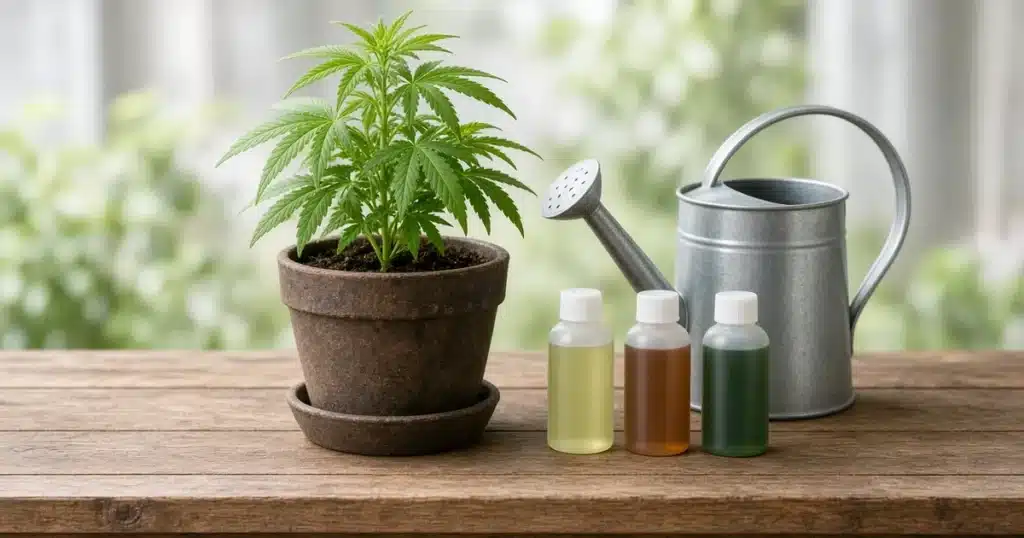
Organic dry amendments break down over time and rely on soil life to release nutrients. USU notes that organic materials vary in “rates of availability,” which means you plan ahead rather than react quickly. Bottled liquid nutrients act fast and are easier to adjust, but are also easier to overdo. Either can work. Mixing heavy amounts of both is a common cause of overfeeding.
A sample week in veg
Here is what a light, flexible routine might look like for a plant in a 3 to 5 gallon pot of pre fertilized mix, once the starter nutrients run low: water with plain water, wait until the pot feels light again, then feed at about half the label rate, then plain water again. Watch the newest leaves for a few days after each feed. If they look healthy and green, hold steady. If lower leaves keep paling, nudge the strength up a little. This is an example, not a prescription.
Safety notes
Store fertilizers out of reach of children and pets. Wear gloves and a dust mask when handling dry meals and powders. If you use manure or manure based compost, use only fully composted material, never raw manure.
Troubleshooting soil feeding
Brown, crispy leaf tips. This often signals feed that is too strong. Feed at a lower strength and water to runoff.
Lower leaves yellowing in veg. Nitrogen may be running low. Feed lightly and recheck in a few days.
Yellowing between veins on older leaves. This can point to magnesium, but check runoff pH and your watering first, because pH swings and soggy or bone dry roots can cause the same look. See our magnesium deficiency guide.
Purple, dark lower leaves and slow growth. Check for cold roots or low phosphorus. See our phosphorus guide.
Plants look worse after feeding more. The issue may be pH or roots, not nutrient supply. Check runoff pH and root health before adding more. Our leaf symptom guide can help you sort it out.
FAQ
How often should I feed cannabis in soil?
It depends on the soil and the plant. Many growers feed every second or third watering in veg and flower, starting at a low strength and adjusting to how plants respond.
Do seedlings need nutrients in soil?
Usually not at first. Many potting mixes carry enough fertilizer for the first few weeks. Feeding seedlings too early is a common cause of burned tips.
What do the three numbers on fertilizer mean?
They show the percent of nitrogen, phosphate and potash. Utah State University Extension uses bone meal as an example: 6-12-0 means 6% nitrogen, 12% phosphate and no potash.
Should I test my soil before growing cannabis?
For outdoor beds, yes. Clemson Extension says a soil test report recommends the type and amount of fertilizer and lime, helping you avoid both deficiencies and overfeeding.
When should I stop feeding before harvest?
Many growers cut back sharply in the last one to two weeks and let older leaves fade. Follow your nutrient label and watch the plant.
Sources
- Clemson Cooperative Extension HGIC 1652, Soil Testing. https://hgic.clemson.edu/factsheet/soil-testing/ (opened 2026-10-16)
- Utah State University Extension, Selecting and Using Organic Fertilizers. https://extension.usu.edu/yardandgarden/research/selecting-and-using-organic-fertilizers (opened 2026-10-16)