
Growing Marijuana Outdoors Versus Indoors
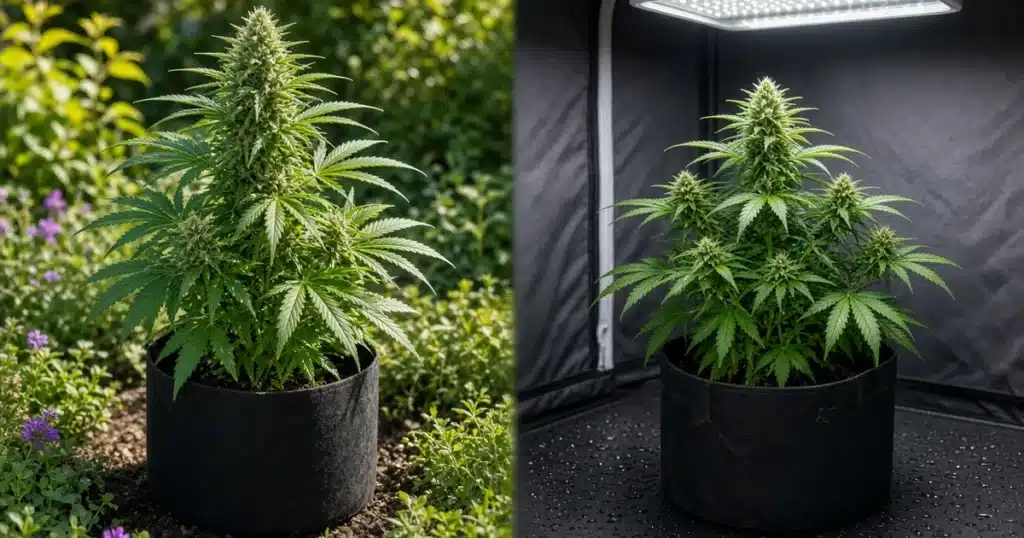
Indoors or outdoors is one of the first choices a new grower makes, and it shapes almost everything after it: what you buy, how much you spend, which seeds suit you and how much control you have. Neither is better in every case. Below, we will compare the two side by side and give you a simple way to choose. It draws on Purdue University Extension, University of Georgia Extension and Oregon State University Extension research, plus a Utah State University thesis. The UGA and Oregon State findings come from hemp. Laws on where you may grow, including whether plants must be out of public view or locked away, vary by state, so check your state’s home grow law before you choose.
Light: the biggest difference
Outdoors, the sun does the work for free. Indoors, you supply every bit of light. Purdue University Extension explains that plants respond to the daily light integral, or DLI, “the amount of PAR received each day as a function of light intensity” and duration. Purdue compares DLI to a rain gauge: it adds up all the light plants get in a day.
Summer sun can deliver a lot of light. A Utah State University thesis notes that in Logan, Utah, at the peak of summer, sunlight can reach about 2,000 micromoles per square meter per second at solar noon, and that the peak summer DLI there is around 60 moles per square meter per day. Matching that indoors takes strong lights and a lot of electricity, which is why indoor growing costs more to run.
Season and timing
Outdoor photoperiod plants follow the calendar. In its hemp guidance, University of Georgia Extension explains that “most hemp cultivars will flower when exposed to day lengths of fewer than approximately 13 to 14 hr,” so outdoor plants flower as nights lengthen in late summer. Indoors, you choose the flip date by changing the light timer.
In a hemp guide, Oregon State University Extension notes that “autoflower varieties are generally ripe to harvest around 75 days after planting, while full season types require closer to 120 days.” That gives outdoor growers in short or dry seasons another option.
Water
Outdoor plants in the ground can reach deep soil moisture but face heat and drought. OSU notes that autoflowers “require less water to achieve a crop” in its hemp work. Indoor plants in containers depend entirely on you for water, but you control how much and when.
Side by side
| Factor | Indoor | Outdoor |
|---|---|---|
| Light | You buy and power it | Free sunlight |
| Startup cost | Higher (tent, light, fans, filter) | Lower (soil, pots or beds) |
| Running cost | Electricity every day | Water, amendments |
| Control | High: light, temperature, humidity | Low: weather decides |
| Harvests per year | Several possible | Usually one for photoperiods |
| Plant size | Limited by space | Can be large |
| Pests | Fewer, but outbreaks spread fast | More pests, birds, deer |
| Smell | Needs a carbon filter | Spreads to neighbors |
| Privacy and security | Easier to keep out of view | Harder. Check local rules |
How to choose: step by step
- Check the law first. Find out whether your state allows home growing, how many plants, and whether plants must be indoors, locked or out of view.
- Look at your space. A sunny, private yard with at least six to eight hours of direct sun favors outdoors. No yard, or no privacy, points indoors.
- Set a budget. Price a tent, light, fan and filter for indoor. Price soil, containers or a bed for outdoor.
- Count your season. Look up your area’s last spring frost and first fall frost. Short seasons favor autoflowers or fast finishing strains outdoors.
- Think about time. Indoor grows need daily checks on equipment. Outdoor grows need watering in heat and pest watching.
- Pick seeds that fit. Compact strains and autoflowers suit small tents. Mold resistant, fast finishing strains suit wet fall climates outdoors.
- Start small. Grow one or two plants your first time and keep notes.
Pests and problems
Indoor and outdoor gardens face different trouble. Outdoors, expect caterpillars in buds, aphids, birds pulling at seedlings, deer and rabbits, and weather damage from wind and hail. Indoors, growers often see fewer kinds of pests, but spider mites, fungus gnats and thrips can spread fast in a warm, closed tent because there are no predators. Indoors, the main disease risk is usually root problems from overwatering. Outdoors, it is bud rot and powdery mildew in damp falls.
Yield and quality
Outdoor photoperiod plants in the ground can grow very large. Indoor plants are limited by space and light, but you can run several cycles a year and control conditions closely. Many growers find indoor buds look more uniform, while outdoor buds vary with the season. Quality in both depends heavily on harvest timing and a careful dry.
Hybrid options
A greenhouse or a sunny window with supplemental light sits between the two. Greenhouses give outdoor sunlight with some shelter from rain and pests. Some growers start plants indoors and move them outside once the weather warms.
Smell and neighbors
Flowering cannabis smells strong. Indoors, a carbon filter on the exhaust fan is the usual way growers cut odor before air leaves the room. Outdoors, there is no filter, so smell carries on warm evenings. Choosing a spot away from property lines, planting fewer plants, and picking less pungent strains can help. Some states and cities have rules about odor or visibility, so this is part of checking your local law.
Safety notes
- Indoor lights, fans and heaters draw real power. Use equipment rated for the load and do not overload outlets or extension cords.
- Keep fertilizers, pest products and harvested cannabis locked away from children and pets.
- Follow every pesticide label exactly, indoors or out, because the label is the law. Few labels list cannabis at all: the Minnesota Department of Agriculture notes that there are no EPA registered pesticide products approved for use on cannabis, and state rules decide which products, if any, may be used on it. Use only products your state allows on cannabis, and check with your state’s pesticide agency first.
- Outdoors in wet falls, inspect buds for mold often, and throw away any moldy material rather than using it.
Troubleshooting
Indoor plants are tall and thin. Light may be too weak or too far away. See our light intensity guide.
Outdoor buds rot in fall rain. Choose faster finishing strains, improve spacing for airflow, and harvest before long wet spells where possible.
Indoor room is too hot. Improve exhaust, run lights at night, or use a more efficient light.
Outdoor plants flowered early. Plants set out early in spring under short days can flower briefly. Plant out after days are long, or use autoflowers.
Related guides
Indoor growers can level the canopy with a ScrOG. Outdoor growers should read about birds and natural pest repellents.
FAQ
Is it better to grow cannabis indoors or outdoors?
Neither is better for everyone. Indoors gives control and several harvests a year at a higher cost. Outdoors uses free sunlight and can grow large plants, but the weather sets the schedule.
Is indoor growing more expensive?
Usually, yes. You buy and power lights, fans and filters. Outdoor growing costs less up front and to run.
How much sun does outdoor cannabis need?
Most growers look for at least six to eight hours of direct sun. A Utah State University thesis notes that peak summer sun in Logan, Utah, can reach a daily light integral of about 60 mol per square meter per day.
Can I grow autoflowers outdoors?
Yes. Oregon State Extension hemp research found autoflowers generally ready about 75 days after planting and needing less water, which suits short or dry seasons.
Do outdoor plants smell?
Yes, especially in flower. Smell can carry to neighbors, so think about privacy and local rules before you choose outdoors.
Sources
- Purdue University Extension, HO-238, Measuring Daily Light Integral in a Greenhouse. https://ag.purdue.edu/department/hla/extension/extension-publications-library/ext-pubs/ho-238-w.html (opened 2026-10-16)
- Utah State University, graduate thesis (2024), Responses of Medical Cannabis to Daily Light Integrals Higher Than Summer Sunlight. https://digitalcommons.usu.edu/etd2023/379/ (opened 2026-10-16)
- University of Georgia Extension, Bulletin 1530, Industrial Hemp Production in Georgia. https://fieldreport.caes.uga.edu/publications/B1530/industrial-hemp-production-in-georgia/ (opened 2026-10-16)
- Oregon State University Extension, EM 9628, Planning a drought-resilient hemp crop. https://extension.oregonstate.edu/catalog/em-9628-planning-drought-resilient-hemp-crop (opened 2026-10-16)


