
Oscillating Fans in a Grow Tent: Air Circulation
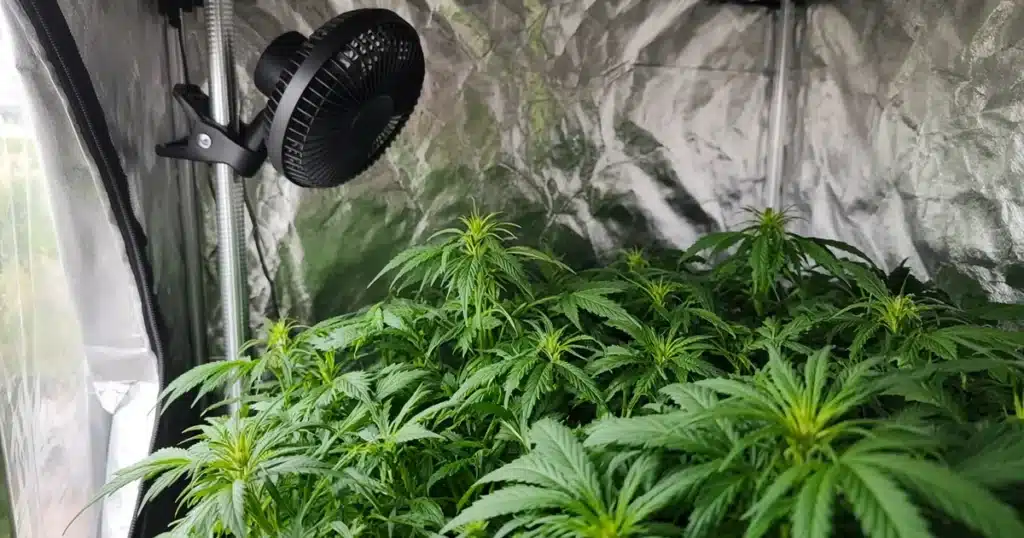
Circulation fans, such as an oscillating fan in a grow tent, keep air moving through a cannabis canopy so leaves dry and humid pockets do not form. UMass greenhouse guidance says air movement is adequate when leaves move slightly. An engineer interviewed by a cannabis trade publication recommends a circular, racetrack airflow pattern over the top of the plants.
Why Does Cannabis Need Moving Air?
UMass Extension, writing for greenhouse growers, says the highest humidity is usually found inside plant canopies, where moisture from transpiration is trapped by poor air movement (UMass). Air that keeps moving keeps mixing, so the air at the leaf surface does not cool below the dew point, and moisture does not condense on the leaves. UMass gives this advice in a section on managing disease in greenhouses. It is greenhouse guidance, not a cannabis trial, and it does not show that fans prevent disease on cannabis.
When Does Moisture Condense on Leaves?
Condensation forms when a leaf is cooler than the dew point of the air around it. UMass gives two examples at 60°F. At 85% relative humidity, water condenses once the leaf is below 55°F. At 95%, the leaf only has to be one degree cooler than the air (UMass). Still air lets leaf surfaces cool and reach that point, which is why mixing matters.
Source: UMass Extension greenhouse guidance (not a cannabis study). At 60°F air, condensation forms on leaves below 55°F at 85% RH and about 59°F at 95% RH.
Leaf temperature at which condensation starts in 60°F air (UMass greenhouse guidance)
| Air at 60°F | Leaf temperature at which condensation starts | Degrees below air |
|---|---|---|
| 85% relative humidity | Below 55°F | 5 |
| 95% relative humidity | About 59°F | 1 |
Where Should You Place Fans in a Grow Tent?
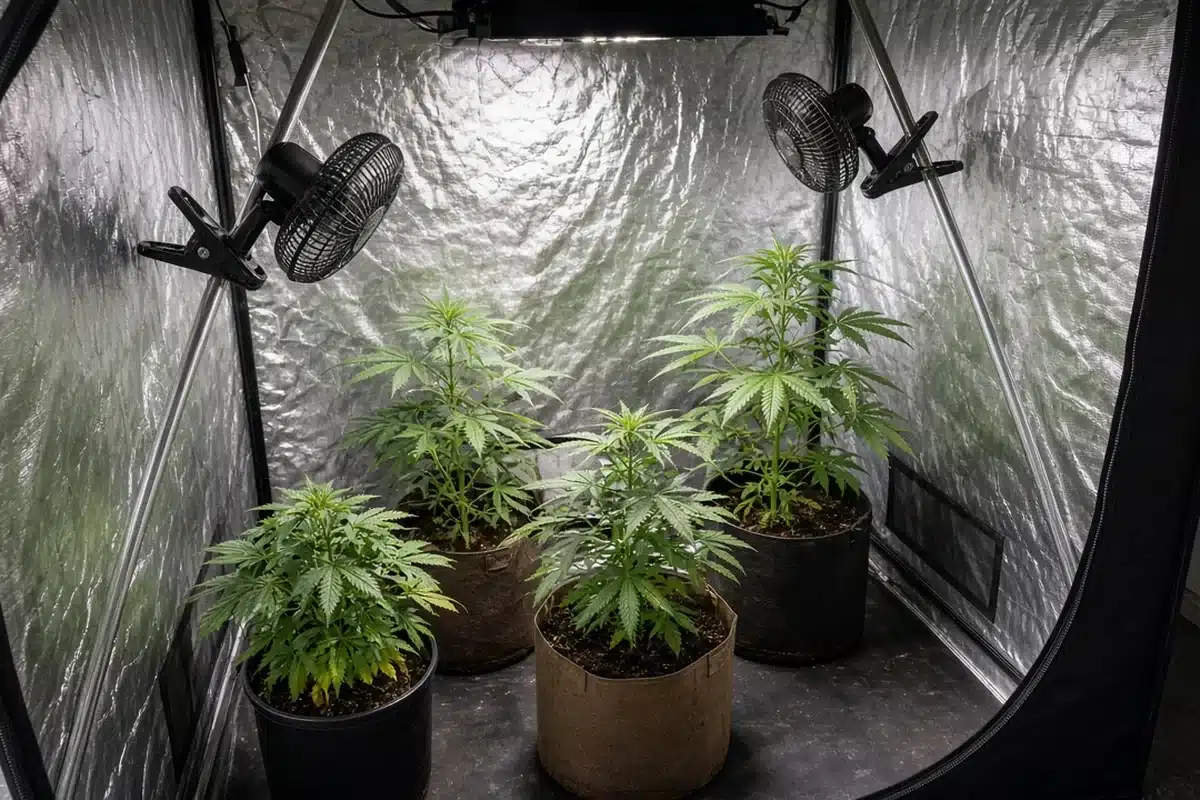
In a Cannabis Science and Technology interview, engineer Nadia Sabeh recommends horizontal airflow, or HAF, in a circular racetrack pattern over the top of the plants (Cannabis Science and Technology). The circular flow acts like a whirlpool and pulls air down into the canopy. She warns that many fans pointing in different directions miss the point, and that vertical airflow fans can leave air trapped above dense cannabis. In greenhouses, UMass describes small HAF fans along each side, pushing air one way on one side and the opposite way on the other (UMass). Setting two or three tent fans in one loop is grower practice based on that idea. Circulation is separate from exhaust, which our guide to the best climate for a grow room covers, and fan placement fits into a full grow tent setup.
How Strong Should the Airflow Be?
UMass gives a simple test: air movement is adequate when the leaves move slightly (UMass). Sabeh adds that blowing air across lower leaves from under the canopy can make plants transpire more and use more water (Cannabis Science and Technology). Strong, direct gusts are a separate problem, covered in our post on cannabis wind burn.
Sources
- UMass Extension: Reducing Humidity in the Greenhouse
- Cannabis Science and Technology (trade publication): Indoor Cannabis Growing, Optimizing Air Circulation
Kind Seed Co kept this fan guide to general growing information, using the sources above.
FAQ
Does airflow lower disease risk?
UMass greenhouse guidance says moving air keeps mixing, so the air at the leaf surface does not cool below the dew point and moisture does not condense on leaves. UMass gives this as disease-management advice for greenhouses. That guidance comes from ornamental crops. It has not been tested in cannabis, so it shows a process, not a proven result.
Can fans blowing on plants cause problems?
Yes, if the air is aimed poorly. In a Cannabis Science and Technology interview, engineer Nadia Sabeh said that blowing air on lower leaves from under the canopy can raise transpiration and water use. UMass suggests aiming for leaves that move slightly, which is gentler than a direct blast.
Why avoid dead air inside the canopy?
UMass says the highest humidity in a greenhouse is usually inside plant canopies, where moisture from transpiration builds up because air does not move enough. Wet leaf surfaces in still air can reach the dew point and collect condensation. UMass says adequate plant spacing helps improve air circulation at plant level.
Do fans help with humidity?
Circulation fans mix the air, which UMass says prevents the air at leaf surfaces from cooling below the dew point. That cuts condensation on leaves, but mixing alone does not remove moisture from the space. UMass pairs air movement with venting and heating to lower humidity in greenhouses.


