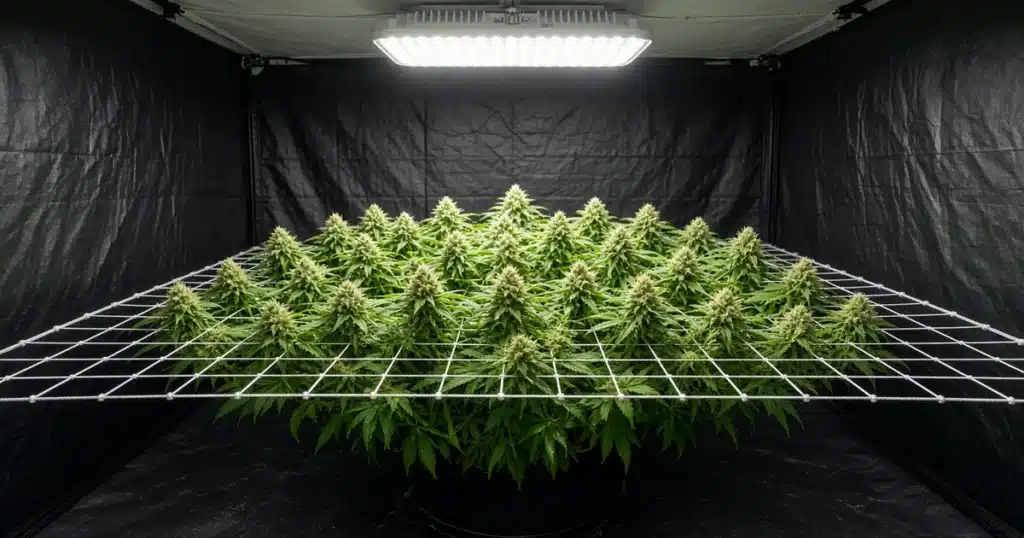
Schwazzing Cannabis: How It Works, When to Do It and the Risks

Schwazzing is heavy fan leaf removal, usually done just before the flip to flowering and again about three weeks into flower. It is risky and can stress or stall a plant. Some growers like the results, but results vary and no yield gain is promised.
Below, you’ll find what schwazzing is, why growers try it, who should skip it, when and how to do it, and how to care for plants afterward.
What schwazzing is
Schwazzing is an extreme form of defoliation. Defoliation means removing leaves, and most growers do a little of it to tidy up the canopy. Schwazzing goes much further. The grower strips most of the large fan leaves from the plant, leaving the bud sites, the small leaves around them and the growing tips.
Leafly describes schwazzing as extreme defoliation and frames it as a high risk technique. The plant looks bare afterward, sometimes shockingly so. The idea is that it will recover quickly and put its energy into flowers rather than big leaves.
Schwazzing is usually done twice, once around the flip and again a few weeks into flower. Some growers only do one round. It is not a beginner technique, and it is not needed for a good harvest.
Why growers do it
Growers who schwazz usually want two things: more light on the lower bud sites and better airflow.
Large fan leaves shade everything below them. In a dense indoor canopy, lower buds can sit in shadow for the whole grow and end up small and airy. Removing the fan leaves lets more light reach those sites. Fewer leaves also means more air moving through the plant, which can lower humidity inside the canopy and reduce the risk of mold in dense buds.
A comparison from another crop helps explain the idea. In grapevines, Extension guides say opening the canopy lets more light reach the fruit. University of Maryland Extension stresses that shoot thinning matters because it lets enough sunlight into the canopy, and especially onto the clusters. Oregon State University Extension lists shoot thinning, leaf removal, hedging and crop thinning as practices used to modify the canopy. That is a comparison from another crop, not evidence for cannabis.
Risks and who should skip it
Heavy defoliation can stress, stall or damage a plant. Skip it on autoflowers, weak or stressed plants, and your first grow.
Leaves are how a plant makes food. Strip too many, and a plant may stop growing for days while it recovers, or it may run short of energy when it needs it most. A stressed plant is also more likely to show problems, and stress can play a part in intersex flowers.
Autoflowers are a poor fit for it. They follow a fixed timeline and have little time to recover from a setback, so a stall can cost them a lot. Weak, sick or underfed plants should be fixed before any heavy pruning. And on a first grow, it is hard to know what healthy recovery looks like, so the risk is higher.
If you’re not sure, go with lighter defoliation instead. You will get some of the benefit with less risk.
When to schwazz
Grower guides commonly describe two rounds. Azarius, a grow shop, describes the usual timing as just before the flip to flowering and again around day 21 of flower. That is grower practice rather than research, so treat it as a starting point.
The first round, just before or right at the flip, clears the canopy before the stretch. The plant has time to regrow leaves as it stretches. The second round, around three weeks into flower, clears leaves that grew back and opens the canopy again before buds fill out.
Don’t schwazz late in flower. Once buds are forming fast, the plant needs its leaves, and there is little time to recover. If you are not sure about timing, see our guide to what happens in the first weeks of bloom at https://kindseed.com/cannabis-flowering-week-1-2/.
How to schwazz, step by step
- Only schwazz healthy, vigorous photoperiod plants.
- Clean and sharpen your scissors.
- Remove large fan leaves that shade bud sites, working top to bottom.
- Leave the small leaves near bud sites.
- Give the plant time to recover before any more cuts.
- Repeat lightly only if the plant has bounced back.
Before you start, water and feed the plant normally a day or two ahead, so it goes into the cut well supplied. Work in good light so you can see each bud site.
Cut each fan leaf at the stem, close to where it joins the branch, rather than tearing it. Clean cuts are generally easier on the plant. As you go, step back now and then and look at the whole plant. You want light reaching the bud sites, not a bare stick.
Leave the growing tips and the small sugar leaves around the bud sites alone. Those are part of the flowers. If a leaf is not shading anything, you can leave it.
Schwazzing vs lighter defoliation
Lighter defoliation removes only the leaves that clearly block light or crowd the canopy. It might mean taking off a handful of large fan leaves and clearing small growth from the bottom of the plant that will never get much light.
The difference is how much you take. Schwazzing removes most of the fan leaves at once. Lighter defoliation removes a few, spread over time. The goals are similar, but lighter defoliation is far gentler on the plant.
For most home growers, lighter defoliation is the better choice. It opens the canopy, improves airflow and carries much less risk of a stall. You can always take a little more later. You can’t put leaves back once they’re gone.
Troubleshooting
| Sign | Likely cause | What to do |
|---|---|---|
| Growth stalls after stripping | Too much removed | Wait and skip the second round |
| Leaves yellowing fast | Plant is short on stored energy | Check feeding and pH, do not strip more |
| Buds look small | Possible causes: genetics, light, stress | Try lighter defoliation next time |
| Autoflower stunted | Too little time to recover | Do not schwazz autoflowers |
Recovery time is the key signal. A healthy plant should show new growth within several days. If it does not, hold off on any more cuts.
Aftercare
After a schwazz, give the plant a calm, steady environment. Keep temperature and humidity in a comfortable range, and keep feeding normally rather than adding extra nutrients to push recovery.
Watch the plant closely for the next week. Healthy new leaves and growing tips are good signs. Drooping, yellowing or no new growth mean the plant is struggling, so skip the second round and let it recover.
Keep notes on what you removed, when, and how the plant responded. If you try it again on the same strain, those notes will tell you whether it was worth it in your setup.
Sources: University of Maryland Extension, Canopy Management: Shoot Thinning and Positioning (https://extension.umd.edu/resource/canopy-management-shoot-thinning-and-positioning). Oregon State University Extension EM 9071, The Role of Canopy Management in Vine Balance (https://extension.oregonstate.edu/catalog/em-9071-role-canopy-management-vine-balance). Leafly. Azarius.
FAQ
What is schwazzing?
Schwazzing is an extreme form of defoliation where a grower removes most of the large fan leaves from a cannabis plant, usually around the flip to flowering and again a few weeks later. It aims to get more light to lower bud sites, but it is high risk.
Does schwazzing increase yield?
Some growers report better results, but results vary and no yield gain is promised. Heavy leaf removal can also stress or stall a plant. Lighter defoliation gives some of the same benefits with less risk.
When should I schwazz?
Grower guides commonly describe two rounds: just before the flip to flowering and again around three weeks into flower. Only do the second round if the plant has fully recovered from the first. Do not schwazz late in flower.
Can I schwazz autoflowers?
It is not recommended. Autoflowers follow a fixed timeline and have little time to recover from a setback, so heavy defoliation can stunt them. Stick to removing only the odd leaf that clearly blocks light.
How many leaves should I remove?
There is no fixed share. Remove only the large fan leaves that shade bud sites, and leave the small leaves near the buds and the growing tips. If you are unsure, take less. You can always remove more later.