Sea of Green Growing
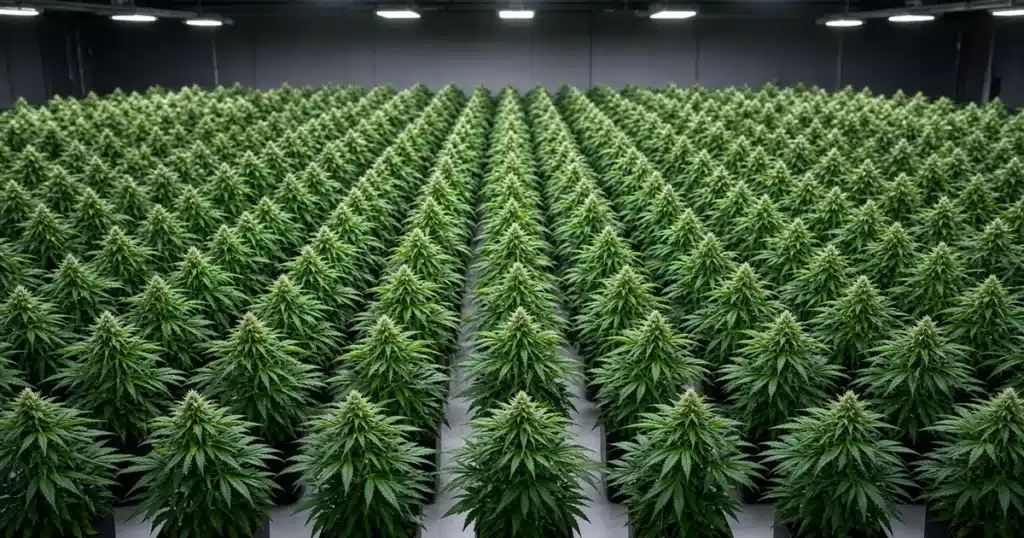
Sea of green is an indoor method that grows many small plants close together instead of a few large ones. Each plant gets a short veg, switches to flower early and grows one main cola, so the tops form a single even canopy under the light. It suits growers who want a uniform crop from limited room.
Growers often shorten it to SOG. Below are the steps, the Extension sources behind them, the trade offs and the problems that come up most often. Kind Seed Co keeps the method simple: even plants, even light and steady air.
What Sea of Green Means
A sea of green is a canopy of many short plants, each topped by one main flower cluster, packed so their tops meet in one flat layer. From above it looks like a single green surface, which is where the name comes from.
The method rests on how cannabis flowers. USU Extension groups cannabis with plants that respond to short days, starting to flower once day and night are close to equal. Switching the light schedule early keeps each plant small, and growing many of them fills the space.
Why Even Light Matters
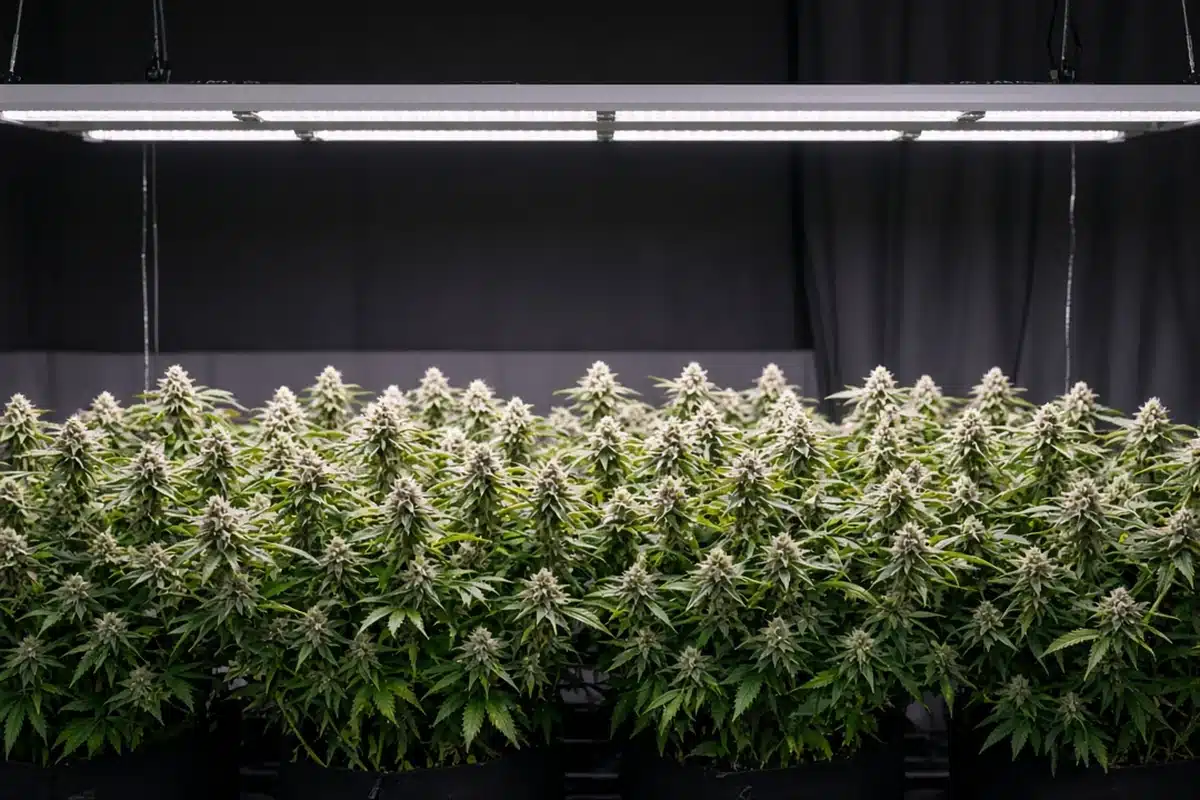
Every plant in a sea of green needs about the same light, because one tall plant shades its neighbours. UConn Extension, writing about vegetable transplants, says that giving plants enough light and enough space helps reduce stretch.
Virginia Cooperative Extension sums light over a full day as DLI: PPFD at the canopy times hours of light times 0.0036. The values below are example inputs to show how the schedule changes the total, not cannabis targets.
| Example PPFD | DLI at 18 hours (veg) | DLI at 12 hours (flower) |
|---|---|---|
| 400 | 25.9 | 17.3 |
DLI shown as mol/m²/day, from the VT formula.
VT also notes that light becomes less even across the canopy as fixtures move closer to plants. In a sea of green that matters more than usual, because the canopy is meant to be flat from edge to edge. Our page on choosing LED lights covers fixture choice.
Steps for a Sea of Green Setup
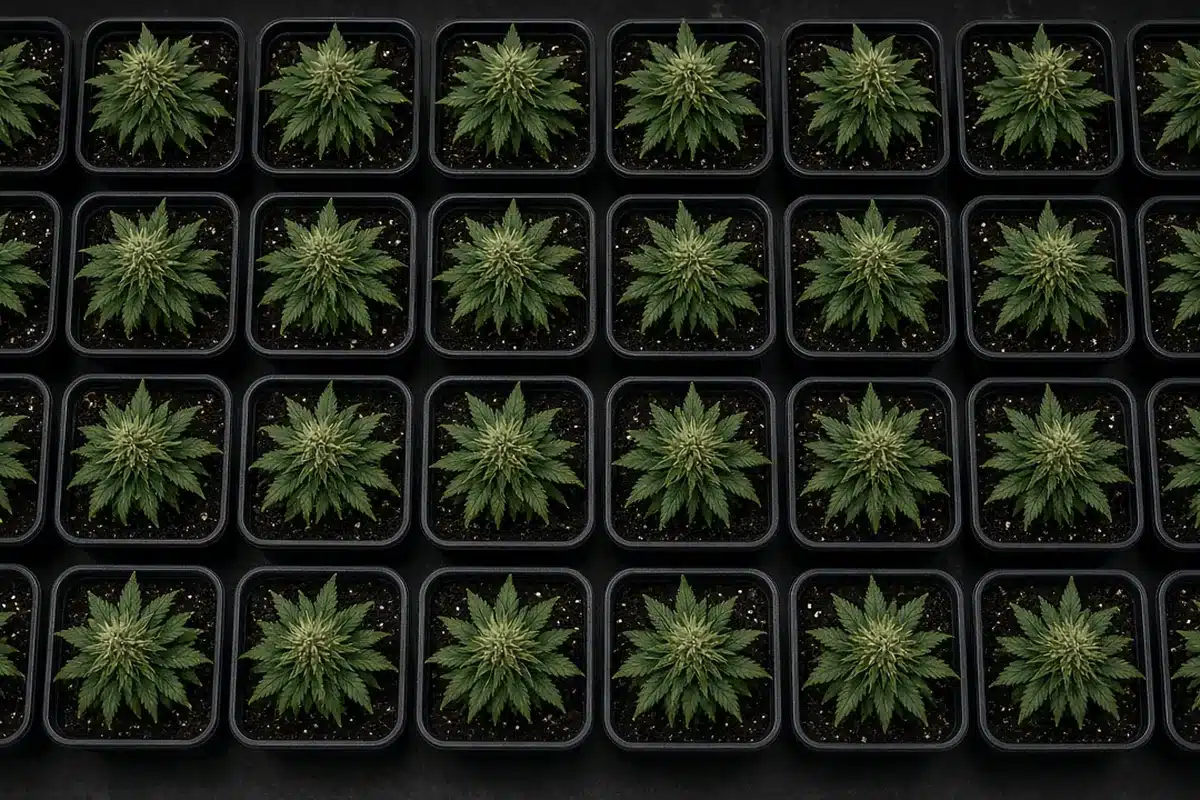
Follow these steps in order. They keep the plants even, which is the whole point of the method.
- Choose suitable genetics. Pick a cultivar with a compact shape and a flowering time that fits your calendar, and use the same one across the canopy.
- Start uniform plants. Plants of one age and one genetic line grow more evenly. Rooted cuttings from one mother are a common route, and the page on making cannabis clones shows how.
- Use small containers. Small pots keep each plant compact and let you set them close together.
- Space the plants evenly. Work out how many pots fit by dividing the canopy area by the footprint of one pot, then leave room for air to move.
- Set even light. Hang the fixture so the whole canopy gets similar light, and check PPFD at several points across the tops.
- Shorten the veg. Switch the schedule early. USU notes that cannabis flowers once nights grow about as long as days, so a 12 hour day starts flowering. Read when to switch to flowering for the timing.
- Trim the lower growth. Remove small lower shoots that sit in shade so each plant puts its growth into the top.
- Harvest together. Even plants finish at about the same time, so the whole canopy comes down in one go.
Humidity and Airflow in a Dense Canopy
Watch humidity closely, because a packed canopy holds moist air. An MSU Extension article warns that relative humidity above 85% can give fungal pathogens a good environment, since water lost through the leaves stays on them.
MSU also explains that air at 80 F can hold about twice the water of air at 60 F, so the same humidity reading means something different at each temperature. Its table shows that at 70% humidity the vapor pressure deficit, or VPD, rises from 0.55 kPa at 60 F to 0.90 kPa at 75 F and 1.45 kPa at 90 F.
| Temperature | Relative humidity | VPD |
|---|---|---|
| 60 F | 70% | 0.55 kPa |
| 75 F | 70% | 0.90 kPa |
| 90 F | 70% | 1.45 kPa |
From the MSU Extension article on VPD and relative humidity.
For a dense canopy, MSU suggests keeping a VPD above 0.5 kPa while finishing plants in greenhouses. Steady air movement through and over the canopy helps the leaves dry.
Benefits of the Sea of Green Method
The main gains are uniformity and use of space. Because every plant is small and similar, the canopy is easy to light evenly and easy to manage.
- Even plants make light easier to set across the whole canopy.
- A short veg keeps each plant compact in a low space.
- One genetic line and one age means plants finish together.
- A single flat canopy is simple to check and trim.
Drawbacks of the Sea of Green Method
The trade offs come from the number of plants and how close they sit. More plants mean more pots to water and more chances for one plant to fall behind.
- Many plants take more time to water and check.
- A dense canopy holds humidity, which MSU links to fungal trouble.
- Uneven starts break the flat canopy and shade the smaller plants.
- Local rules may limit how many plants you can grow, so check them first.
Other canopy methods spread a few plants across a screen instead. Read how screen growing works to compare that approach.
Troubleshooting
Most sea of green problems come from uneven plants or a canopy that holds too much moisture. Find your case below.
Plants finish at uneven heights. Start plants of one age and one line, and check light at several points across the canopy.
Buds low on the plant fill out poorly. Light falls off below the top layer. Trim lower shoots that sit in shade.
Humidity climbs under the dense canopy. MSU links humidity above 85% to fungal trouble. Improve air movement and keep the VPD above 0.5 kPa.
One plant shades its neighbours. Lower it, move it to the edge or trim it back to the canopy height.
Plants stretch after the light change. UConn ties stretch to low light and crowding, so check the light level and the spacing.
Try the SOG Method at Home
Pick a compact cultivar and start small. Browse our indica feminized seeds or sativa feminized seeds.
Sources
- Utah State University Extension, Ten Frequently Asked Questions About Growing Cannabis: https://extension.usu.edu/crops/research/ten-frequently-asked-questions-about-growing-cannabis
- UConn Extension, Managing Plant Height of Vegetable Transplants: https://ipm.cahnr.uconn.edu/managing-plant-height-of-vegetable-transplants/
- Virginia Cooperative Extension, SPES-720 Daily Light Integral for Indoor Growing: https://www.pubs.ext.vt.edu/content/dam/pubs_ext_vt_edu/spes/spes-720/SPES-720.pdf
- Michigan State University Extension, VPD vs. Relative Humidity: https://www.canr.msu.edu/uploads/resources/pdfs/vpd-vs-rh.pdf
FAQ
What is sea of green in cannabis growing?
It is an indoor method that grows many small plants close together. Each plant has a short veg, switches to flower early and grows one main cola, so the tops form one flat canopy under the light. You end up with a uniform crop from limited room rather than a few large plants.
How many plants fit in a sea of green?
It depends on your space and pot size. Divide the canopy area by the footprint of one pot, then leave a little room for air to move between plants. No Extension source we used sets a count, and local rules may cap how many plants you can grow, so check those before you start.
How long should plants veg in a sea of green?
Keep veg short. Utah State Extension says cannabis begins flowering once nights are about as long as days, so switching to a 12 hour day early keeps each plant small. No source we used gives a set number of days, so time the switch by plant size and space.
Does sea of green work with fast finishing plants?
Yes, a sea of green suits compact plants that finish quickly, as long as every plant is the same age and genetic line. Uniform plants keep the canopy flat, so the light reaches each top evenly and the whole crop comes down at about the same time.
How is sea of green different from other canopy methods?
A sea of green fills the space with many small plants that each grow one main top. Other canopy methods use fewer, larger plants and spread their branches across a screen or net to make an even layer. Both aim for an even canopy but get there in opposite ways.