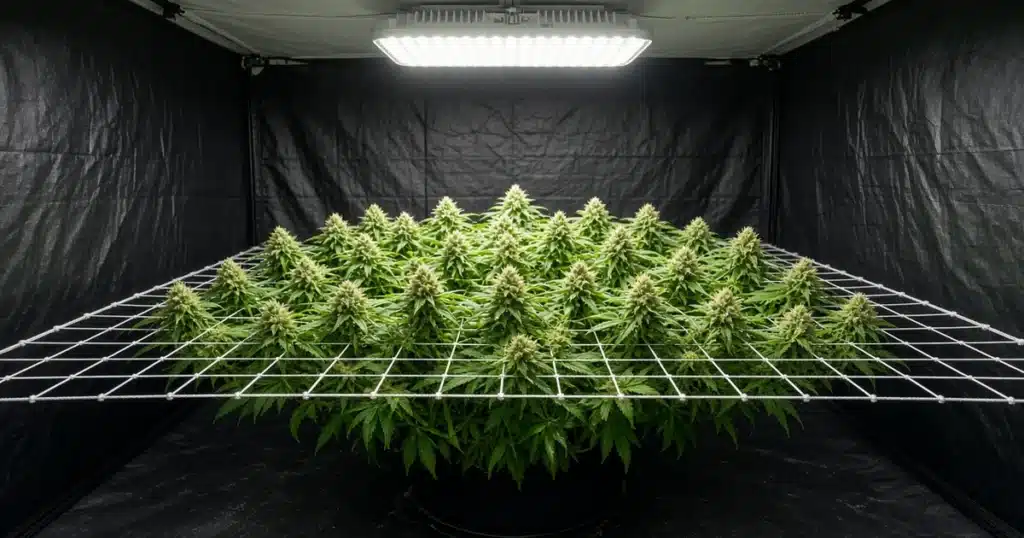
A Guide to Lollipopping Your Cannabis Plant
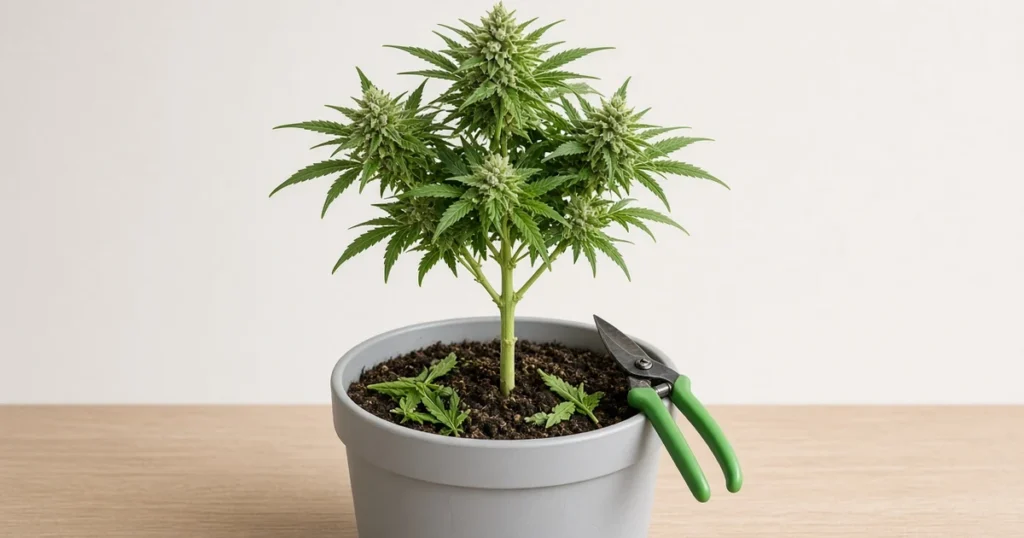
Lollipopping means stripping the lower branches and leaves from a cannabis plant so it looks like a lollipop: a bare stem with a bushy top. Growers do it hoping to send more of the plant’s energy to the top buds that get the most light, and to open up airflow near the base. It is popular, but it is not a magic fix. This guide covers how to do it, when to do it, how it fits autoflowers, and what one university study actually found.
Why growers lollipop
Lower branches sit in shade, especially indoors where light fades fast with distance. They often produce small, airy buds that take time to trim. Removing them can:
- Shift growth toward the top colas
- Improve airflow under the canopy, depending on plant shape
- Make watering and inspection easier
- Reduce the number of small buds that take a long time to dry
- Cut trimming time at harvest
What the research shows
A 2022 study from the University of Hohenheim in Germany tested lollipopping on a CBD type cannabis grown indoors. The researchers removed “the two lowest side branches” at 27 days after planting and the next two at 36 days. Lollipopped plants grew taller with fewer side shoots, and they had the highest fresh weight in the top flower, 33.9 g (about 1.2 oz) per plant. However, they had the lowest total CBD yield of the three treatments. The trend ran topping, then untreated control, then lollipopping, and the difference between lollipop and control was not statistically significant.
The authors suggest lollipopping may suit a sea of green setup, where many small plants each grow one main cola. Keep the limits in mind: this was one CBD dominant genotype in one setup. It is a useful data point, not proof that lollipopping raises or lowers yield in every garden.
The practical takeaway is that, in this study, lollipopping shifted more flower weight to the top of the plant without raising total yield. It is a way to shape quality and workflow more than a guaranteed yield boost.
When to lollipop
Timing matters more than technique. The University of Saskatchewan guide, a Canadian university guide we use here for growing basics, notes that training is done during the vegetative stage, and warns that pruning branches during the early flowering stretch “can cause excessive stretching.” USask adds that plants “can sometimes double, triple, or even quadruple in height” during the stretch.
For photoperiod plants, many growers lollipop just before switching to 12 hours of light and 12 hours of darkness, then do a light cleanup a few weeks into flower. For autoflowers, see the section below.
How to lollipop a cannabis plant
- Wait for a healthy plant. Only lollipop a plant that is growing vigorously and has plenty of nodes.
- Pick your timing. Late veg is the usual window for photoperiods. Avoid heavy cuts during the flowering stretch.
- Clean and disinfect your tools. Wipe your scissors or snips with rubbing alcohol, following the product directions.
- Find the light line. Look at where light stops reaching the canopy. Branches below that line are candidates.
- Remove the lowest growth first. Cut small shoots and branches from the bottom third of the plant, close to the stem.
- Take less than you think. Remove growth gradually. The Hohenheim researchers took two branches at a time, about nine days apart.
- Let the plant recover. Give it several days before any further pruning, and keep conditions steady.
Should you lollipop autoflowers?
Go light or skip it. Autoflowers flower by age, and the University of Saskatchewan notes they begin flowering after about 4 to 5 weeks. That leaves little time to recover from heavy cuts, and the guide warns against pruning during the stretch. If you lollipop an autoflower, remove only a few small, shaded shoots, and do it early, before flowering starts.
Lollipopping and other training
Lollipopping pairs well with methods that build an even canopy, such as low stress training or a screen. The idea is to create a flat top of strong colas, then remove what grows beneath it. In the Hohenheim study, topping produced the highest CBD yield of the three methods, so topping and lollipopping are not interchangeable.
Lollipopping vs defoliation
People often mix up these two techniques. Lollipopping targets whole branches and shoots on the lower part of the plant. Defoliation removes fan leaves, often from the middle and top, to let light reach bud sites. Lollipopping is usually a one or two step job. Defoliation tends to be repeated. Doing both hard at once stacks stress on the plant, so space them out and watch how your plant responds before taking more.
Signs your plant is ready
A plant is usually ready for lollipopping when:
- It has several strong upper branches that reach the light
- Lower shoots are thin, shaded and lagging behind
- The canopy is dense enough that air barely moves near the base
- New growth is healthy green, with no signs of nutrient stress or pests
If the plant is pale, wilting or recovering from transplant, wait. Pruning a stressed plant slows it down further.
What to expect afterward
In the first few days, the plant may look bare at the bottom and pause slightly. After that, growth at the top often picks up. Keep watering and feeding on your normal routine, but remember that a smaller plant may drink a little less for a few days, so check the pot weight before you water. In the Hohenheim study, lollipopped plants grew taller than the other groups, so leave headroom. Watch for stretching, keep your light at a safe distance, and inspect the canopy for pests and mold now that the base is easier to see.
Troubleshooting
| Problem | Possible cause | What to do |
|---|---|---|
| Plant stalled after pruning | Too much removed at once | Prune in smaller steps and let the plant recover |
| Plant stretched hard in early flower | Pruning during the stretch | Finish heavy pruning in veg next time |
| Autoflower stayed small | Heavy cuts with no recovery time | Skip lollipopping or keep it very light on autos |
| Top buds still airy | Low light at the canopy, not lower branches | Check light intensity and distance |
| Mold near the base | Poor airflow | Clear dead leaves and add air movement |
For related terms, see our cannabis glossary at https://kindseed.com/cannabis-glossary/, and for compact plants that fit a sea of green (many small plants in a compact setup), see our indica autoflower comparison at https://kindseed.com/top-10-indica-autoflower-strains-on-kindseedcom/.
Sources: Crispim Massuela et al. 2022, Impact of Harvest Time and Pruning Technique on Total CBD Concentration and Yield (University of Hohenheim, Plants) (https://pmc.ncbi.nlm.nih.gov/articles/PMC8747189/). University of Saskatchewan (Canadian university guide), Gardening at USask: Cannabis (https://gardening.usask.ca/gardening-advice/sorted-by-plant/cannabis.php).
FAQ
What is lollipopping in cannabis?
Lollipopping is removing the lower branches and leaves so the plant has a bare lower stem and a bushy top. It aims to focus growth on the top buds and improve airflow near the base.
Does lollipopping increase yield?
Not reliably. A University of Hohenheim study on one CBD type cannabis found lollipopped plants had the highest top fresh weight but the lowest total CBD yield, though the difference from untreated plants was not statistically significant.
When should I lollipop my plants?
For photoperiod plants, late veg is the usual window. The University of Saskatchewan warns that pruning branches during the early flowering stretch can cause excessive stretching.
Should I lollipop autoflowers?
Go light or skip it. Autoflowers start flowering after about 4 to 5 weeks, so remove only a few small, shaded shoots early, before flowering starts.
How much should I remove when lollipopping?
Start with the bottom third of the plant and remove growth gradually. The Hohenheim researchers removed two branches at a time, about nine days apart.