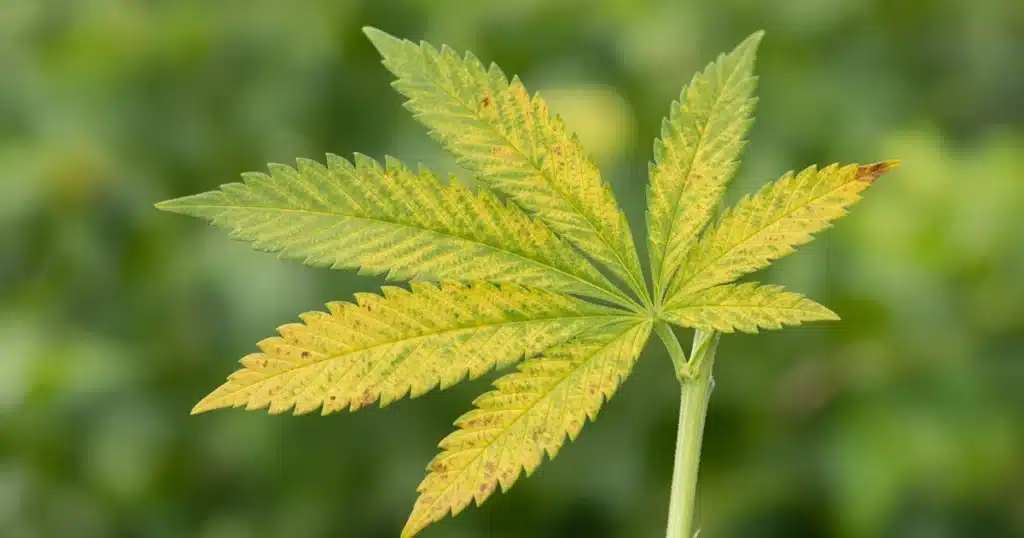
Zinc Deficiency in Cannabis Plants
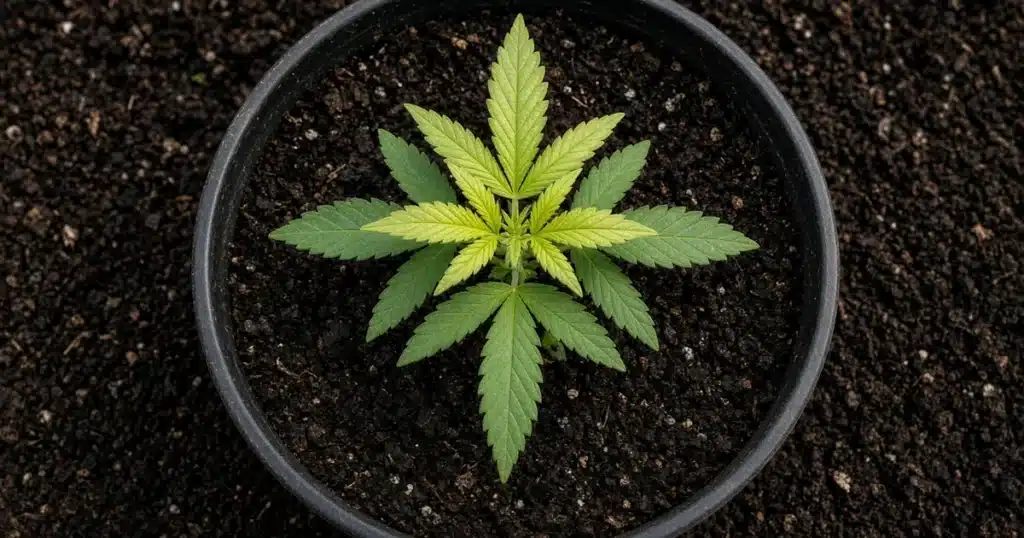
A cannabis zinc deficiency shows up on the youngest growth first. Iowa State Extension lists the classic signs on young leaves: pale tissue between the veins, smaller leaves, shorter gaps between nodes and a bunched, rosette shape at the tip, often with the whole plant stunted.
Those signs overlap with other problems. So Kind Seed Co sets out what the nutrient does, what pushes it out of reach, how to tell it apart from look alikes, and what to check before you add anything.
What Zinc Does in a Cannabis Plant
Zinc is a micronutrient, needed in small amounts but needed all the same. It helps run many enzyme systems.
Rutgers Cooperative Extension fact sheet FS721 calls it a structural part or helper for a wide range of enzyme systems. Rutgers adds that zinc supports the making of growth hormones, pollen, starch and seed, and plays a role in protein synthesis.
Kansas State University Research and Extension calls zinc relatively immobile inside the plant. That detail explains the pattern. A plant cannot pull much zinc out of older leaves to feed new ones, so when supply runs short, the fresh growth at the top shows it while the older fan leaves can look normal.
Signs of Cannabis Zinc Deficiency
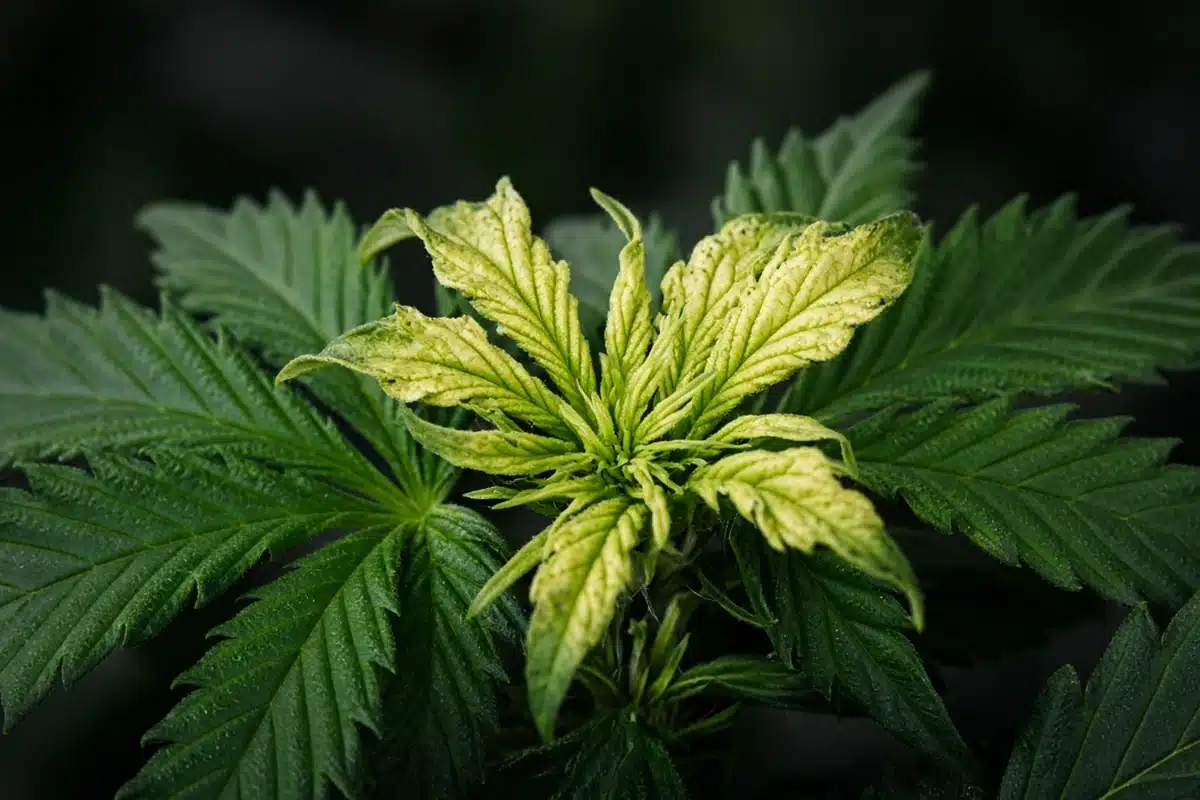
The signs show on the top leaves: pale stripes between the veins, small leaves and a crowded tip. Older leaves can look normal.
Iowa State and Kansas State describe the same core picture from different angles. Check the youngest leaves for these:
- Pale areas between the veins. Kansas State calls this interveinal chlorosis. Its bulletin describes pale stripes or a whitish strip running from the leaf base toward the tip, while the margins, the area by the midrib and the tip itself often keep their green.
- Small new leaves. Iowa State lists reduced leaf size as a key sign.
- Short internodes. Iowa State and Kansas State both note shortened gaps between nodes, which makes the top look crowded.
- A bunched or rosetted tip. Iowa State describes a rosetted or bunchy growth habit.
- Overall stunting. Kansas State adds that severe shortage can turn new leaves nearly white.
Rutgers lists a similar set across many crops, including little leaf, wavy edges on malformed leaves and rosetting of the terminal leaves.
What Causes Cannabis Zinc Deficiency
Most cases come from conditions that block uptake, such as high pH, cold wet roots or heavy phosphorus. Zinc can be in the pot and still be out of reach.
Kansas State lists the conditions that make a shortage more likely: high soil pH, low organic matter in high pH soil, cool and wet soil, and heavy phosphorus feeding on soils that are already marginal in zinc. Kansas State adds that a high phosphorus level on its own does not create the problem.
Rutgers explains the pH link. Zinc availability falls as pH rises, because zinc forms compounds the roots cannot take up. Rutgers also notes that phosphorus tends to reduce zinc activity in plant tissue, that copper, iron and manganese can hold back zinc uptake, and that shortages are usually worst in cool, wet spring weather because low soil temperatures cut availability.
When the root zone holds a nutrient but the plant cannot take it up, growers call it lockout. Our guide to nutrient lockout in cannabis covers that wider problem.
| Zinc in plant dry matter (Rutgers FS721) | What Rutgers links it to |
|---|---|
| Below 20 ppm | Usually linked to deficiency |
| 25 to 150 ppm | Normal plant range |
| Above 400 ppm | Linked to toxicity in some plants |
These are general crop ranges from a tissue test, not cannabis targets and not a feeding guide.
Zinc Look Alikes on New Growth
Iron and manganese shortages also pale young leaves between the veins. Small leaves and short internodes point more to zinc.
Iowa State warns that zinc shortage is often confused with iron or manganese shortage, since all three cause pale tissue between the veins on young leaves. Zinc, Iowa State adds, tends to bring small leaves and short internodes. For the full set of leaf patterns across nutrients, open our guide to reading leaf signs.
| Sign on new growth | Zinc | Iron | Manganese |
|---|---|---|---|
| Pale tissue between veins | Yes | Yes | Yes |
| Leaves smaller than normal | Often | Not a key sign | Not a key sign |
| Short internodes, bunched tip | Often | Not a key sign | Not a key sign |
| Where it starts | Young leaves | Young leaves | Young leaves |
Based on the Iowa State Extension zinc page, which names iron and manganese as the common look alikes. If the new leaves are pale but full size and evenly spaced, check our article on iron deficiency in cannabis next.
A Careful Order of Operations
Rule out pH, root temperature and the feed before you add any product. Work through the checks in this order.
- Check the pH first. Test what goes into the pot and what drains out. Rutgers says zinc availability falls as pH climbs, so a high reading points to the cause. Our page on understanding pH for cannabis goes further into testing.
- Check the root zone temperature and moisture. Kansas State lists cool, wet soil among the causes. Feel the pot and check the room at night.
- Review the feed. Look at how much phosphorus you have added lately. Kansas State and Rutgers both tie heavy phosphorus to lower zinc use on soils already low in zinc.
- Look at the new growth closely. Compare leaf size and node spacing with the older leaves below.
- Make a single change and wait. Fix pH or temperature before you add any product, so you know which change worked.
- Judge by the next sets of new leaves. Kansas State notes that plants often outgrow a mild shortage, and zinc does not move back into marked leaves.
What Not to Do
Do not add zinc products on a guess. Too much zinc brings its own trouble.
Rutgers links leaf levels above 400 ppm to toxicity in some plants. Do not stack several fixes in one day, and do not judge progress by the old marked leaves. If you want certainty, Kansas State recommends using both a soil test and a tissue test to confirm what the soil and the plant hold.
How to Prevent Zinc Deficiency
Hold root zone pH steady, keep pots from staying cold and soggy, and avoid heavy phosphorus feeding unless a test calls for it. Those three habits cover most of the risk.
Rutgers also notes that mycorrhizae can increase zinc uptake in many plants, while phosphorus fertilization often reduces root colonization by those fungi. A measured feed and a warm, well drained root zone help keep zinc within reach.
Troubleshooting
Each case below points to a likely cause. Start with the one closest to your plant.
New leaves are small and bunched but the pH is fine. Check root zone temperature and moisture, then review phosphorus in the feed. If those are fine too, a soil test and tissue test give a firm answer.
Signs appeared after a cold, wet week. Rutgers says zinc shortages are worst in cool, wet weather and that signs may fade after a spell of warm, sunny days. Move the pot somewhere warmer, let it dry back, and watch the next new leaves.
The problem started after a high phosphorus bloom feed. Kansas State links heavy phosphorus to zinc shortage on marginal soils. Return to your normal feed and judge by new growth.
You added a zinc product and old leaves are still yellow. That is expected. Zinc is relatively immobile, so marked leaves rarely change. Watch the leaves that form after the change.
Only one plant shows signs. A single plant points to its own pot. Check its pH, drainage and feed history before changing anything for the rest.
Ready for your next grow? Shop feminized cannabis seeds.
Frequently Asked Questions
How can I be sure it is zinc?
Look for the full pattern on new growth: pale tissue between the veins plus small leaves and short internodes, as Iowa State describes. Then rule out pH and cold, wet roots. Kansas State recommends a soil test and a tissue test together for a firm answer.
Should I add zinc if my pH is already high?
Correct the pH first. Rutgers explains that zinc availability falls as pH rises, so zinc already in the mix may be out of reach. Adding more without fixing the pH can leave the problem in place and push leaf zinc toward the range Rutgers ties to toxicity.
Can I hurt a plant with extra zinc?
Yes. Rutgers links leaf zinc above 400 ppm to toxicity in some plants. That is a general crop figure, not a cannabis limit, but it is a good reason to test before adding anything. Kansas State suggests pairing a soil test with a tissue test.
Do organic soils get zinc deficiency?
They can. Kansas State lists low organic matter with high pH among the risk factors, and Rutgers says the role of organic matter varies with the type and amount present. Cool, wet conditions and high phosphorus can cause trouble in any mix.
Will new leaves recover their old color?
Leaves that already show damage usually stay marked, because Kansas State describes zinc as relatively immobile in the plant. Judge progress by the leaves that form after you fix the cause. Kansas State notes that plants often outgrow a mild shortage.
Sources
- Iowa State University Extension and Outreach, Identifying Plant Nutrient Deficiencies: Zinc: https://yardandgarden.extension.iastate.edu/identifying-plant-nutrient-deficiencies/newer-leaves/growing-point-lives/interveinal-chlorosis/zinc
- Kansas State University Research and Extension, MF3028 Diagnosing Nutrient Deficiencies in the Field: https://www.agronomy.k-state.edu/extension/soil-fertility/MF3028.pdf
- Rutgers NJAES Cooperative Extension, FS721 Zinc: Evaluating Needs of Soils and Crops in New Jersey: https://njaes.rutgers.edu/pubs/download.php?strPubID=FS721