
Air Layering Cannabis: Rooting a Branch Before You Cut It
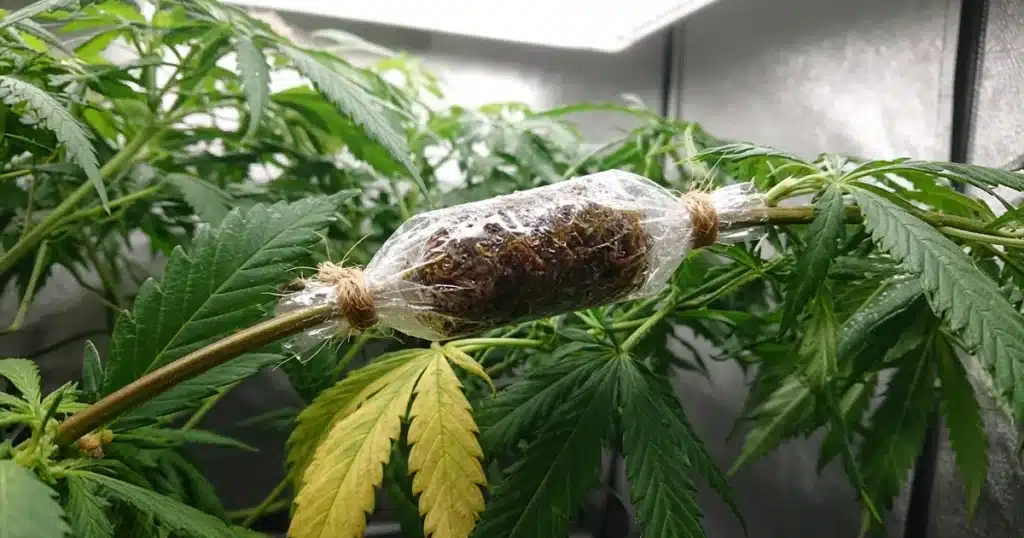
Air layering means making roots form on a branch while it is still attached to the parent plant, then cutting it free once rooted. NC State Extension describes the method for houseplants and woody plants. Cannabis growers borrow those steps for branches, but we found no cannabis study that tests the method, so it remains grower practice.
What Is Air Layering?
NC State Extension defines layering as rooting a stem while it is still attached to the parent plant, and a layer is the rooted stem once removed (NC State). NC State lists marcottage as another name for air layering. It says layering is helped by wounding the stem where roots will grow, and that the rooting medium should provide air and constant moisture. Air layering is one form of layering.
Air Layering vs Cloning: How Is It Different From a Cutting?
A cutting is removed first and rooted separately, which is how most growers make clones. In one study, cannabis stem cuttings were assessed for rooting after twelve days, and cuttings with three leaves had 15% higher root quality than those with two, though leaf number did not change rooting success. A 0.2% IBA rooting gel gave 2.1 times the rooting success of a willow extract gel (Caplan et al.). That study tested cuttings only, not air layers. An air layer keeps its water supply from the parent plant until it has roots.
How Do Growers Air Layer a Cannabis Branch?
NC State’s general method is to remove a 1-inch strip of bark or make an upward cut in the stem, dust it with rooting hormone, wrap it in moist sphagnum moss and enclose it in plastic or foil (NC State). It notes that rooting hormone is not always necessary. Cannabis growers apply the same steps to a healthy branch and cut below the new roots once they show. That last step is grower practice, not a tested cannabis method. Check the product label and local rules for your crop.
When Is a Regular Cutting the Better Choice?
Cuttings are the tested route for cannabis propagation (Caplan et al.). A 2024 study also found aeroponics was as effective as, and in some cases more effective than, rockwool and foam for rooting cannabis cuttings (Plants 2024). A clone box helps if you root cuttings instead.
Prefer to start from seed instead? You can browse cannabis seeds.
Sources
- NC State Extension Gardener Handbook: Propagation
- Caplan et al. 2018, Canadian Journal of Plant Science: Vegetative Propagation of Cannabis by Stem Cuttings
- Plants 2024 (PMC): Evaluating Propagation Techniques for Cannabis sativa
What you read here is general growing information, which Kind Seed Co based on the sources above.
FAQ
What is layering in plant propagation?
NC State Extension describes layering as rooting a stem while it is still attached to the parent plant. The rooted stem, once removed, is called a layer. Some plants layer naturally, and propagators help the process by wounding the stem where roots should grow and keeping the area moist and aerated.
What did the cutting study measure?
In a Canadian study, cannabis stem cuttings were placed in a growth chamber for twelve days and then assessed for rooting. Cuttings with three leaves had 15% higher root quality than those with two, and removing about one-third of the leaf tips cut rooting success from 71% to 53% in that study.
Is rooting hormone needed for air layering?
NC State Extension's air layering method includes dusting the wounded stem with rooting hormone, but it also notes that rooting hormone is not always necessary. For cannabis cuttings, a Canadian study found a 0.2% IBA gel gave 2.1 times the rooting success of a willow extract gel.
Why keep the moss moist?
NC State Extension says the rooting medium for layering should always provide aeration and a constant supply of moisture. Wrapping moist sphagnum moss in plastic or foil holds that moisture against the wounded stem. Moss that dries out no longer gives the constant moisture NC State says the rooting medium needs.


