Drying Cannabis in High Humidity Without Mold
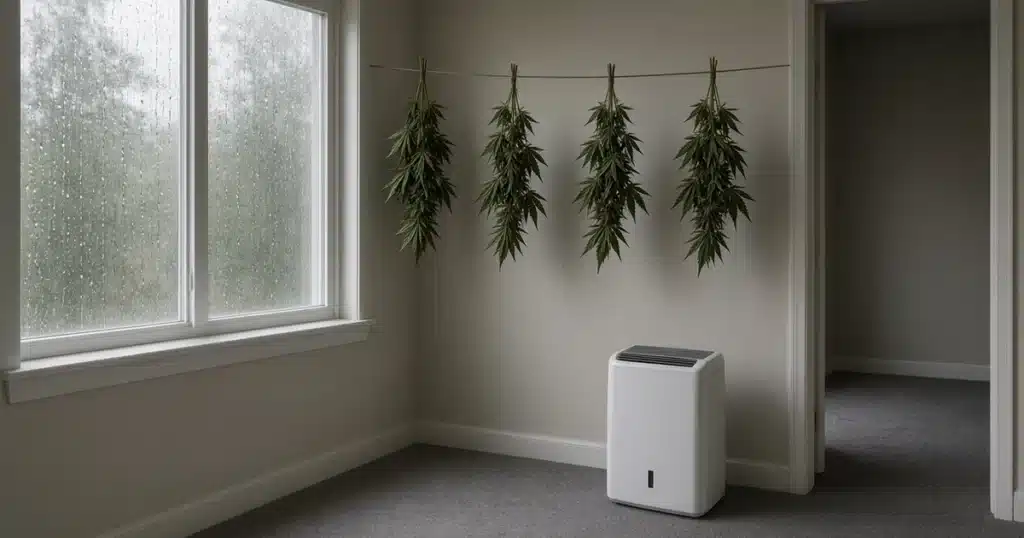
Quick answer: You can dry buds in humid weather if you stop drying in the open air and take control of a closed room. Run a dehumidifier and a fan the whole time, and hold humidity at 50 to 55 percent with 60 percent as the ceiling. Hang small bunches with space between them, and check buds for gray fuzz every day during the first week, when mold is most likely to start.
Can You Dry Buds When the Air Is Humid?
Yes, but not with the windows open. Humid outdoor air is the problem, so the fix is a room you can seal off from it. The Oregon State University Extension review of hemp post harvest work says slow drying takes place inside a darkened room, helped by fans, heaters or dehumidifiers. In a humid climate, the dehumidifier is the part you can’t skip.
NC State Extension gives the line to stay under. It says growers have dried successfully in buildings and barns by keeping the airflow good and the humidity at 60 percent or less. Oregon State’s target is a little lower, at 50 to 55 percent. Oregon State also cautions that when humidity and temperature are not well controlled, drying can drag on and flower quality can suffer. In a humid climate, that control has to come from equipment, since the outside air won’t provide it.
Mold is the risk you are managing. The UF/IFAS Extension field guide to hemp diseases says gray mold, caused by the fungus Botrytis cinerea, ranks among the common hemp diseases in Florida, with high humidity to blame. The flower buds are hit first. Wet air and dense buds are a bad mix.
UF/IFAS also explains how the fungus moves. Its spores are splashed by rain and carried by wind, and they infect through wounds and natural openings in flowers and leaves. A closed room keeps outdoor air, and whatever it carries, away from your harvest.
Speed is part of the defense too. Oregon State says lowering moisture content reduces unwanted microbial growth. The University of Missouri Extension harvest guide says farms dry CBD hemp to 10 to 12 percent moisture within 48 hours to prevent mold. A home room won’t match that pace, but the lesson holds. Buds that sit wet for days give mold its chance.
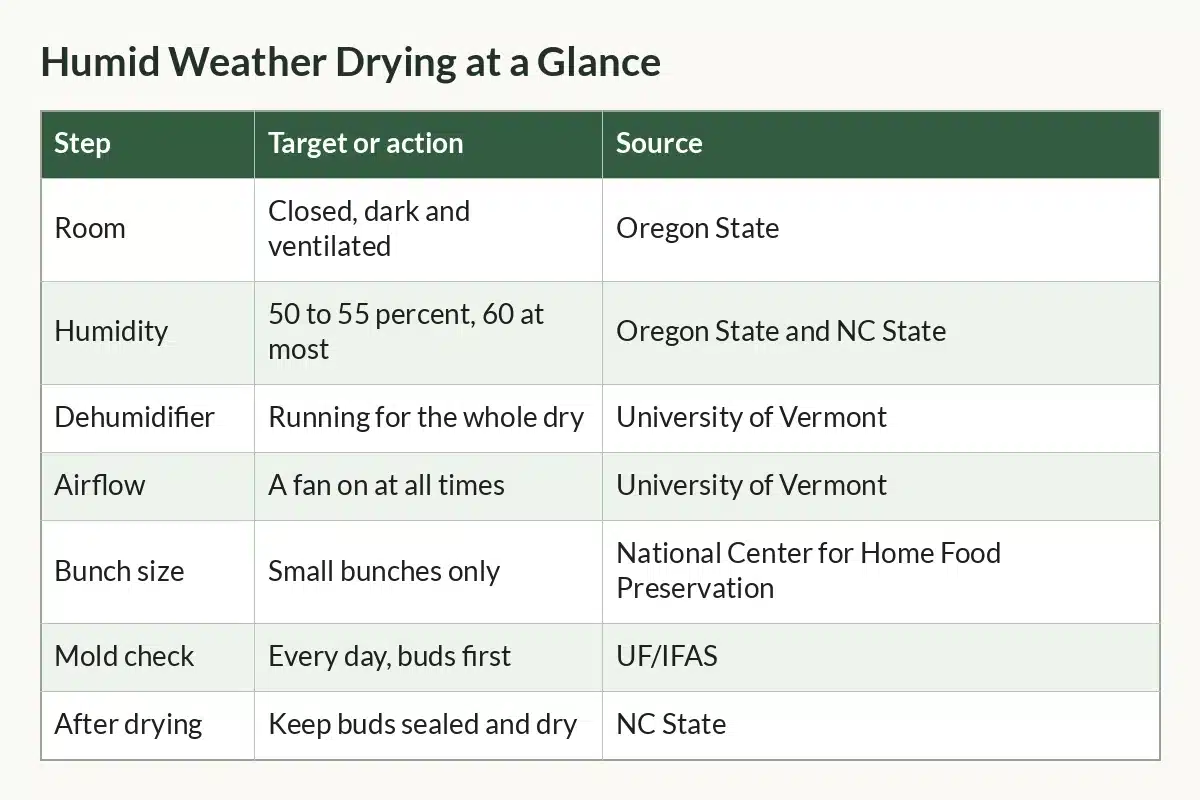
Humid Weather Drying at a Glance
| Step | Target or action | Source |
|---|---|---|
| Room | Closed, dark and ventilated | Oregon State |
| Humidity | 50 to 55 percent, 60 at most | Oregon State and NC State |
| Dehumidifier | Running for the whole dry | University of Vermont |
| Airflow | A fan on at all times | University of Vermont |
| Bunch size | Small bunches only | National Center for Home Food Preservation |
| Mold check | Every day, buds first | UF/IFAS |
| After drying | Keep buds sealed and dry | NC State |
How to Set Up a Drying Room in a Humid Climate
- Pick a room you can close. An interior room, a closet or a tent works better than a porch or an open garage. Oregon State’s slow drying setup is a dark room with fans and dehumidifiers. It adds that a simple structure like a barn or shipping container can work, as long as the room stays well ventilated.
- Set the dehumidifier before the buds go in. Bring the room down toward 50 to 55 percent first. Freshly cut plants release a lot of water as they dry. Most of the weight of fresh hemp tissue is water, according to Oregon State.
- Run a fan the whole time. In the University of Vermont drying trial, every drying setup had a fan, and fans and dehumidifiers stayed on until the buds were dry.
- Hang small bunches with gaps. The National Center for Home Food Preservation says herbs with high moisture content will mold if they are not dried quickly, and that large bunches will mold. Single branches give air the best path.
- Plan for air exchange. The North Carolina A&T hemp program aims to swap out all the air in its drying container once an hour. It calls 60 to 70°F the optimal range for that container.
- Keep a log. Write down humidity twice a day. If it climbs past 60 percent, act that day.
Wet plants need extra care before they ever reach the room. If your buds came in soaked, our guide on how to deal with wet weed covers that rescue step.
How Big Should the Dehumidifier Be?
Big enough to hold your room at or below 60 percent with the buds inside. None of the Extension sources here give a size in pints per day, so the honest answer is to size it to the result. NC State’s 60 percent line and Oregon State’s 50 to 55 percent target tell you what the machine has to achieve.
The Vermont trial shows why it is worth getting right. With a fan running at room temperature, the buds that also had a dehumidifier finished on October 12. Buds dried without one finished on October 14. The dehumidifier group also tested higher in total cannabinoids, at 20.7 percent against 18 percent. Vermont also spotted a little mold on its room temperature samples in the opening days of the dry.
Load size matters as much as the machine. North Carolina A&T notes that a field plant needs 3 to 5 square feet unless its buds have been bucked off first. More plants mean more water in the air. Our guide to choosing a dehumidifier for a grow room walks through capacity and placement.
How to Check Buds for Mold While They Dry
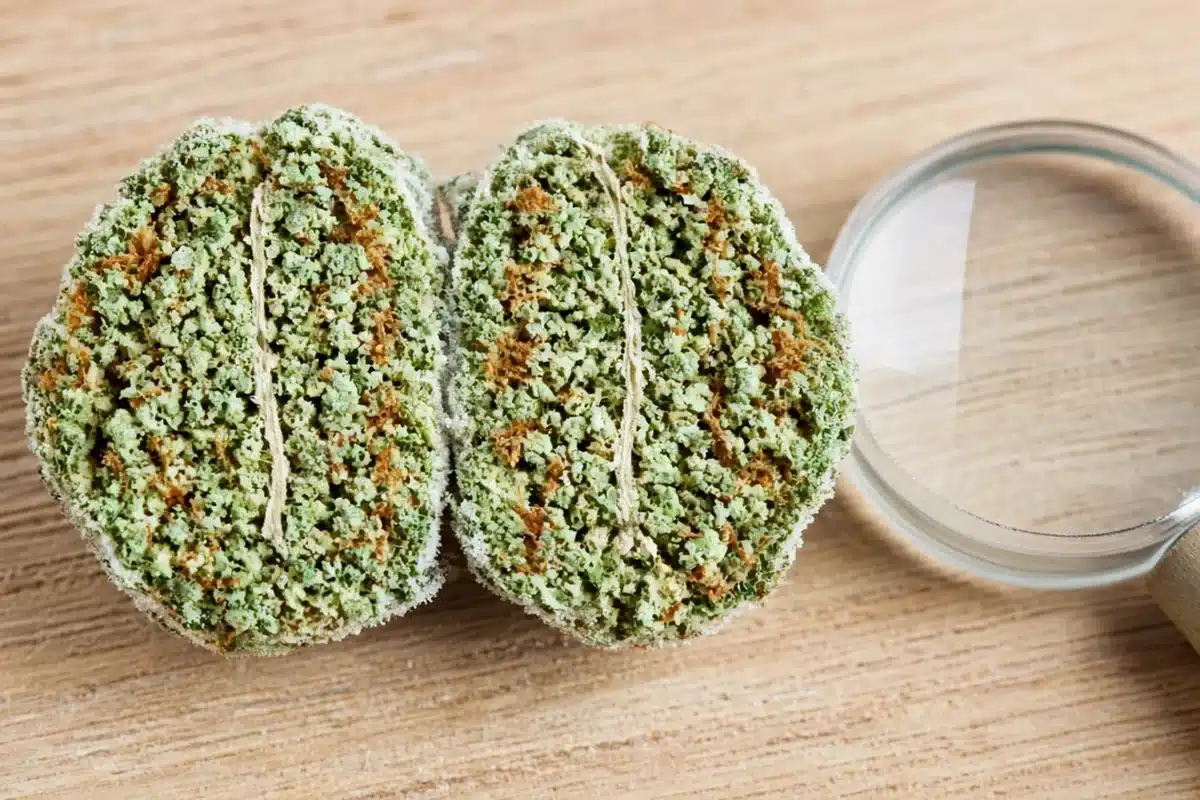
Look at the buds every day, and look hardest early on. The early days are when Vermont’s room temperature samples showed a little mold.
UF/IFAS describes what gray mold looks like on hemp. Gray or grayish white fungal growth and spores show up on buds, leaf stems and stems. The buds show blight before anything else. As the disease gets worse, stems can be girdled and break, and branches die back.
Dense buds can hide it. Gently open the largest buds on a branch and look inside. Check the spots where buds touch each other or press against a line. Vermont’s room temperature samples, which sat on trays, needed turning to keep air flowing across the flowers. If you dry loose buds on a screen, turning them during the dry follows the same idea.
When you find mold, remove that bud or branch from the room right away. Then check its neighbors and bring the humidity down. Throw out the moldy material. Our post on smoking moldy cannabis explains how to spot it in finished buds.
Troubleshooting Humid Drying
Humidity won’t drop below 60 percent. The room is too open or the load is too big. Close it off, remove some branches or add dehumidifier capacity. NC State ties success to holding 60 percent or less.
Buds smell musty. Check them closely for gray growth. UF/IFAS lists gray or grayish white growth on buds as a sign of gray mold. It notes that gray mold is common in Florida, where humidity runs high, and that wind and splashing rain carry the spores.
The outsides feel dry but the centers stay damp. Dense buds hold water inside. Open a few to check, and keep the fan and dehumidifier running. NC A&T says size and density are among the things that set how long buds take.
Dry buds turn soft again in jars. NC State says dry hemp can soak moisture back up and mold if it isn’t kept dry. Seal jars tightly and store them away from humid rooms. Oregon State notes that light, air and heat in storage can lower some cannabinoid levels.
Rain is on the plants at harvest. That is a separate problem from a humid room. Our wet weed guide covers it.
Sources
- Oregon State University Extension, Post harvest processing of hemp flowers: https://extension.oregonstate.edu/catalog/post-harvest-processing-hemp-flowers
- NC State Extension, Hemp Harvest Timing and Drying: https://hemp.ces.ncsu.edu/hemp-harvest-timing-and-drying/
- University of Florida IFAS Extension, PP379 Field Guide to Hemp Diseases: https://ask.ifas.ufl.edu/publication/PP379
- University of Vermont, 2021 Hemp Cannabidiol Drying Trial: https://www.uvm.edu/d10-files/documents/2024-08/2021_Hemp_Cannabidiol_Drying_Trial.pdf
- National Center for Home Food Preservation (University of Georgia), Drying Herbs: https://nchfp.uga.edu/how/dry/herbs
- University of Missouri Extension, MX79 Harvesting Industrial Hemp: https://extension.missouri.edu/publications/mx79
- North Carolina A&T, Hemp harvest and post harvest considerations: https://ncat.edu/caes/agricultural-research/industrial-hemp-program/hemp-conference/files/ivey.pdf
FAQ
What humidity is too high for drying buds?
Anything above 60 percent, based on NC State. Oregon State aims for 50 to 55 percent.
Do I really need a dehumidifier in a humid climate?
In most humid climates, yes. Vermont's room temperature buds dried with one finished about two days sooner, and across the trial they tested higher in total cannabinoids.
When does mold usually show up?
Early. Vermont's room temperature samples showed slight mold within the opening days.
What does gray mold look like on buds?
UF/IFAS describes gray or grayish white fungal growth on buds, leaf stems and stems.
Does a heater help in humid weather?
It can. Oregon State counts heaters among the usual drying tools, and NC State says some growers add heat with success. Until more research is in, NC State would keep added heat at or below 100°F.
Can I dry buds outside in humid weather?
It is a poor fit. Humid air is what you are trying to keep away from the buds.