
When to Harvest Outdoor Cannabis: Timing by Month and Climate
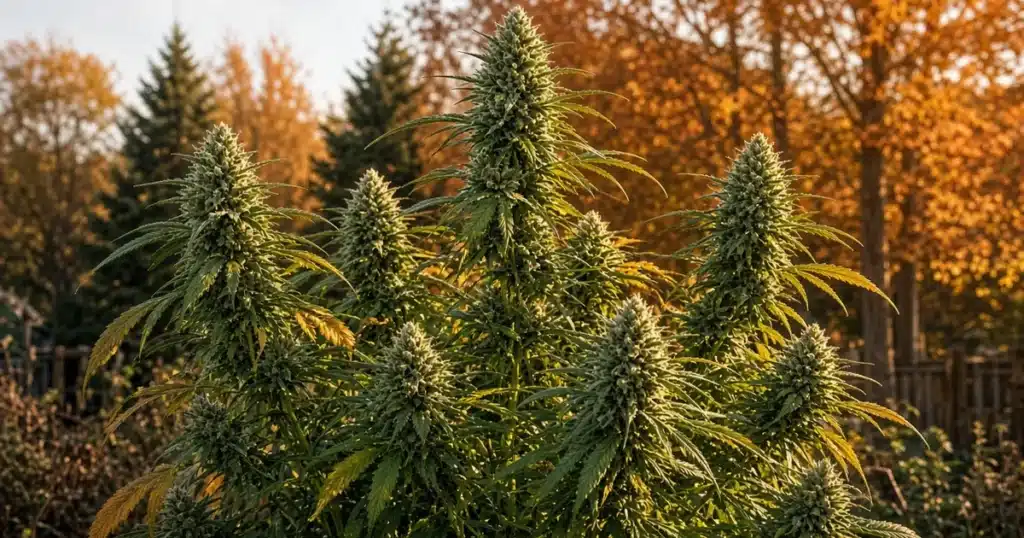
Quick answer: Outdoor cannabis harvest timing depends on variety, planting date and where you grow. In Vermont, UVM Extension says flower hemp harvest usually lands somewhere from the end of September to mid October. Across the Northeast, UVM reports harvests that start in late August and can stretch past October. In Missouri, MU Extension puts CBD hemp harvest from September to mid October. In North Carolina, NC State notes a growing shift toward timing harvest by weeks after flowering starts. Use the dates for the region closest to yours, then confirm with the plant itself.
When Is Outdoor Cannabis Harvest Season?
There is no single national harvest date in the sources. Each Extension program reports dates for its own region, and those dates come from hemp research. Hemp and marijuana are the same species, Cannabis sativa, but your plants, your variety and your weather will differ from a research farm.
In Vermont, the UVM Extension guide to hemp for flower production says harvest begins after flowers have fully developed. That usually happens from the end of September to mid October, it adds, with the exact timing set by variety, planting date and growing region.
For the wider Northeast, the UVM Extension 2022 hemp flower harvest date report gives a broader window. In the Northeast, it says, harvest can begin in late August and run into October, sometimes later. Variety and weather decide where in that window it falls.
In Missouri, the University of Missouri Extension harvest guide lists the typical period for CBD hemp as September to mid October.
Those regional windows overlap, but they are not the same. If you grow far from Vermont or Missouri, use them as a rough guide and lean on what your plants show you. Our guide to growing cannabis in different climates covers how climate shapes the whole season.
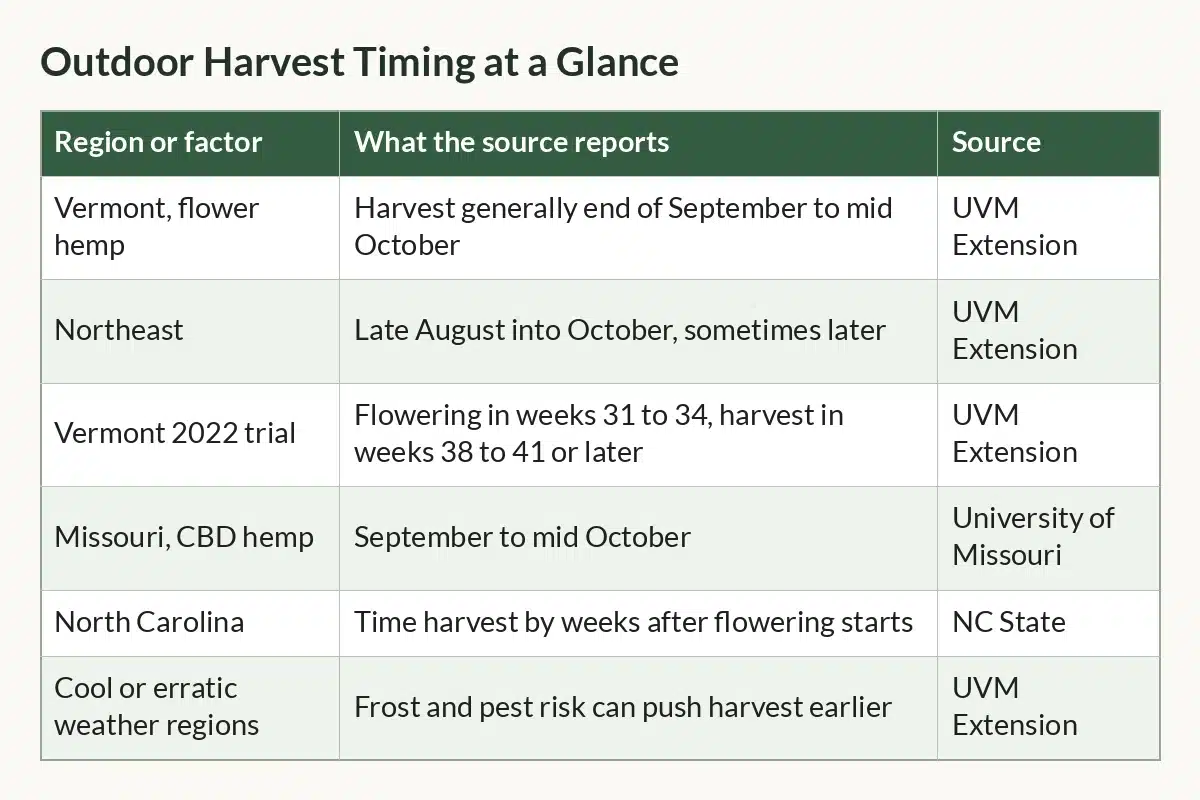
Outdoor Harvest Timing at a Glance
| Region or factor | What the source reports | Source |
|---|---|---|
| Vermont, flower hemp | Harvest generally end of September to mid October | UVM Extension |
| Northeast | Late August into October, sometimes later | UVM Extension |
| Vermont 2022 trial | Flowering in weeks 31 to 34, harvest in weeks 38 to 41 or later | UVM Extension |
| Missouri, CBD hemp | September to mid October | University of Missouri |
| North Carolina | Time harvest by weeks after flowering starts | NC State |
| Cool or erratic weather regions | Frost and pest risk can push harvest earlier | UVM Extension |
What Shifts the Harvest Date?
UVM Extension names three main factors in Vermont: variety, planting date and growing region.
Variety made a clear difference in the UVM data. The 2022 Vermont trial compared an early, a mid and a late maturing variety planted on the same day, June 6. The early variety reached harvest around week 38 of the year, the mid variety around week 39, and the late variety at week 41 or later. UVM notes that the late variety could have used another 1 to 2 weeks to fully mature. In calendar terms, weeks 38 to 41 of 2022 ran from about mid September to mid October.
Flowering type matters too. For auto flowering varieties, UVM says, each variety’s relative maturity dates can generally be used to set harvest. Full term, or photoperiod, varieties need careful monitoring with visual and aroma cues instead.
Weather is the third piece. UVM points out that the 2022 Vermont season was cooler than average, with well above average rain in June and again in October. Its report names weather as a real driver of when harvest happens, which is why the Northeast window runs from late August into October or later.
Planting date shifts everything downstream. UVM Extension lists it as one of the factors that set Vermont harvest timing, so a late planting can push harvest later in the fall.
How Many Weeks After Flowering Starts?
In one Vermont season, it took roughly 5 to 10 weeks, depending on variety. NC State Extension in North Carolina says harvest advice was first based on trichome and pistil color, which it calls rather vague. It reports that seed companies and breeders increasingly recommend timing harvest by weeks after floral initiation, the point when flowering begins. NC State calls this a more objective way to time harvest, because cannabinoid production is so tightly tied to the plant’s genetics.
The catch outdoors is spotting when flowering starts. NC State says that catching the shift from vegetative to flowering growth in the field is difficult. It adds that by the time growers notice a crop flowering, it has often been in the flowering phase for a couple of weeks. Indoor growers who control the light know the exact start date, and field growers do not.
NC State’s photo guide was grown in a greenhouse, with 16 hours of light cut to 12 hours to start flowering, and follows two varieties for 10 weeks. Its example schedule uses a harvest 6 weeks after floral initiation. That is one example, not a rule for every plant.
The Vermont trial gives field numbers. UVM recorded flowering in weeks 31 to 34 of the year and harvest in weeks 38 to 41 or later. Counting from those weeks, the three varieties took roughly 5 to 10 weeks from flowering to harvest. That range is our arithmetic from UVM’s table, for those three varieties in one Vermont season.
If your seed supplier lists a flowering time, NC State’s point is that it is a useful planning number. Mark the week you first see flowers, then count forward.
How Fall Weather Changes the Plan
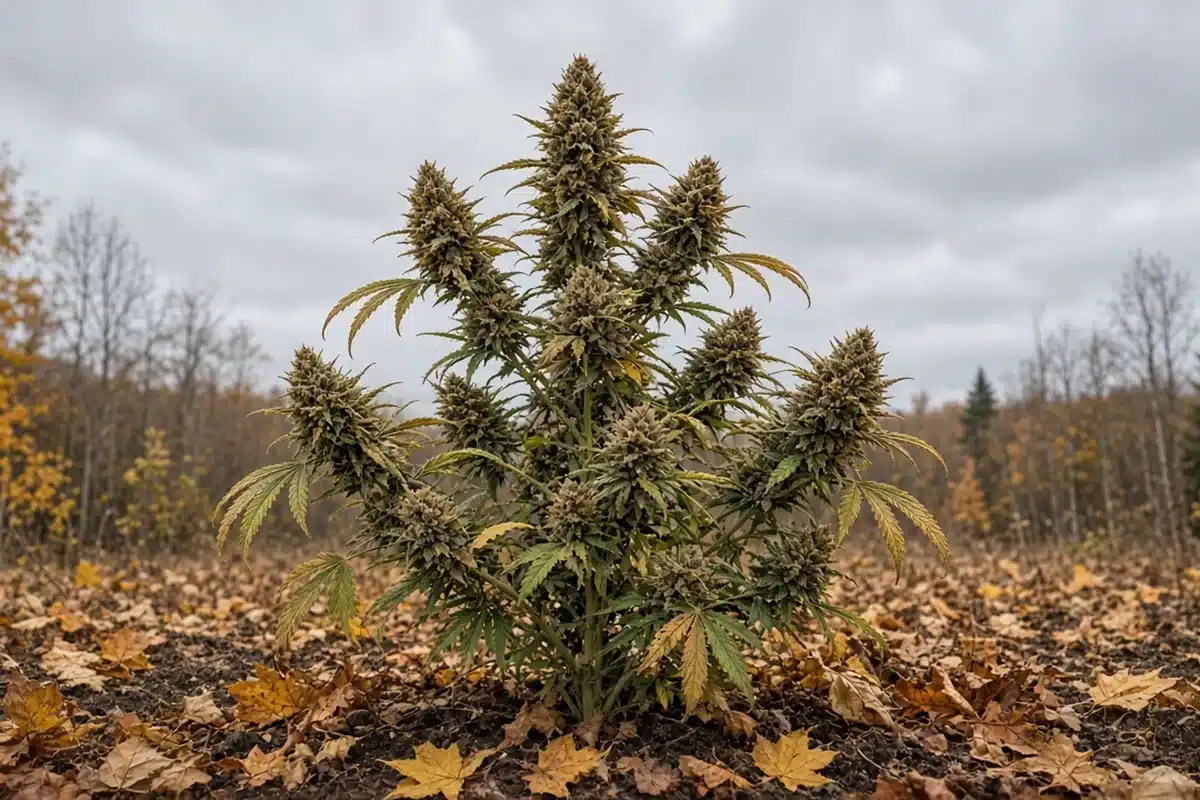
UVM Extension calls shorter days and frost risk a major concern for growers in the Northeast and other cooler or erratic weather regions. It says the risk of frost, or of crop loss from pest pressure, can often hasten harvest. In those places, the weather can decide the date as much as the plant does.
Wet fall weather adds disease risk. The UF/IFAS Extension hemp disease guide in Florida says gray mold is one of the common hemp diseases there because of high humidity, and that flower buds are the first to be blighted. If you grow where fall stays humid, watch your buds closely as harvest nears.
UVM also reports that harvest date changes flower chemistry. Its 2022 Vermont report says harvest date can affect cannabinoid and terpene concentrations, and that early harvest can mean lower cannabinoid levels. So a weather driven early cut has a cost, and waiting has risks of its own.
How to Tell a Plant Is Ready
The calendar gets you close. The plant tells you when. Our full guide on whether your marijuana is ready for harvest covers the signs in detail. Here is the short version from the regional sources:
- Watch the pistils. In Vermont, UVM generally begins harvest once about 90 percent of the pistils have started browning, along with other visual cues. MU Extension in Missouri lists 70 to 80 percent of pistils turning orangish brown. Our post on cannabis pistils explains what to look for.
- Check the trichomes. UVM says trichomes turn opaque and eventually amber before they degrade. NC State’s harvest timing guide notes that trichomes on a plant do not all mature at the same time. Our cannabis trichomes 101 guide shows the stages up close.
- Look at the bracts. UVM says the bracts of each flower begin to swell as plants mature.
- Count the weeks. Compare the weeks since flowering began with your variety’s listed flowering time, as NC State suggests.
- Check the forecast. In cooler regions, UVM says frost or pest risk can move the date up.
Troubleshooting a Late or Early Harvest
The plants still look unripe in late October. Vermont’s late variety reached harvest at week 41 or later and could have used 1 to 2 more weeks. Late varieties simply finish later, so a short season may not suit them.
Frost is in the forecast. UVM says frost risk can hasten harvest in the Northeast and other cooler or erratic weather regions. Weigh the frost risk against UVM’s note that an early harvest can mean lower cannabinoid levels.
You missed when flowering started. NC State says field growers often notice flowering a couple of weeks after it begins. Next season, check plants more often in midsummer and note the first flowers.
Buds show gray fuzz as harvest nears. UF/IFAS says gray mold blights flower buds first and is common in high humidity. UF/IFAS also notes that wind and splashing rain spread the spores and that severe cases can girdle stems.
Your plants finished in August. UVM reports Northeast harvests starting as early as late August. Early maturing varieties can finish well ahead of the main window.
Sources
- UVM Extension, Industrial Hemp for Flower Production: https://www.uvm.edu/d10-files/documents/2024-06/2020_Hemp_101.pdf
- UVM Extension, 2022 Hemp Flower Harvest Date: https://www.uvm.edu/d10-files/documents/2024-08/2022_Hemp_Flower_Harvest_Date.pdf
- NC State Extension, Visual Guide to Floral Hemp Maturation: https://hemp.ces.ncsu.edu/visual-guide-to-floral-hemp-maturation/
- NC State Extension, Hemp Harvest Timing and Drying: https://hemp.ces.ncsu.edu/hemp-harvest-timing-and-drying/
- University of Missouri Extension, MX79 Harvesting Industrial Hemp: https://extension.missouri.edu/publications/mx79
- University of Florida IFAS Extension, PP379 Field Guide to Hemp Diseases: https://ask.ifas.ufl.edu/publication/PP379
FAQ
What month do you harvest outdoor cannabis?
It depends on your region. UVM says end of September to mid October in Vermont, and MU says September to mid October for CBD hemp in Missouri.
Can outdoor cannabis be ready in August?
In the Northeast, UVM reports hemp harvest can start in late August, depending on variety and weather.
How many weeks after flowering is outdoor harvest?
It varies by variety. Our count from UVM's Vermont trial is about 5 to 10 weeks for three varieties. NC State uses 6 weeks as one example.
Should I harvest early if frost is coming?
UVM says frost risk often hastens harvest in cooler regions. It also notes early harvest can lower cannabinoid levels.
Do auto flowering plants follow the same calendar?
No. UVM says their harvest can generally be set from each variety's relative maturity dates.


