
Fimming Cannabis: How to FIM and FIM vs Topping
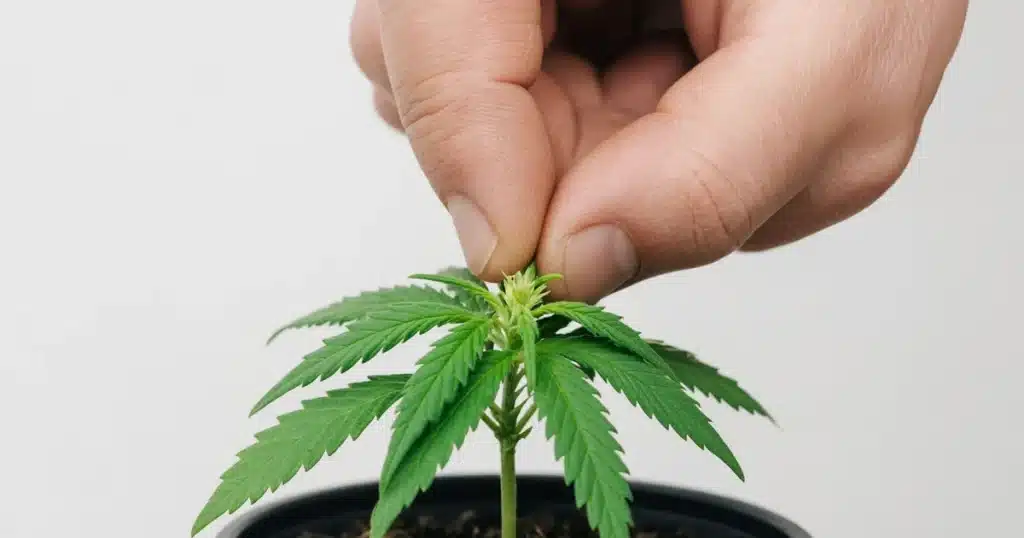
Fimming cannabis means pinching or cutting off most, but not all, of the newest shoot at the top of the plant. The name comes from the phrase "F*** I Missed", because the cut is meant to be imperfect. The damaged tip often regrows as several new tops instead of one, which spreads the canopy wider.
Why fimming changes the shape of the plant
Cannabis grows in repeating units. Researchers at the Volcani Center described each unit, called a phytomer, as a stem section with one leaf, a side shoot and a pair of bracts at the leaf base. The tip at the top of the main stem keeps adding new units and holds back the side shoots below it. Growers call that apical dominance.
When you damage that tip, the plant loses some of that control. Side buds near the top wake up and start to grow. With topping, the cut removes the tip cleanly and the two shoots at the node below take over. With a FIM, part of the tip is left behind, and the leftover tissue can push out several shoots at once from the crowded growth at the very top.
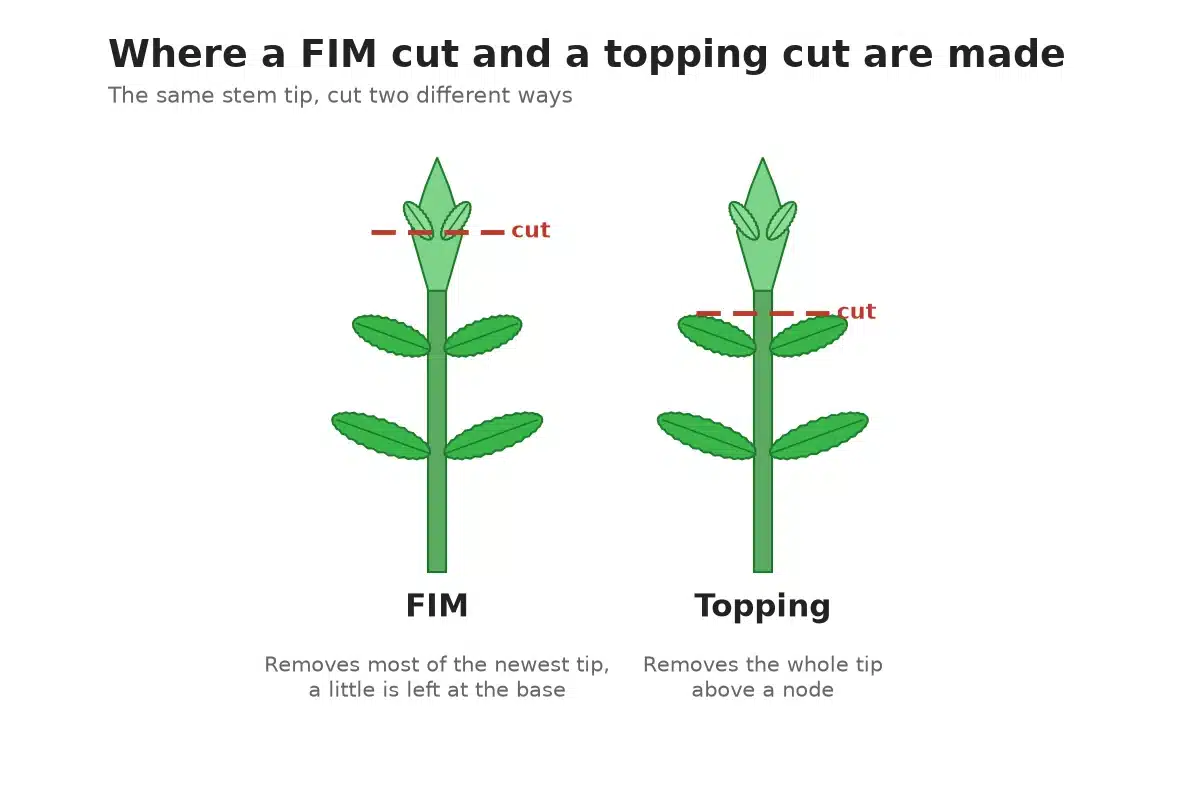
How is FIM different from topping?
Topping removes the whole tip above a node and usually gives two new main shoots. FIM leaves a small part of the tip, which can give three or more new tops, though the result is less predictable than topping. For the full topping method, read the Kind Seed Co walkthrough on topping cannabis plants.
| Point | FIM | Topping |
|---|---|---|
| What is removed | Most of the newest tip, with a little left at the base | The whole tip above a node |
| Usual new tops | Often 3 or more, less predictable | Usually 2 |
| Recovery | Often quicker, less tissue removed | A few days of slower growth |
| Predictability | Lower | Higher |
| Best fit | Growers happy to trade control for more tops | Growers who want an exact, even layout |
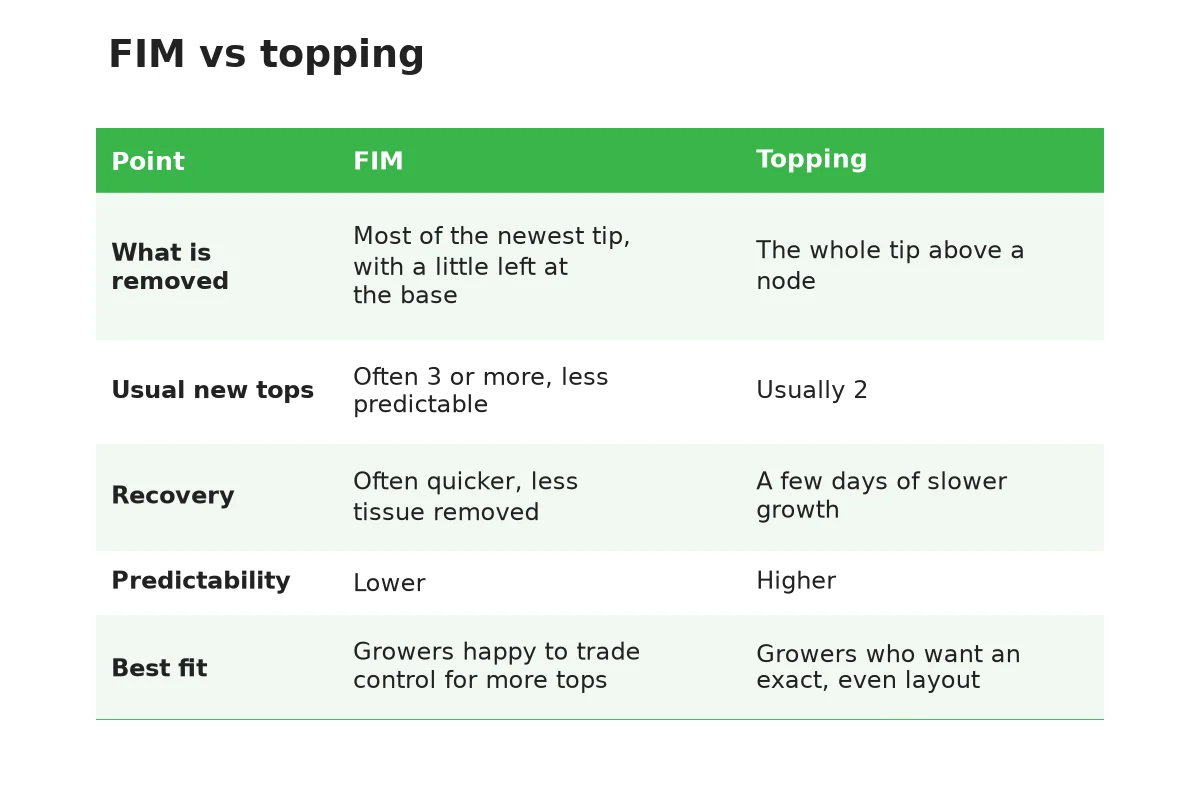
Method comparison based on common grower practice.
Research backs up the general idea that shaping a plant changes how it grows. Danziger and Bernstein tested eight shaping treatments on two cannabis cultivars. The treatments that changed plant structure the most, such as removing primary and secondary branches, had the biggest effect on the cannabinoid profile. They also found the response differed by cultivar. The paper did not test fimming itself, so read it as a reason to train with care rather than as a FIM result.
When should you FIM a plant?
FIM a plant once it has several healthy nodes and is growing strongly, well before you plan to flip it to flowering. Avoid training stressed, sick or flowering plants.
Timing by stage:
- Seedling. Too early. The tip is tiny and the plant has little stored energy. Let it grow on.
- Early veg. The usual window. The plant has a few sets of true leaves above the first node and new growth looks dark and vigorous.
- Mid veg. Still fine for side shoots, or for a second FIM on new tops once they have their own nodes.
- Late veg. Risky. Give any cut enough time to recover before the switch, or switch to bending instead.
- Flowering. Do not FIM. The plant is building buds, and new tops have no time to catch up.
How do you FIM cannabis step by step?
- Wash your hands and use clean, sharp scissors, or pinch with clean fingers.
- Find the newest growth at the very top, the small cluster of leaves still folded together.
- Hold the cluster lightly and pinch or snip off most of it, leaving the base.
- Do not cut into the stem below.
- Check the plant is well watered and not under heat stress.
- Give the plant several days to regrow. Do not repot or prune hard during that time.
- When new tops appear, count them and spread them out.
- Combine with tie-downs to keep tops level. See low stress training.
Try FIM on one plant before you do the whole tent, since results vary from plant to plant.
Problems after a FIM and how to fix them
Only one new shoot grows back. The cut took too little of the tip, so it regrew as a single shoot. Fix: wait for it to grow a few new nodes, then top it or FIM it again.
Two shoots, like a topped plant. The cut went too deep and removed the whole tip. Fix: nothing needed. Treat it as a topped plant and train the two shoots.
Twisted or uneven new tops. Damaged tissue often grows out crinkled at first. Fix: give it time. New leaves usually look normal after a few sets.
Plant stalls for a long time. The plant was likely stressed before the cut, by heat, poor roots or a recent transplant. Fix: sort out the stress first and do not cut again until growth is strong.
Top growth crowds together. Several tops come up from one point and shade each other. Fix: tie them out gently in different directions so light reaches each one.
Aftercare in the days after a FIM
After the cut, keep conditions steady while the plant pushes new growth, and avoid adding new stress while it heals.
- Watering. Keep your normal watering rhythm. A plant that dries out hard right after a cut recovers slowly, and so does one sitting in soggy soil.
- Feeding. Do not push extra nutrients to "help" recovery. Stick with the feed the plant was already handling well.
- Light. Leave the light where it was. Raising intensity right after a cut adds stress at the same moment the plant is regrowing its top.
- Handling. Do not start tie-downs on the fresh tops until they are firm enough to bend without snapping.
- Watching. Check the top daily. Within a few days you should see small new shoots pushing up from the leftover tissue. If nothing moves, look for stress elsewhere before blaming the cut.
Once the new tops have a couple of nodes each, start spreading them out so each one sits in its own patch of light.
Why an even canopy matters
The goal of fimming is not only more tops. It is more tops at the same height under the light. Research by Rodriguez-Morrison and colleagues found that the density of the top bud rose as canopy light intensity rose. So a top that sits far below the others gets less light and tends to make a looser bud. Spreading and leveling tops after a FIM helps share the light more evenly.
The same light study found that more of each plant ended up as flower as light rose. The share of plant weight in flowers climbed from 0.56 at the lowest light level to 0.73 at the highest. Tops that stay in the shade miss out on that gain.
Source: Rodriguez-Morrison, Llewellyn and Zheng, Frontiers in Plant Science, 2021.
Danziger and Bernstein saw a related effect from shaping. Their treatments made cannabinoid levels more even across the plant, mainly by raising levels in the lower parts of the plant. They also found the effect depended on the cultivar. Opening a plant up changes what its lower buds make, not just how many tops it has, which is one more reason to spread new tops out after a FIM rather than leave them stacked.
You can pair fimming with other methods too. Bending tough stems is covered in super cropping cannabis.
Should autoflowers be fimmed?
Autoflowers run on a fixed clock, so recovery time matters more. Many growers prefer low stress training for them instead of cuts. Bending stems costs no recovery time, which suits a plant that cannot wait. If you do FIM an autoflower, do it early and only on a strong plant.
Common mistakes when fimming
- Fimming too young. A seedling tip is too small to pinch well, and the plant has little reserve.
- Fimming a stressed plant. Cuts on a plant that is hot, dry, root bound or fresh from a transplant add stress on stress.
- Expecting an exact number of tops. FIM is meant to be imperfect. Plan for some plants to give two tops and some to give more.
- Cutting too late. New tops need veg time to grow before the flip.
- Skipping the tie-downs. Without spreading, the new tops crowd together and shade each other.
- Using dirty tools. Clean scissors or hands reduce the chance of problems in the fresh wound.
- Cutting again too soon. Wait until new growth is strong before the next cut.
Sources
- Danziger N, Bernstein N. Plant architecture manipulation increases cannabinoid standardization in ‘drug-type’ medical cannabis. Industrial Crops and Products. 2021;167:113528. https://www.sciencedirect.com/science/article/abs/pii/S0926669021002922
- Spitzer-Rimon B, Duchin S, Bernstein N, Kamenetsky R. Architecture and Florogenesis in Female Cannabis sativa Plants. Frontiers in Plant Science. 2019;10:350. https://pmc.ncbi.nlm.nih.gov/articles/PMC6454139/
- Rodriguez-Morrison V, Llewellyn D, Zheng Y. Cannabis Yield, Potency, and Leaf Photosynthesis Respond Differently to Increasing Light Levels in an Indoor Environment. Frontiers in Plant Science. 2021;12:646020. https://pmc.ncbi.nlm.nih.gov/articles/PMC8144505/
FAQ
How many tops does fimming give?
Fimming often gives three or more new tops, but results vary. Sometimes the tip regrows as one shoot, sometimes as several. That is the trade-off compared with topping, which more reliably gives two. Pairing FIM with tie-downs helps keep any new tops at an even height under the light.
Can you FIM and top the same plant?
Yes, growers often combine them on different shoots. A common approach is to top the main stem once, then FIM side shoots later. Each cut needs a few days of recovery, so space them out and stop training before flowering starts.
Does fimming stress the plant?
Any cut is a small stress. Fimming removes less tissue than topping, so many growers find recovery quicker. Healthy plants in good conditions handle it well. Wait until the plant has several strong nodes, and skip fimming plants already stressed by heat, pests, poor roots or a recent transplant.
Is fimming better than low stress training?
Neither is better in every case. Low stress training bends stems without cutting, which suits autoflowers and small spaces where recovery time is short. Fimming changes the plant's top growth by cutting. Many growers use both, fimming early and tying shoots down after, to get a wide, even canopy.


