
Cannabis Pistils: What They Are and Why They Change
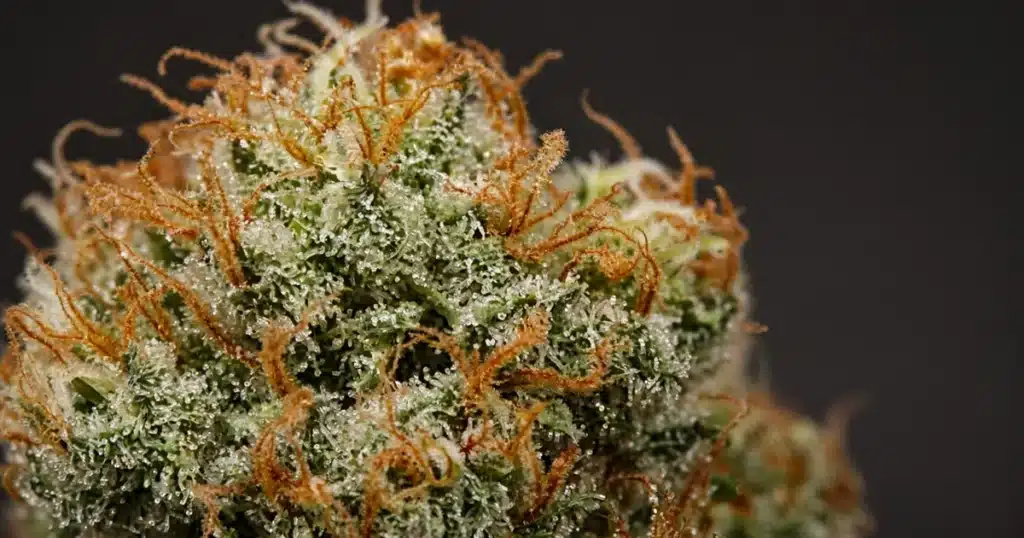
Cannabis pistils are the hair-like parts that stick out of female flowers. Each female flower has two of these thin stigmas, which catch pollen from the air. They start white, then often darken to orange, red or brown as the flower ages or after pollination. They are separate from trichomes, the tiny resin glands that cover the buds.
What are pistils on a cannabis plant?
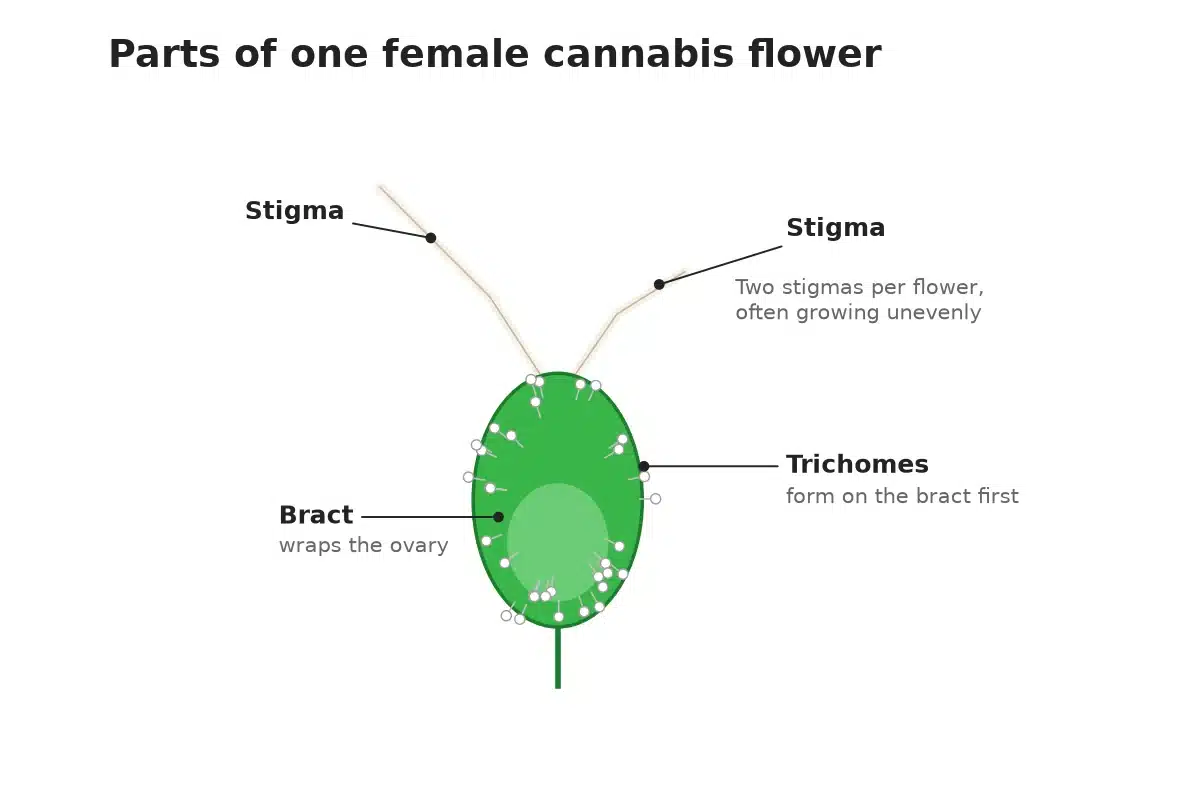
Botanically, the visible hairs are stigmas, part of the pistil. The pistil also includes the ovary, which sits tucked inside a small leaf-like bract. Growers use "pistil" for the whole visible hair, and that is the meaning used on most grow forums and seed packs.
Researchers at the Volcani Center in Israel looked at female cannabis flowers under a scanning electron microscope. They described each female flower sitting in the angle of a small subtending bract, with a second bract that wraps around the ovary. As the flower matured, two stigmas grew out of that wrapping bract, usually at slightly different speeds. Later, tiny papilla cells covered each stigma from the tip down toward the base. Those papillae are what make a fresh pistil look fuzzy under a loupe.
The same team found that glandular trichomes formed on the wrapping bract before the stigmas even stretched out. So the frost on a bud mostly sits on bracts, while the hairs poke through them.
| Structure | What the researchers described |
|---|---|
| Stigmas per female flower | 2, often growing unevenly |
| Flowers per flowering unit | 1 or 2, with bracts and a reduced leaf |
| Branching inside a flowering head | Up to 7 visible orders |
| Where trichomes form first | On the bract that wraps the ovary, before stigmas stretch |
Source: Spitzer-Rimon et al., Frontiers in Plant Science, 2019.
That stacked branching is why a cola is so packed with pistils. It is many tiny branches, and each one carries pairs of flowers.
When do pistils first show?
Single female flowers with pistils can form at branch joints even under long days. The Volcani team saw these solitary flowers on all three cultivars they grew under 16 hours of light. The paper also notes that seed-grown plants usually make their first solitary flowers at the fourth to sixth internode. That is the moment growers watch for to sex plants early. See early female plant signals.
Those early flowers did not all behave the same way. In NB130 and NB150, the single flowers went on to full bloom under long days. In NB140 they stayed undeveloped, with no visible stigmas, until the plants were given short days. So one plant can show clear pistils in veg while its neighbor shows none, and neither is a sign that something is wrong.
Those early pistils show as a pair of white hairs beside a small green bract, right where a leaf stem meets the main stalk. Male plants do not normally grow them, since they make pollen sacs instead.
Pistils stage by stage after the flip
The table below follows one cultivar, NB140, after it moved from 16 hours of light to 12 hours. The research team counted flowering in the main head as started once at least three pairs of stigmas showed at the top of the shoot.
| Days on 12/12 | What happened in NB140 |
|---|---|
| 5 | Solitary flowers at leaf joints fully formed, stigmas visible |
| 8 | No flowering head yet, but heavy branching under the microscope |
| 11 | Still no visible stigmas at the top |
| 12 | Visible stigmas at the top of the main shoot |
| About 8 to 10 days after first stigmas | The shoot tip ended in a female flower |
Source: Spitzer-Rimon et al., Frontiers in Plant Science, 2019.
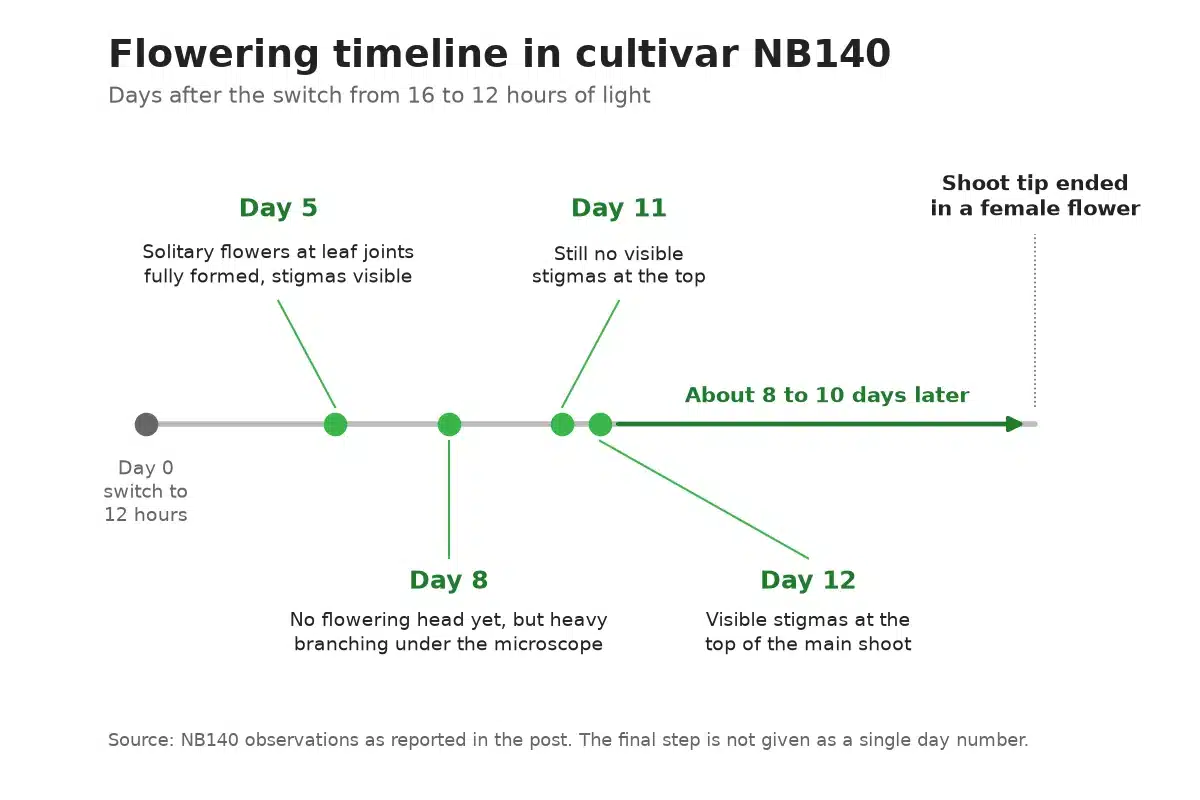
Timing changed by cultivar. A second cultivar, NB150, already showed stigmas at the top of the main shoot after 8 days, while NB130 matched NB140 and showed them at 12 days. Expect your own plants to land somewhere in that kind of window, with real differences from strain to strain.
From there, the stages most growers see look like this:
- Early bloom. Clusters of white pistils appear at the tops of the main stem and branches. Buds look like tufts of hair more than solid flowers.
- Mid bloom. New flowers keep stacking on, so white pistils stay common while the clusters swell and trichomes thicken.
- Late bloom. Pistils start to darken and curl back toward the bud as the flowers age. Fewer new white hairs appear.
- Ripening. Most pistils have turned orange, red or brown and pulled in close. Trichome color becomes the better guide from here.
Pistils and pollination
A pistil has one job in nature, which is to catch pollen. Cannabis is wind pollinated, so the long, fuzzy stigmas work like a net held out into moving air. The papilla cells that cover a mature stigma give pollen grains more surface to stick to. Once a grain lands and grows down into the ovary, that flower starts to form a seed, and its two hairs usually wither and darken soon after.
That is why a seeded bud often shows brown, shriveled pistils in patches while the rest of the plant still looks fresh. If you want seed-free flowers, keep male plants and any hermaphrodite plants well away from females in bloom. If you are making seeds on purpose, white, upright pistils are the sign that flowers are still open to pollen.
Why do pistils change color?
Pistils darken as they age, dry, or after they catch pollen. Heat, dry air and rough handling can also brown them early, so color alone is not always a ripeness sign.
- White and upright: fresh and receptive.
- Orange or red and curling: aging.
- Brown and shriveled: old or damaged.
Color alone can mislead. A pistil can brown early from heat, dry air or rough handling, so one dark patch does not mean the whole plant is done.
What goes wrong with pistils, and how do you fix it?
Pistils browning across the whole plant in mid bloom. Likely causes are pollination or a hot, dry room. Look inside a few buds for swelling seed pods. If there are no seeds, check canopy temperature and humidity and bring them back into the range your strain likes.
Brown or crispy pistils only on the top buds. This usually points to heat or light stress right under the lamp. Raise the light a little or dim it, and add gentle airflow across the canopy.
A burst of new white pistils late in flowering. This often shows up with foxtailing, when buds keep pushing out new growth under stress. Heat and very strong light near the tops are common triggers. Cool the canopy and judge harvest from trichomes rather than from the new hairs.
Pistils mixed with small banana-shaped growths. These are anthers, which make pollen. The Volcani team saw one cultivar end its flowering heads in mixed male and female flowers, and the authors suggested stress or plant hormone signals as a possible cause. Remove affected plants from a seed-free grow or pick off the anthers with care.
Are pistils a good harvest sign?
They are a rough guide only. Many growers watch the share of darkened pistils, but strains differ and new pistils can keep forming late. Checking trichomes with a loupe gives a closer look. See cannabis trichomes 101 and is your marijuana ready for harvest.
For harvest timing, read pistils and trichomes together. Kind Seed Co advises against leaning on either one alone.
Reading pistils on your own plants
- Check plants at the same time of day, under white light rather than a colored grow light.
- Look at buds from the top, middle and bottom of the plant, since tops ripen ahead of lower buds.
- Estimate the share of hairs that have darkened and curled in each spot.
- Pick out any buds that browned early near the lamp and leave them out of your estimate.
- Use a loupe on the bracts under the pistils to look at trichome heads.
- Write down what you see every few days so you can spot the trend instead of reacting to one day.
Pistil-reading errors to avoid
- Harvesting on pistil color alone. Heat-browned hairs can make a plant look riper than it is.
- Touching buds to check them. Handling can brown pistils and flatten trichomes. Look, do not squeeze.
- Reading only the top cola. Lower buds often ripen later than the top, so judge the plant as a whole.
- Mistaking early solitary flowers for bloom. Paired white hairs at branch joints in veg are a sex sign, not a sign the plant is flowering.
- Missing anthers among the hairs. A quick look for small sacs each week can save a grow from stray pollen.
Sources
- Spitzer-Rimon B, Duchin S, Bernstein N, Kamenetsky R. Architecture and Florogenesis in Female Cannabis sativa Plants. Frontiers in Plant Science. 2019;10:350. https://pmc.ncbi.nlm.nih.gov/articles/PMC6454139/
FAQ
Are pistils the same as trichomes?
They are different parts. Pistils are the hair-like stigmas that catch pollen, and there are two per female flower. Trichomes are tiny resin glands on the bracts and small leaves around the flowers. Trichomes are where most aroma compounds form, while pistils have a role in pollination and add color to the bud.
Why are my pistils turning brown early?
Early browning can come from age, pollination, heat, low humidity or touching the buds. If pistils brown across the whole plant in mid bloom, check canopy temperature and look for seeds. A few brown pistils on the tallest buds often point to heat or light stress at the top.
Do white pistils mean the plant is not ready?
Not always. Some plants keep producing new white pistils late in flowering, especially under stress or with foxtailing. Judge readiness across the whole plant and check trichomes with a loupe. White pistils on lower buds are also common when upper buds are further along.
How soon do pistils appear after switching to 12/12?
It depends on the strain. In one research grow, the top of the main shoot showed clusters of stigmas after 8 days in one cultivar and 12 days in two others. Single pistils at leaf joints can show even earlier, and some appear before the switch at all.
Do males have pistils?
Pistils belong only to female flowers. Male plants make pollen sacs instead. A female plant that also grows pollen-making anthers is called a hermaphrodite. Seeing paired white hairs at branch joints is the usual early sign that a plant is female, and it shows up before full bloom.


