
How Do Cannabis Buds Form? Bud Structure Explained
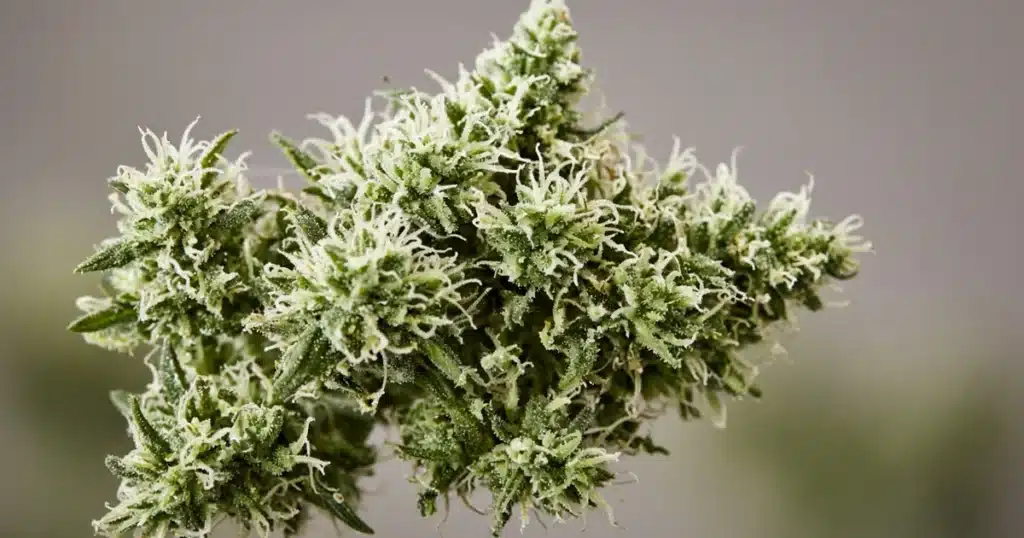
Cannabis buds form when short days change how shoot tips grow. Instead of making long stems with big leaves, each tip branches again and again into tiny side shoots, and every small unit carries flowers and bracts. Researchers found short days do not switch on single flowers so much as reshape the shoot into a dense, many-branched cluster, which is the bud.
What is a cannabis bud made of?
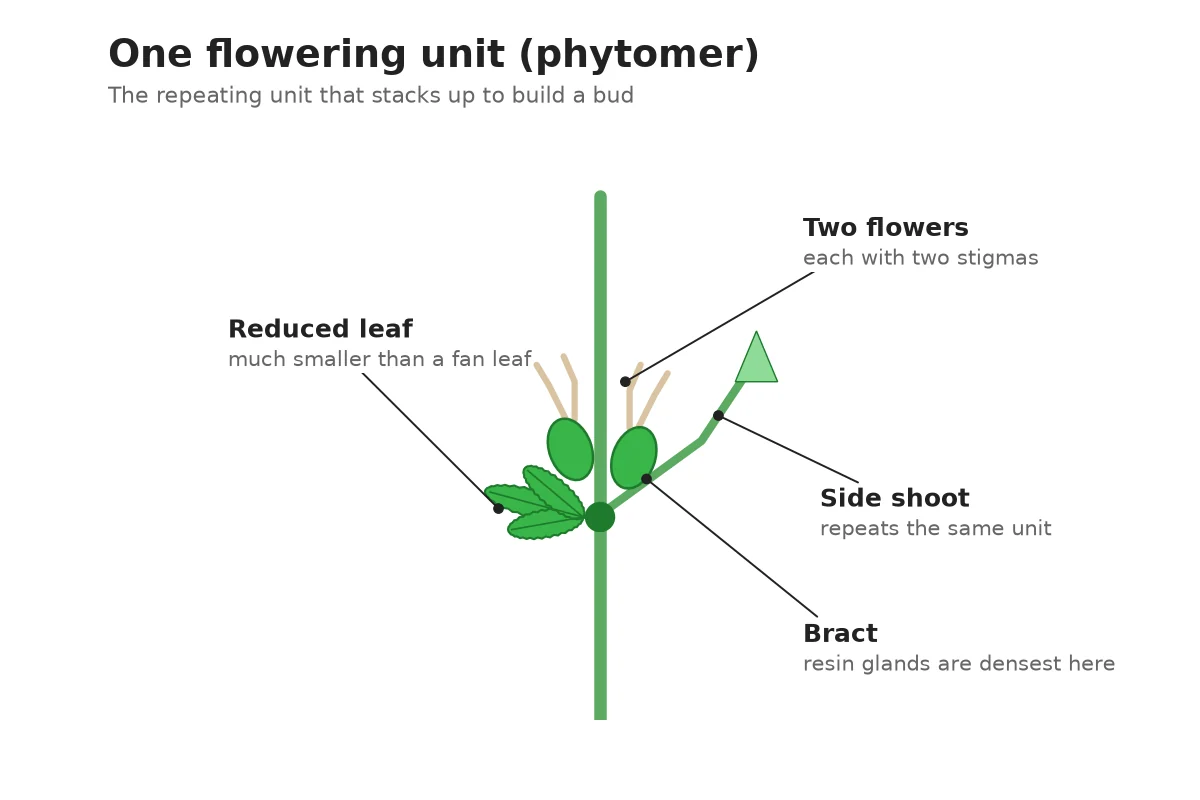
A bud is a compound flowering head. Botanists call it a compound raceme. Spitzer-Rimon and colleagues described each small unit, called a phytomer, as a reduced leaf, bracts, one or two flowers and a side shoot. The same basic unit builds the plant in veg. In bloom it simply shrinks and stacks up.
| Part | What it is | What it does in the bud |
|---|---|---|
| Reduced leaf | A small leaf, much smaller than a fan leaf | Often trimmed as sugar leaf |
| Bracts | Small leaf-like parts at each flower | Carry most of the resin glands |
| Flowers | One or two per unit, each with two stigmas | Catch pollen, form seeds if pollinated |
| Side shoot | A new tiny branch | Repeats the same unit again |
Source: Spitzer-Rimon et al., Frontiers in Plant Science, 2019.
The study counted up to 7 visible orders of branching inside a single flowering head. That stacking of tiny branches is what makes a finished bud look solid rather than like a loose spray of separate flowers. Every branch makes another branch with the same parts, over and over, with almost no stem between them.
What changes between veg and bloom
| Condition | What the researchers found |
|---|---|
| Long days, 16 hours light | Single flowers and bracts still form at shoot joints, long stems, large fan leaves |
| Short days, 12 hours light | Intense branching into a compound raceme |
| Inside a flowering head | Up to 7 visible orders of branching |
| Leaves up the stem | Leaves get smaller, with shorter stalks and fewer leaflets |
Source: Spitzer-Rimon et al., Frontiers in Plant Science, 2019.
In veg, the plant is already able to flower. The team saw single flowers at leaf joints under 16 hours of light in all three cultivars. What short days change is the shape of growth at the tips. Stem sections between units shrink, branching speeds up, and the leaves near the top get smaller with fewer leaflets. The result is a tight cluster of flowers and bracts.
Why do short days trigger buds?
Photoperiod plants read night length. Long nights change the shoot tip so it branches densely instead of stretching. See the cannabis light cycle. For what the first weeks after the switch look like, see cannabis flowering weeks 1 and 2.
The Volcani paper draws a useful line here. Single flowers form at the leaf joints under both long and short days, so for flower formation alone the authors describe cannabis as close to day-neutral. What short days add is the bud itself. Under them, the shoot tip switches to dense branching, and under the microscope each bud was built from branchlets up to seven orders deep. Every one of those small units repeated the same basic pattern: two single flowers and two bracts at the base of a reduced leaf, plus a side shoot.
For photoperiod plants, short days trigger the dense flowering clusters we call buds. Autoflowers work on a different trigger, since they flower by age instead of night length.
How buds form stage by stage
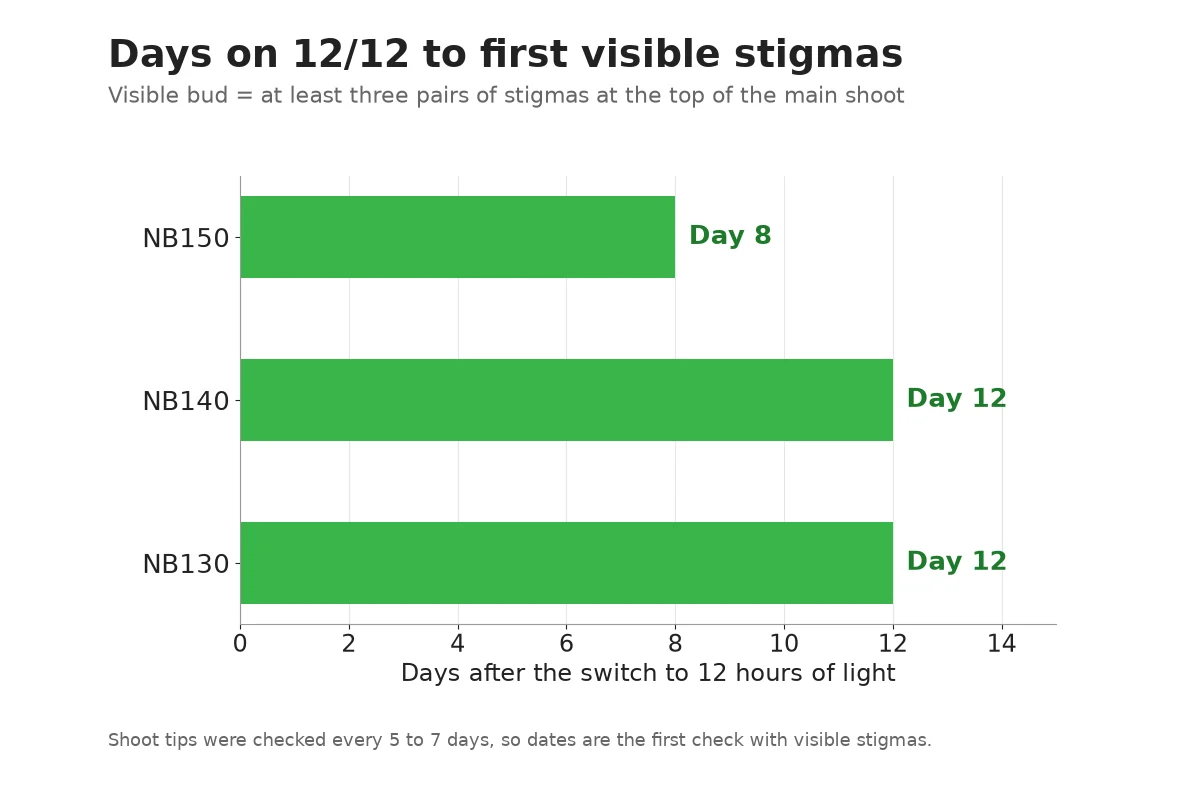
The researchers moved young plants to 12 hours of light three weeks after rooting and checked shoot tips every 5 to 7 days. They defined a visible bud as at least three pairs of stigmas at the top of the main shoot.
| Days on 12/12 | NB140 | NB150 | NB130 |
|---|---|---|---|
| 5 | Single flowers at leaf joints fully formed | Not reported | Not reported |
| 8 | Heavy branching seen under the microscope, no visible bud | Visible stigmas at the top | No visible bud |
| 11 | No visible bud yet | Already flowering | No visible bud yet |
| 12 | Visible stigmas at the top | Already flowering | Visible stigmas at the top |
| 22 | Main flowering heads on main, second and third order branches | Not reported | Not reported |
Source: Spitzer-Rimon et al., Frontiers in Plant Science, 2019.
Put simply, bud building starts inside the tip before you can see anything. Here is how that looks from the grower’s side:
- First days after the flip. Nothing looks different from outside, but the tips are already branching under the surface. Single pistils at leaf joints may become more obvious.
- First visible clusters. Small tufts of white pistils appear at the very top of the main stem and branch tips. In the research grow, this took 8 to 12 days depending on cultivar.
- Stacking. New flowering units keep forming on top of and beside the first ones. The tips keep growing during this phase, so clusters lengthen as well as thicken.
- Filling. Bracts swell and resin builds up on them. Gaps between clusters close and the bud starts to look like one solid piece.
- Finishing. The tip either keeps growing slowly or ends in a final flower, depending on genetics.
Does every bud end in a flower?
Not always. In the same study, one cultivar kept growing at the tip, one ended with a female flower, and one ended in a mixed male and female flower. In NB140, the tip ended in a normal female flower about 8 to 10 days after the first clusters of stigmas showed. NB130 never closed its tip. It kept making new units even after 7 months. To Kind Seed Co, that helps explain why bud tips can look so different from strain to strain.
The cultivars also grew to very different sizes. After one month, NB130’s main shoot reached about 106 cm, NB140 about 63 cm and NB150 about 52.5 cm. These growth differences help explain why some cultivars form longer, looser colas while others form tighter clusters.
Where on the plant buds form
Buds do not only form at the very top. The researchers saw main flowering heads at the tips of the main stem and of the second and third order branches. Smaller clusters also form at leaf joints all along the stems. So a single plant carries a range of bud sizes, from the main cola down to small popcorn clusters low inside the canopy.
Branch length plays a part. In NB140, the main shoot reached about 63 cm after a month while the longest lower side branches reached about 26 cm. Short, low branches sit in shade under the upper canopy, which is one reason lower buds often stay small.
A simple routine for tracking bud growth
- Mark the day you switch to 12 hours of light.
- Pick three tips to watch: the main top, one upper branch and one low branch.
- Look at each tip every two or three days with a loupe, at the same time of day.
- Note the first day you see at least three pairs of white stigmas at the top. That matches the point the researchers used to call a bud visible.
- Keep watching how fast the clusters stack and close the gaps between them.
- Compare plants. Big differences in timing usually come from genetics rather than from something you did wrong.
Why are some buds denser than others?
Density depends on genetics, light, and how many flowers pack into each cluster. See calyx to leaf ratio. The top cluster on the main stem becomes the main cola.
Light has a measurable effect. Rodriguez-Morrison and colleagues grew cannabis for 12 weeks on 12 hours of light at canopy light levels from 120 to 1,800 micromoles per square meter per second. Dry flower yield rose in a straight line with light across that whole range. The density of the top bud also rose as light went up.
Why buds fail to fill out, and what helps
Airy, loose buds. Common causes are weak light, buds sitting far below the lamp, or genetics with an open structure. Fix: even out the canopy so more tops sit close to the light, and match light strength to what the plants can handle.
Buds that keep stretching with long gaps. Light that is too weak can leave clusters spaced out. Fix: check light strength at bud height, not only at the top of the plant.
Late burst of new growth on finished buds. It can look like towers of fresh clusters stacked on mature ones. Too much heat or very strong light at the tops often sets it off. Fix: cool the canopy and raise or dim the light.
Mixed male and female flowers at the tip. The researchers saw this in one cultivar and suggested stress or plant hormone signals could play a role. Fix: keep conditions steady and check tips for small pollen sacs during bloom.
Where growers go wrong with budding plants
- Expecting buds the day after the flip. The branching starts out of sight, so give it time before deciding something is wrong.
- Judging every strain by one timeline. Even three cultivars in one room took different numbers of days to show buds.
- Leaving low branches in the shade. Clusters that get little light tend to stay small and airy.
- Assuming all buds should end in a flower. Some genetics keep growing at the tip by nature.
Sources
- Spitzer-Rimon B, Duchin S, Bernstein N, Kamenetsky R. Architecture and Florogenesis in Female Cannabis sativa Plants. Frontiers in Plant Science. 2019;10:350. https://pmc.ncbi.nlm.nih.gov/articles/PMC6454139/
- Rodriguez-Morrison V, Llewellyn D, Zheng Y. Cannabis Yield, Potency, and Leaf Photosynthesis Respond Differently to Increasing Light Levels in an Indoor Environment. Frontiers in Plant Science. 2021;12:646020. https://pmc.ncbi.nlm.nih.gov/articles/PMC8144505/
FAQ
Are cannabis buds flowers?
Yes. A bud is a cluster of many small female flowers packed on tiny branches, along with bracts and small leaves. Each flower has two hair-like stigmas. The resin glands sit mostly on the bracts and small leaves around the flowers, which is why dense clusters look frosty.
Why do buds only form on 12/12 for photoperiod plants?
Long nights change how the shoot tips grow, so they branch densely into flowering clusters. Research found single flowers can appear even under long days, but the dense bud shape comes with short days. Autoflowers flower by age instead of night length.
What is a cola?
A cola is a large flowering cluster at the end of a main stem or branch. It is made of many smaller clusters stacked together on tiny side shoots. The biggest one, at the top of the main stem, is usually called the main cola, and it tends to sit closest to the light.
Can you make buds denser?
Bud density depends on genetics first. Good light, steady temperatures and an even canopy help each cluster fill out. Research with LEDs found the density of the top bud rose as canopy light increased, so keeping tops evenly lit is a practical way to help.


