
Grow Light Timers: How to Keep Cannabis on Schedule
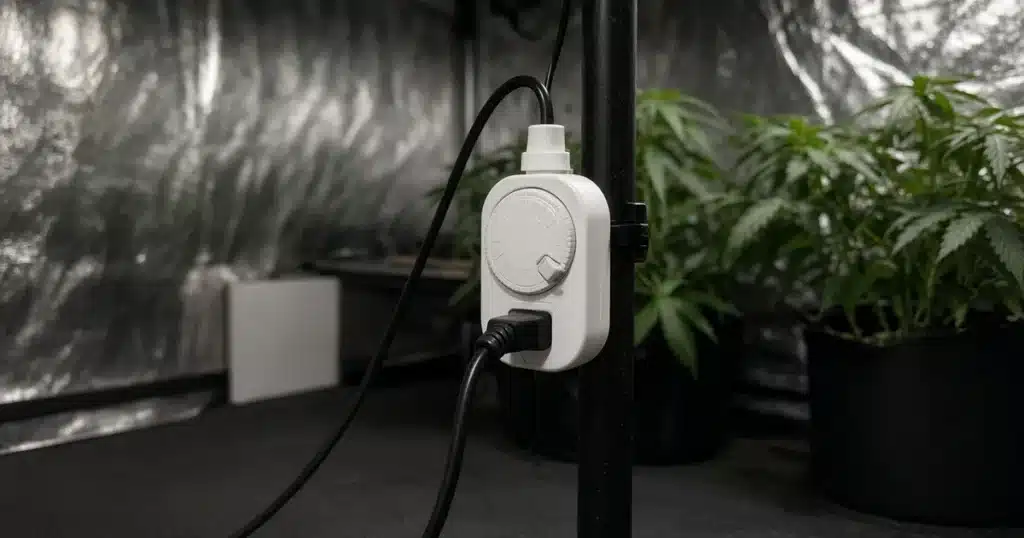
A grow light timer switches lights on and off at the same times every day, which matters because photoperiod cannabis flowers in response to day length. Most indoor growers use 12 hours of light to trigger flowering. Research shows light during the dark period can delay flowering, so a timer that holds an exact schedule helps.
Why Does Cannabis Need a Light Timer?
Indoor growers usually keep photoperiod cannabis under long days of 16 hours or more in veg, then switch to 12 hours to start flowering (Plants 2023). Research shows photons during the dark period delay flowering in short-day plants. In one study, added near-infrared (NIR) light, run for the full 24 hours, delayed cannabis flowering by 12 days at the highest level tested (Kusuma et al.). Our light cycle post explains the schedule itself.
Mechanical vs Digital Timers: What Is the Difference?
The research above does not compare mechanical and digital timers, so the choice is grower preference. What matters for the plants is a steady schedule and an unbroken dark period. Our grow tent setup guide covers the rest of the tent.
Source: Plants 2023 (PMC10386198), ten drug-type cultivars.
Data for this chart:
| Light hours | Result | Source |
|---|---|---|
| 12 to 14 | Flowering initiation in all cultivars | Plants 2023 |
| 14 vs 12 | No delay to about 4 days, by cultivar | Plants 2023 |
| 15 | Some initiated, but floral tissue did not develop further | Plants 2023 |
Source: Kusuma et al. 2021, PLOS ONE. 850 nm NIR LEDs ran for the full 24 h over a 12 h white and red photoperiod. Delay is versus no added NIR. NIR levels follow the paper’s Methods.
Flowering delay under added near-infrared light
| Species | Flowering delay | NIR levels tested (Methods) | Source |
|---|---|---|---|
| Cannabis | 12 days | 62 and 121 µmol m⁻² s⁻¹ | Kusuma et al. 2021 |
| Soybean | 3 days | 44 and 87 µmol m⁻² s⁻¹ | Kusuma et al. 2021 |
How Do You Set a Timer for Veg and Flower?
Set long days for veg, then switch to 12 hours on and 12 off for flowering, which most indoor growers use (Plants 2023). In that study, flowering started in all ten cultivars at up to 14 hours of light, with delays of up to about 4 days at 14 versus 12 hours. At 15 hours, some cultivars started flowers that did not develop further.
How Do You Check That a Timer Is Working?
Grower practice is to watch the light switch off and on for the first few days and after power cuts. Because added light, even near-infrared, can delay flowering (Kusuma et al.), it also helps to check for stray light. See our supplies list for other basics.
Sources
- Plants 2023 (PMC): Is Twelve Hours Really the Optimum Photoperiod for Indoor Cannabis?
- Kusuma, Westmoreland, Zhen and Bugbee 2021, PLOS ONE: Photons From NIR LEDs Can Delay Flowering in Soybean and Cannabis
Kind Seed Co wrote this timer guide as general growing information, leaning on the research above.
FAQ
Why does uninterrupted darkness matter?
Photoperiod cannabis is a short-day plant. Research in PLOS ONE explains that photons during the dark period delay flowering in short-day plants, and the authors found that near-infrared light from LEDs peaking at 850 nm, given for the full 24 hours, delayed cannabis flowering by 12 days at the highest level tested. A steady timer protects the dark period.
Is 12 hours of light always best for flowering?
Not always. A study of ten indoor cultivars found flowering started in all of them at up to 14 hours of light, with delays of up to about 4 days at 14 versus 12 hours. For some cultivars, ideal levels for key flowering measures fell between 12 and 13 hours.
Can near-infrared light delay flowering?
Yes. In a PLOS ONE study, near-infrared light applied for the full 24 hours delayed flowering in cannabis by 12 days and in soybean by 3 days at the highest levels tested. The researchers said their results suggest that long-wavelength light can still activate the plant's light-sensing pigments.
What light schedule is used for veg?
According to a 2023 study, indoor growers typically keep photoperiod cannabis under long days of 16 hours or more during vegetative growth, from germination or cloning through the transplant stage. Once plants reach the right size, they move to a short-day photoperiod, usually 12 hours, to trigger flowering.


