Top 5 Natural Pest Control Options for Cannabis Growers

Home growers want to keep bugs off their plants without reaching for harsh sprays. The good news is that the best pest control starts with habits, not products. Below are five low impact tools, with the most detail on diatomaceous earth, since that is what most growers ask about. One rule runs through all of it: if you use any product sold to control pests, read the label and follow it. The label is the law, and state rules on what may be used on cannabis vary, so check yours.
1. Diatomaceous earth
Diatomaceous earth, often shortened to DE, is a fine powder made from fossils. The National Pesticide Information Center (NPIC), based at Oregon State University, explains that it “is made from the fossilized remains of tiny, aquatic organisms called diatoms,” whose skeletons are silica.
How DE works
DE is not a poison that pests eat. NPIC says it “causes insects to dry out and die by absorbing the oils and fats from the cuticle of the insect’s exoskeleton,” and that “its sharp edges are abrasive, speeding up the process.” UC IPM, the University of California’s pest program, describes it the same way: a contact insecticide that works “by absorbing moisture and scratching the insect’s exoskeleton.”
The catch here is moisture. NPIC notes DE “remains effective as long as it is kept dry and undisturbed.” Watering, rain and dew reduce its effect, which matters in a garden that gets watered often.
Food grade vs other DE
NPIC explains that “food grade” DE products “are purified” and are used, for example, as anticaking materials in feed. Pool filter DE is a different, heat treated material and is not what gardeners want. For pest use, choose a product registered as a pesticide and read its label for where it can be applied.
Safety with DE
DE is low in toxicity, but the dust still matters. NPIC says that “if breathed in, diatomaceous earth can irritate the nose and nasal passages,” and “if an extremely large amount is inhaled, people may cough and have shortness of breath.” It “may also irritate the eyes, due to its abrasive nature,” and on skin “it can cause irritation and dryness.” UC IPM advises reading the label for protective gear and wearing basic protection “such as chemical resistant gloves, long sleeves, and goggles.” Wear a dust mask or respirator approved by NIOSH, and follow the label’s protective gear list.
How to apply DE step by step
- Follow the label, and check that the product is labeled for your site, such as a garden, containers or indoor use, before you apply it. Also check your state’s rules for cannabis.
- Wait for a dry day outdoors, or switch off fans indoors so the dust stays put.
- Put on the protective gear the label lists, including gloves, long sleeves, eye protection and a dust mask or respirator approved by NIOSH.
- Lightly dust the soil surface, pot rims and the base of stems where crawling pests travel.
- Keep DE off flowers. Buds are what get consumed later, and powder residue there is unwanted.
- Avoid watering the dusted area. DE only works while it stays dry, so if plants need water, pour it gently at the base of the stem, away from the dusted ring, or water before you dust.
- Reapply only as the label allows, and only after the powder gets wet or washed away.
- Keep checking plants so you know whether pests are actually dropping.
2. Scouting and early removal
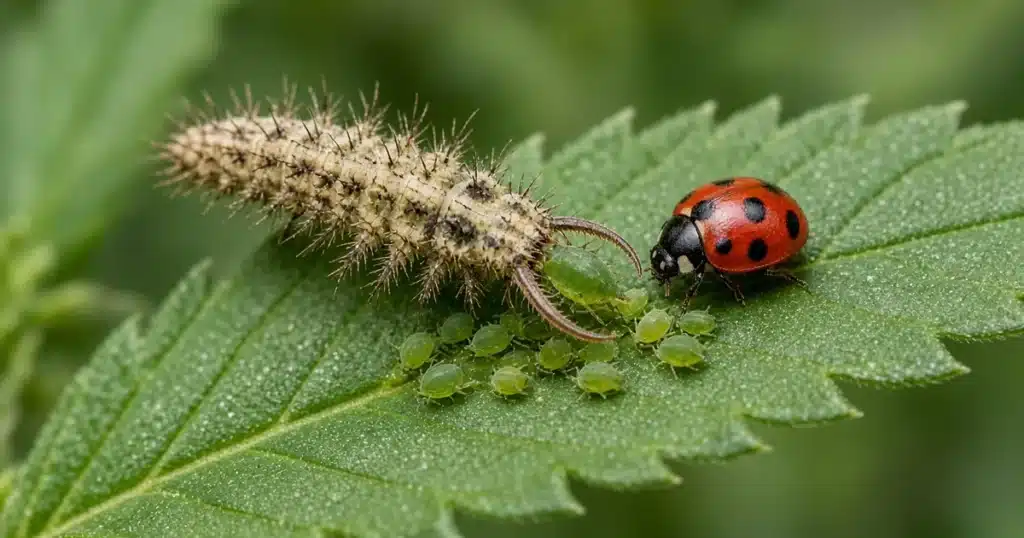
The cheapest pest control of all is catching problems early. Turn over leaves twice a week, look at new growth, and use a hand lens. Pick off caterpillars by hand and remove badly infested leaves. Yellow sticky cards near the canopy help you see flying pests like fungus gnats before numbers build.
3. Water sprays and physical barriers
A firm spray of plain water knocks many soft bodied pests off leaves. Do it in the morning so foliage dries quickly, because leaves that stay wet late invite mold, which our guide at https://kindseed.com/stoner-alert-smoking-moldy-cannabis/ covers. Row cover over young outdoor plants keeps flying insects off until plants are larger.
4. Companion plants
Many growers plant aromatic herbs and flowers such as dill, basil, marigold and yarrow near cannabis to draw in helpful insects. The evidence for real repellent effects is mixed, so count them as a bonus to regular scouting, not a shield.
5. Neem and other labeled products
Neem oil and insecticidal soaps are popular with home growers. These are pesticide products, so the same rule applies: use them only if the label lists your use site, follow it exactly, and check your state’s rules for cannabis. Do not spray anything on flowers late in the season.
Where DE fits and what it is registered for
NPIC reports that “there are over 150 products registered for use inside and outside of buildings, farms, gardens, and pet kennels,” and that DE products are registered against pests including “bed bugs, cockroaches, crickets, fleas, ticks, spiders, and many other pests.” That list tells you DE is aimed at crawling pests that walk through it. Flying insects that rarely touch a dusted surface are a poor match, and pests sheltered under leaves may never meet the powder at all.
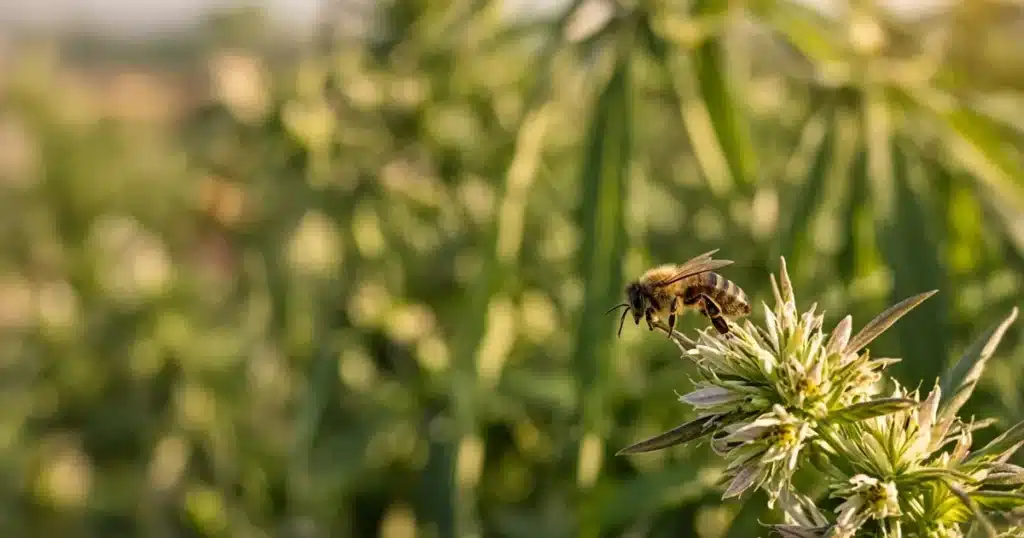
On the environmental side, NPIC says DE “is practically non-toxic to fish and aquatic invertebrates” and that agencies consider it unlikely to harm birds, fish or wildlife. UC IPM lists no data yet for honey bees and beneficial insects, so it is wise to keep dust away from flowering plants where bees forage, including weeds in bloom near your garden.
Comparing the five options
| Option | Best for | Main limit |
|---|---|---|
| Diatomaceous earth | Crawling pests at soil and stems | Stops working when wet |
| Scouting and removal | Catching all pests early | Takes regular time |
| Water spray and barriers | Soft bodied pests, young plants | Needs repeating |
| Companion plants | Drawing in beneficial insects | Repellent effect varies |
| Neem and soaps | Labeled pests on leaves | Label and state limits apply |
Troubleshooting
| Problem | Likely cause | What to do |
|---|---|---|
| DE seems to do nothing | Powder got wet or compacted | Reapply on a dry day if the label allows |
| Coughing or sneezing while dusting | Breathing DE dust | Stop, ventilate, wear a mask approved by NIOSH next time |
| Pests keep coming back | Missed eggs or hidden colonies | Scout leaf undersides twice a week |
| White residue on buds | DE or spray drift on flowers | Keep products off flowers. Protect buds when applying |
| Leaves spotted after spraying | Spraying in hot sun | Spray early in the day and follow the label |
Build a simple routine
Pick two days a week for a walk through the garden with a hand lens. Note what you see, act early, and keep records. If you are just getting started, our guide to growing one plant at https://kindseed.com/grow-one-single-cannabis-plant/ is an easy place to build habits.
FAQ
Does diatomaceous earth work on cannabis pests?
It can help against crawling pests that touch it. Extension sources explain that DE dries insects out by absorbing oils from their outer layer, and its sharp edges speed that up. It works best kept dry, so rain and watering reduce its effect.
Is diatomaceous earth safe to handle and apply?
DE is low in toxicity, but the dust can irritate the nose, eyes and skin. Read the product label, wear gloves, eye protection and a dust mask or respirator approved by NIOSH, and keep it off flowers.
Should I use food grade diatomaceous earth?
Food grade DE is purified, but for pest control choose a product registered as a pesticide and follow its label. Pool filter DE is a different material and is not for garden use.
What companion plants help with cannabis pests?
Many growers use dill, basil, marigold and yarrow to draw in beneficial insects. Evidence for direct repellent effects is mixed, so use them alongside regular scouting.
Can I use neem oil on cannabis?
Neem products are pesticides. Use one only if its label lists your use site, follow the label exactly, and check your state’s rules for cannabis. Do not spray flowers late in the season.
Sources
- National Pesticide Information Center (Oregon State University Extension), Diatomaceous Earth General Fact Sheet (https://npic.orst.edu/factsheets/degen.html)
- UC IPM, University of California, Pesticide Active Ingredients Database: diatomaceous earth (https://ipm.ucanr.edu/home-and-landscape/pesticide-active-ingredients-database/active-ingredient-details/?uaiKey=134&uaiStatusKey=9)