
How Long Do Cannabis Seeds Last? Viability and Tests
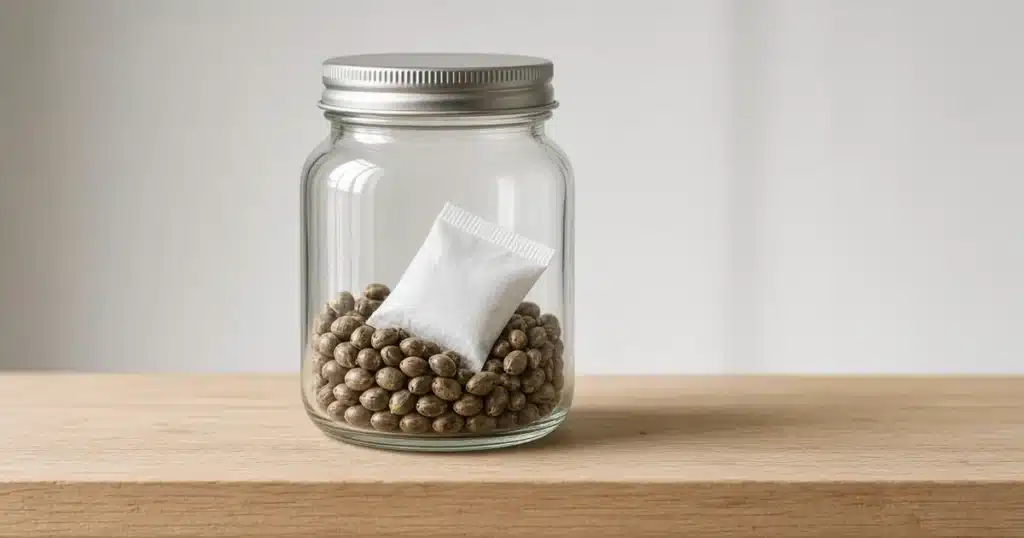
Cannabis seeds can stay viable for years when kept cool and dry, but warm, moist seeds can lose all germination in under 18 months. Research on hemp, marijuana and wild-type seeds found that lowering either temperature or seed moisture made a large difference to how long seeds lasted. There is no fixed shelf life. A batch’s real age depends on how it was stored, and a simple germination test of a sample tells you where your seeds stand before you plant.
What does research show about seed life?
Three studies give the clearest picture.
Agriculture and Agri-Food Canada, 2012. Ernest Small and Brenda Brookes stored seeds of three hemp cultivars, a marijuana strain and a wild ruderal strain for 66 months. They tested four temperatures (20, 5, -20 and -80 °C) and three seed moisture levels (about 11, 6 and 4%).
University of Ljubljana, 2004. Darja Kocjan Ačko and Dea Baričevič tested five hemp cultivars stored for two and three years, either in a refrigerator or at room temperature.
Hemp storage trial, 2025. A team including the University of Texas Rio Grande Valley dried hemp seed to 6, 8, 10 and 14% moisture, sealed it and stored it at -20, 4, 10 and 21 °C for up to 24 months.
| Study and storage | Result |
|---|---|
| Fresh declared hemp seed, five cultivars | 96.1% average germination |
| After 3 years in a refrigerator (4 to 7 °C) | 65.0% average germination |
| After 3 years at room temperature (20 to 25 °C) | 46.4% average germination |
| Seeds at about 11% moisture stored at 20 °C | Zero germination in under 18 months |
| Some commercial hemp lots after 1 year | Germination down by 50% |
Sources: Kocjan Ačko and Baričevič, Acta agriculturae Slovenica, 2004, Small and Brookes, Journal of Natural Fibers, 2012, Cockson et al., Agrosystems, Geosciences and Environment, 2025.
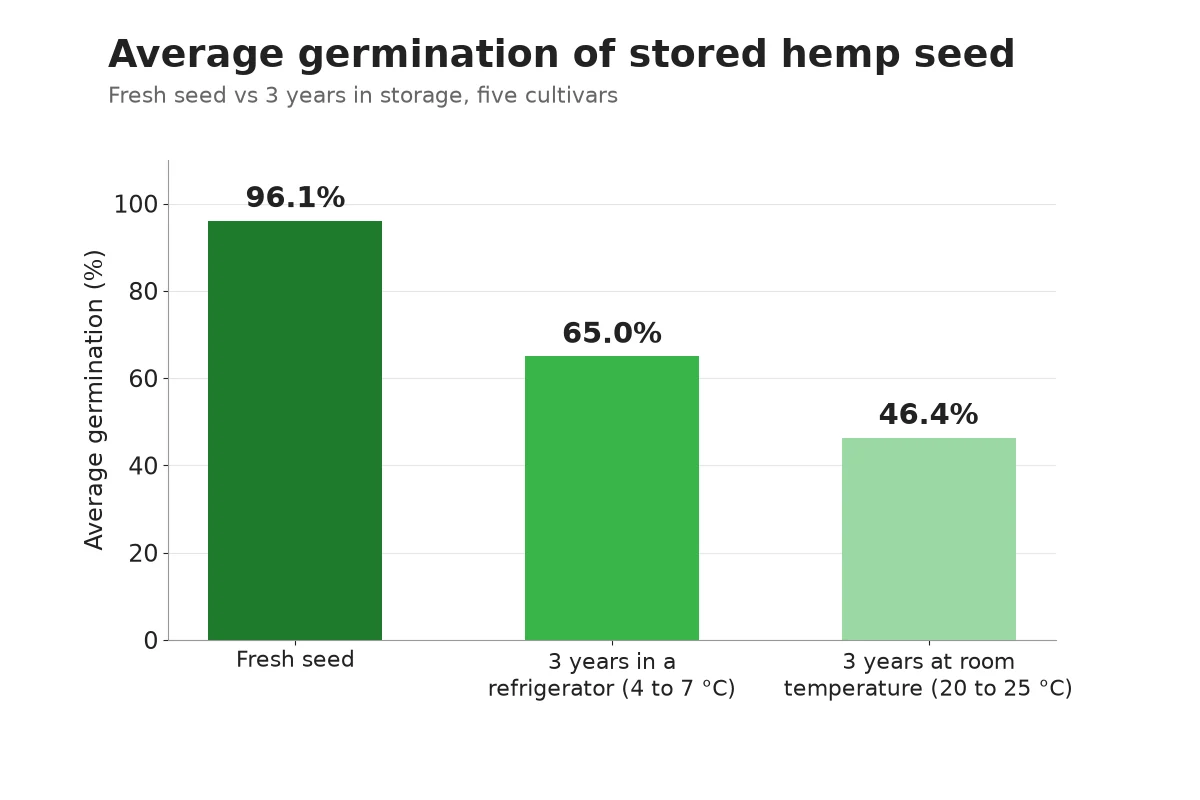
Even fridge storage did not hold germination at its starting level in the Slovenian work, but it kept far more seeds alive than room temperature. Moisture made an even sharper difference in the Canadian work. Seeds held at about 11% moisture and room temperature lost all germination in under 18 months.
What keeps seeds viable longer?
Dry and cool are the two levers, and dry matters most.
- Small and Brookes found that either cutting temperature to 5 °C or less, or cutting seed moisture to about 6% or less, had a huge benefit for keeping seeds alive.
- Cooling further added a small extra benefit. Drying below about 6% added none.
- Oxygen-free storage showed no clear benefit.
- The 2025 trial found germination fell over time at 10 and 14% moisture, and fell faster at warmer temperatures. The authors advised keeping seed moisture under 8% and storing at 4 to 10 °C.
For the practical side of keeping seeds sealed and dark, see the Kind Seed Co list of seed storage mistakes.
How long do seeds last under different conditions?
The research points to a simple ranking rather than a calendar.
Warm and damp, like a drawer in a humid room. The weakest case. Seeds at 11% moisture and 20 °C failed completely in under 18 months.
Room temperature, average dryness. Expect a steady decline. The hemp cultivars stored at 20 to 25 °C fell from 96.1% to 46.4% over three years.
Refrigerated. Clearly better. The same cultivars kept 65.0% after three years at 4 to 7 °C.
Dry, at about 6% moisture or less. The strongest case in the Canadian work, where dryness alone gave a large benefit, with cold adding a little more.
These results came from hemp and research stocks kept under controlled conditions, not from seeds handled, shipped and opened the way home growers handle them. Your seeds may do better or worse, which is why testing beats guessing.
The 2025 trial adds detail for the shelf and the freezer. Seed dried to 6 to 8% moisture and kept at 4 to 10 °C still germinated at 81 to 90% after 24 months. Even at room temperature, 21 °C, seed dried to 6% reached 89% germination after two years. At the other extreme, seed at 14% moisture and 21 °C had stopped germinating entirely after only 3 months. Freezing was not a clear win. Dry seed stored at -20 °C fell to about 66% germination by 24 months even though stain tests still showed about 90% alive, which the authors suggested could be cold-induced dormancy. The trial used a single hemp cultivar, so other seed lots may differ.
Why do seeds lose viability?
A seed is a living embryo with a small food store, sealed in a hard coat. It keeps running at a very slow rate in storage, and warmth and moisture both speed that up. The 2025 trial found the two work together. Higher moisture combined with higher temperature gave the fastest drop in both germination and lab-tested viability, while dry seed held up across the temperatures tested. The authors also suggested that poor storage may explain part of the variation growers see between commercial hemp seed lots.
What does germination speed tell you?
The number that sprouts is only half the story. The Slovenian study measured germination energy, meaning how fast seeds sprout, alongside final germination, and found differences in both between cultivars and between storage conditions. A slow batch can still finish with a good final count, so speed and total are worth recording separately. Slow sprouting is a useful early warning to plan for, even when the end result looks fine. Note on your test record how many seeds were up by about day 6 as well as the final total by about day 12. A batch that is slow but still reaches a good final count is usually worth planting, though it may sprout less evenly.
How do you test old seeds, step by step?
University of Arkansas Extension describes a home germination test that works for any seed.
- Take a sample that represents the whole batch, including small, pale or odd-looking seeds, not just the best ones.
- Count out the seeds. The extension method uses 50 or 100 for accuracy. With a small pack, a smaller sample still gives a useful rough answer.
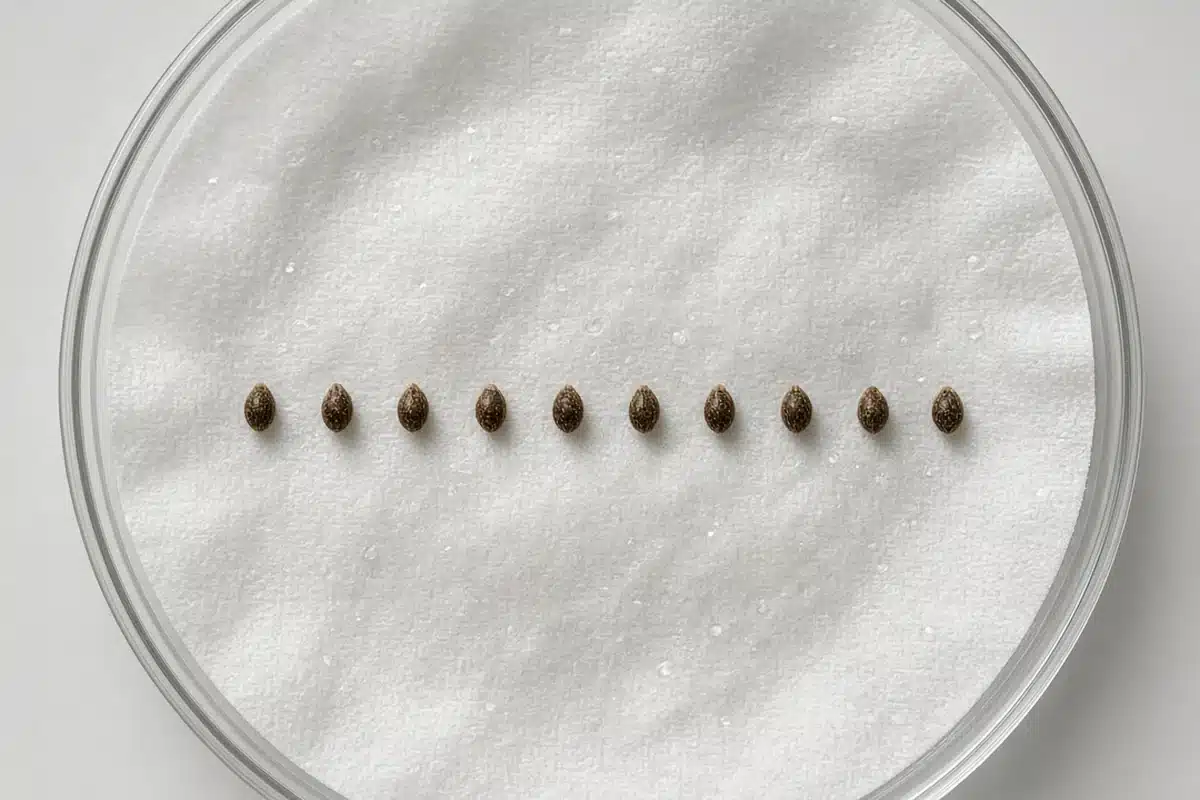
- Lay them across the middle of a paper towel, fold the towel over, moisten it and roll it up.
- Put the roll in a sealable bag and write the date on it.
- Keep it at room temperature. Check every day or so that the towel stays moist but not soaked.
- Count sprouted seeds. Divide sprouted seeds by total seeds and multiply by 100 for your germination percentage.
How long to wait matters. In the Slovenian hemp work, the researchers found day 6 and day 12 gave better readings of germination speed and final germination than the official day 3 and day 7 counts. So check at about day 6 and give slow seeds until about day 12 before calling the result.
For planting the rest of the batch, see how to germinate cannabis seeds.
How do you use the test result?
University of Arkansas Extension gives a simple rule for farm seed. At 85% germination or higher, plant at the normal rate. Below that, divide the number of plants you want by the germination rate to get the number of seeds to start.
Applied to a home grow, if your test shows 50% and you want four plants, start eight seeds. At 75%, start about five or six. The extension guide’s own table follows the same math, doubling the seeding rate at 50% and quadrupling it at 25%.
Write the date and result on the storage container, so the next test has a baseline.
What do germination results tell you?
| Result | What it suggests | What to do |
|---|---|---|
| Most seeds sprout within about 6 days | Strong batch | Plant normally |
| Most sprout, but slowly, by about day 12 | Viable but aging | Start a few extra seeds, give them warmth and time |
| Few sprout | Low viability | Start extra seeds based on the percentage |
| None sprout by day 12 | Batch likely past its useful life | Test again with a fresh sample before giving up |
| Seeds swell and rot without sprouting | Dead seed or a towel kept too wet | Retest with a towel that is damp, not soaked |
Based on University of Arkansas Extension and Kocjan Ačko and Baričevič, 2004.
Can you tell viability by looking?
Only roughly. Color, size and firmness are clues, not proof. Some good-looking seeds fail and some pale seeds sprout. Labs use a tetrazolium stain test to check whether the embryo inside is alive, which the 2025 trial ran alongside its germination counts. For home growers, the paper towel test is the practical choice. For what healthy seeds usually look like, see what good seeds look like.
What are common mistakes?
- Testing only the best-looking seeds, which overstates the batch.
- Calling a test after two or three days, before slower seeds have had a chance.
- Keeping the towel soaking wet.
- Planting a whole old batch without testing a sample first.
- Assuming the fridge stops aging. It slows it.
- Opening a cold container right away, which lets moisture condense on the seeds.
Sources
- Small E, Brookes B. Temperature and Moisture Content for Storage Maintenance of Germination Capacity of Seeds of Industrial Hemp, Marijuana, and Ditchweed Forms of Cannabis sativa. Journal of Natural Fibers. 2012;9(4):240-255. https://doi.org/10.1080/15440478.2012.737179
- Kocjan Ačko D, Baričevič D. Influences of seed age and storage conditions on germination ability of hemp seed (Cannabis sativa L. var. sativa). Acta agriculturae Slovenica. 2004;83(1):85-94. https://doi.org/10.14720/aas.2004.83.1.15561
- Cockson P, Webb A, Martinez-Ochoa N, Moffitt L, Pearce R, Chakrabarti M. Impact of seed moisture and temperature on hemp seed germination. Agrosystems, Geosciences & Environment. 2025;8(2):e70129. https://scholarworks.utrgv.edu/ibcs_fac/93/
- Jennings J. How to Conduct a Seed Germination Test at Home (FSA3149). University of Arkansas System Division of Agriculture. https://www.uaex.uada.edu/publications/pdf/FSA-3149.pdf
FAQ
Can 5-year-old cannabis seeds still grow?
They can if they were kept cool and dry. Research found seeds stored at low temperature or low moisture kept far more germination than warm, moist seeds. Seeds kept warm and humid may fail much sooner. Test a sample before planting a whole batch, so you know what to expect.
How do you know if old seeds are still good?
A germination test is the most reliable home method. Place seeds on a damp paper towel, seal it in a bag at room temperature, and count sprouts. Check around day 6 and give slow seeds until about day 12. Color and firmness are rough clues only.
Should cannabis seeds be stored in the fridge?
Research on hemp found fridge-stored seeds kept more germination after three years than seeds at room temperature, 65.0 percent versus 46.4 percent. Seal seeds in an airtight container with a desiccant so they stay dry, and let the container warm up before opening.
Does seed moisture matter more than temperature?
Both matter, but dryness carries a lot of weight. One study found that cutting either temperature to 5 °C or moisture to about 6 percent greatly helped seed life. Further cooling added a small extra benefit, while drying beyond that did not add much.


