
Manganese Deficiency in Cannabis: Signs, Causes, Fixes
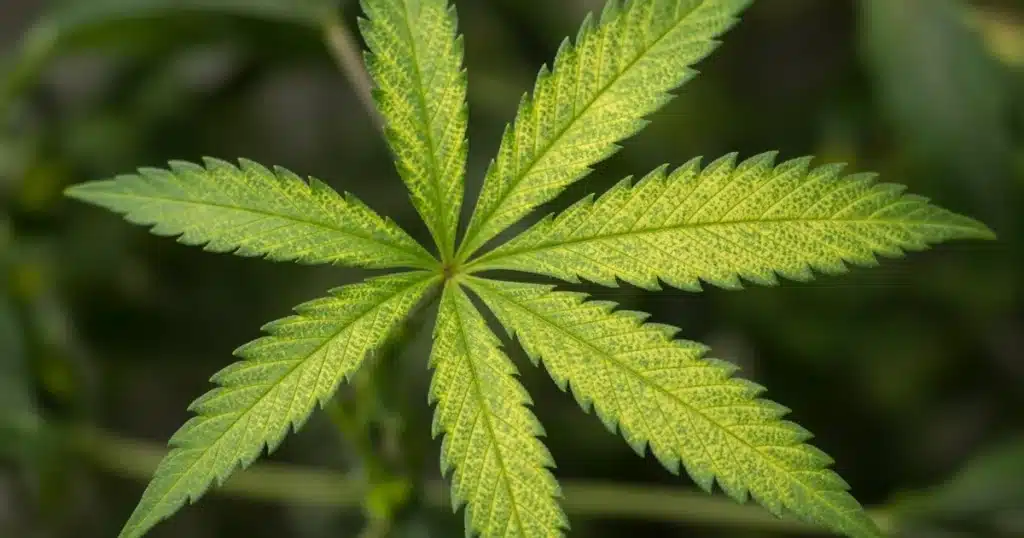
Manganese deficiency in cannabis shows up first on the newer, upper leaves as bright yellow tissue between the veins, with the veins staying green in a netted pattern. In advanced cases small tan dead spots appear. The most common cause is a root zone pH that is too high, so the fix usually starts with pH, followed by a light manganese correction if a test confirms it.
What does manganese deficiency look like?
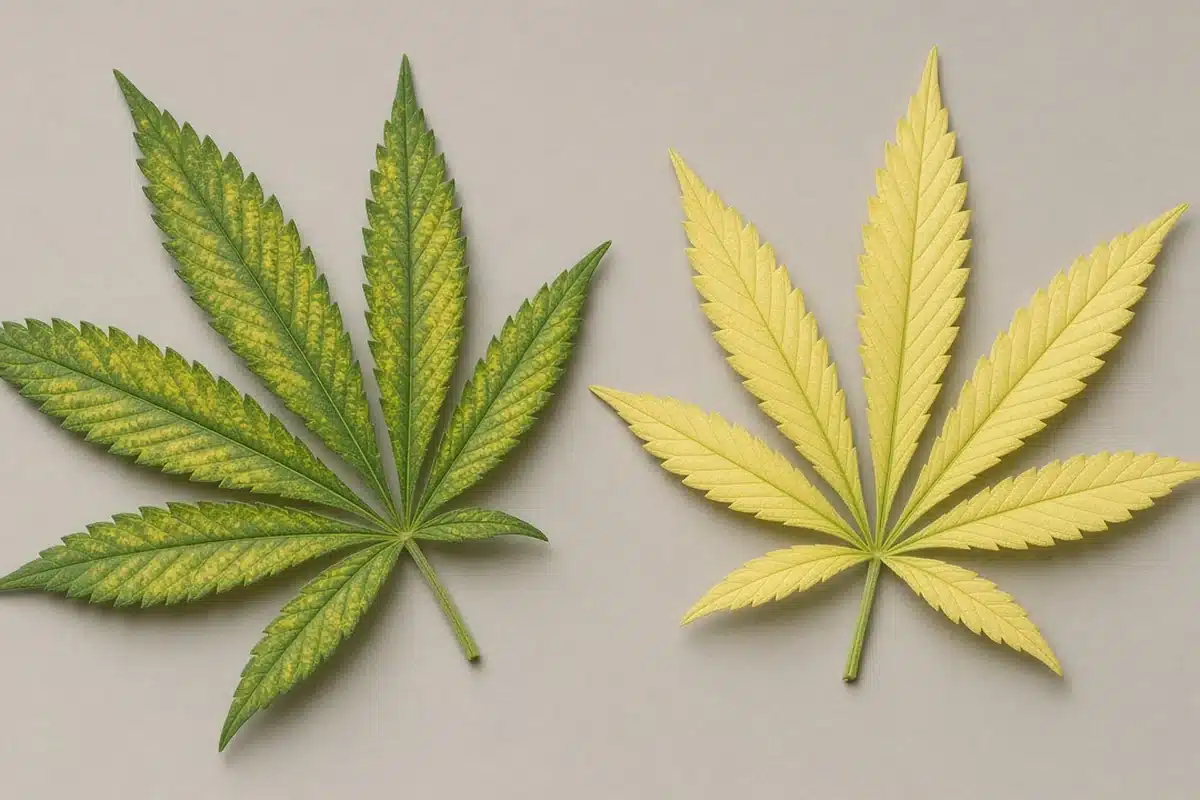
In a North Carolina State University greenhouse trial, hemp plants grown without manganese showed symptoms about six weeks after the trial started. The upper and central leaves developed bright yellow interveinal chlorosis in a netted pattern. The yellowing began near the midrib and spread outward toward the leaf edges. As the problem advanced, small tan necrotic spots formed on the affected leaves.
The same trial measured the leaves. Plants without manganese held 7.56 mg/kg of manganese in their leaf tissue, compared with 29.40 mg/kg in plants fed a complete solution, about 74% lower. Dry weight did not differ much between the groups at that point, which shows how the leaf signs can arrive before growth visibly slows.
Watch for these signs:
- Yellow tissue between green veins on young or middle leaves, not the oldest leaves.
- A netted or "fishbone" look, with a fairly wide green strip along each vein.
- Yellowing that starts near the midrib and moves outward.
- Small tan spots of dead tissue in later stages.
- Lower leaves that stay green while upper growth turns pale.
Why new leaves show it first
University of Minnesota Extension explains that manganese does not move easily inside the plant once it is placed in a leaf. When supply runs short, the plant cannot pull manganese out of old leaves to feed new ones. That is why the symptoms show up on young leaves first. The same pattern is true for iron, which is why the two are often confused.
Manganese vs iron deficiency
Both problems cause interveinal yellowing on new growth, so look closely at the veins and the timing.
| Problem | Where it starts | Pattern | Notes |
|---|---|---|---|
| Manganese deficiency | Upper and central leaves | Netted yellow, wider green veins, tan spots later | Showed at 6 weeks in the NC State trial |
| Iron deficiency | Upper, newest leaves | Yellow starts at the leaf base and edges, veins thinner | Showed at 9 weeks in the same trial |
| Manganese toxicity | Lower, older leaves | Yellow edges moving inward, dead margins | Leaves may drop |
Source: Cockson et al. 2019, Applied Sciences. University of Minnesota Extension.
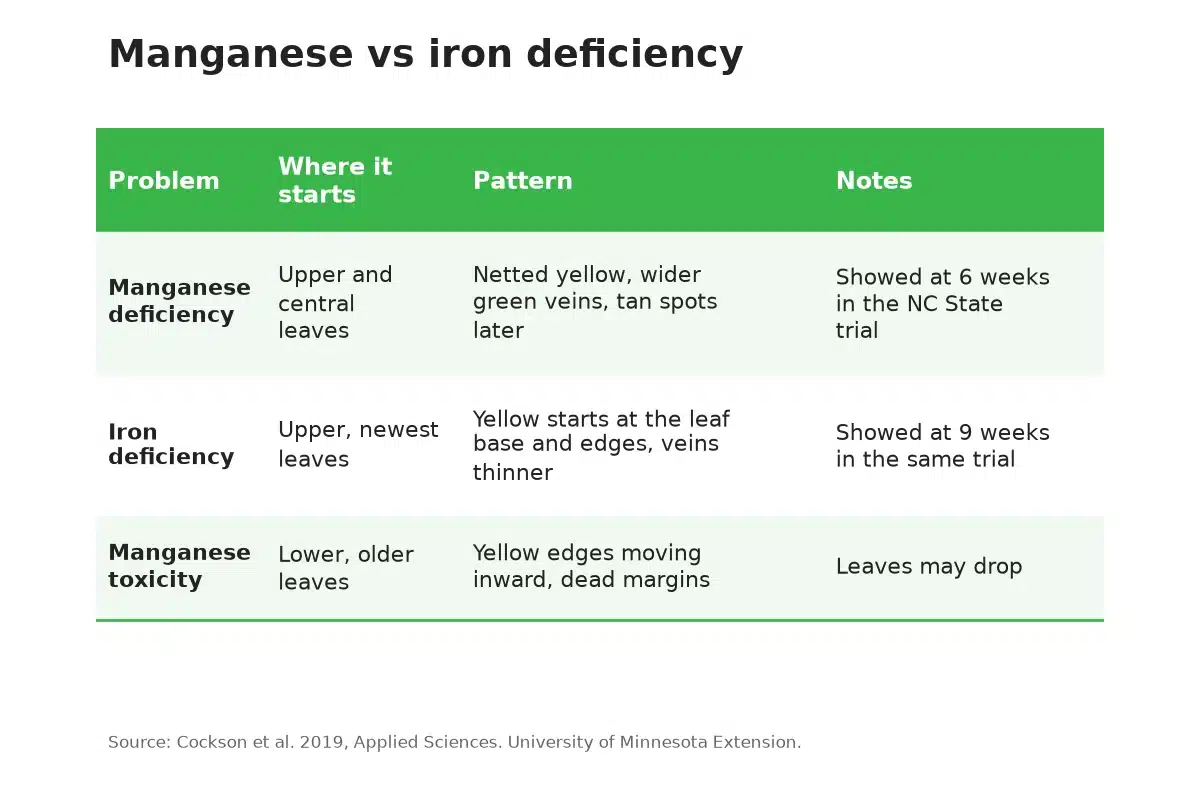
In the NC State trial, iron deficiency appeared later, at about nine weeks. It started as yellowing at the base and margins of the upper leaves, while the lower and middle leaves stayed green. Minnesota Extension notes that with manganese, the green area along the veins tends to stay wider than with iron, which gives the fishbone look. Iron has its own full write-up in iron deficiency in cannabis plants.
Magnesium is another common mix-up. Magnesium moves within the plant, so its yellowing usually starts on older, lower leaves. If the yellowing sits low on the plant, check how to identify and treat magnesium deficiency.
What causes manganese deficiency?
Most cases are not caused by a lack of manganese in the mix. They come from conditions that lock it up.
- High pH. Wisconsin Extension reports that manganese in soil solution drops about 100 times for every one unit rise in pH. Deficiency is common above pH 6.5.
- Sandy and organic soils. Minnesota Extension says deficiency is likely on sandy and organic soils above pH 6.0 and on mineral soils at pH 6.5 or higher.
- High organic matter. Wisconsin Extension notes that soils above 6% organic matter with a near neutral pH may run short.
- Inert or soilless media fed an incomplete nutrient mix, as in the NC State sand trial.
- Too much lime. Lime raises pH, and higher pH lowers available manganese.
What causes manganese toxicity?
Manganese can also be a problem when there is too much. NC State e-GRO notes that micronutrient toxicities show first on lower, older leaves. Common causes include mixing errors, a poorly calibrated injector, and pH that runs too low. When pH falls below about 5, iron and manganese uptake can reach toxic levels.
In the NC State trial, plants given ten times the normal manganese showed symptoms at about seven weeks. Lower leaves yellowed at the margins, the yellowing moved inward, the edges died, and some leaves dropped. Leaf manganese reached 47.88 mg/kg, about 54% higher than the control. Minnesota Extension adds that toxicity is most often seen in acidic, poorly drained soils.
How to confirm the problem
Leaf color alone can mislead you, so check a few things before you change anything.
- Note where the symptoms are. Upper leaves point toward manganese or iron. Lower leaves point toward toxicity or a mobile nutrient such as magnesium.
- Test root zone pH. Measure runoff or a soil slurry and compare it with your target range.
- Check your feed. Confirm the nutrient you use lists manganese and that you mixed it at the label rate.
- Look at recent changes, such as a lime addition, a new water source, or a new nutrient line.
- Consider a tissue test. The NC State researchers recommend sampling the most recent mature leaf. They cite a sufficiency range of 41 to 93 mg/kg of manganese in leaf tissue.
How to fix manganese deficiency
- Correct pH first. NC State e-GRO recommends monitoring substrate pH weekly and keeping it within 5.5 to 6.5. In soil, aim for the lower part of your normal range if pH has crept high. Measuring and adjusting it are both explained in understanding pH.
- Stop adding lime if pH is already high. Wisconsin Extension notes that it is usually easier to correct a high pH deficiency with manganese fertilizer than by trying to acidify the soil.
- Use a foliar spray for a fast response. Wisconsin Extension lists manganese sulfate and chelated manganese as effective foliar sources. Chelates work less well when applied to the soil. Follow the product label rate closely, since too much chelate can burn leaves.
- Feed a complete nutrient that includes micronutrients, mixed at the label rate.
- Watch new growth. Leaves that are already damaged will not turn fully green again. New leaves that come in clean are the sign the fix worked.
How to fix manganese toxicity
- Check pH right away. If it is below 5.5, raise it slowly. NC State e-GRO notes that lime reduces aluminum and manganese toxicity in substrates. Before adding any, read up on garden lime for cannabis.
- Recheck your mixing. A wrong scoop or a misread label can push micronutrients far too high.
- Improve drainage. Toxicity is more common in wet, poorly drained, acidic soils.
- Sample your irrigation water. NC State e-GRO suggests testing water as part of routine monitoring.
Stage by stage: what to watch for
Seedlings rarely show manganese problems, because most starting mixes carry a small nutrient charge. Watch more closely once plants are in vegetative growth and feeding starts.
Vegetative stage. Fast new growth makes upper leaf symptoms easy to see. This is the best time to catch and correct pH drift.
Early flowering. Plants still produce new leaves near the tops. Correct pH early in this stage, because a foliar spray on developing flowers is best avoided.
Late flowering. Some yellowing of older leaves is normal as plants age. Focus on keeping the newest leaves healthy and avoid big changes close to harvest.
Common mistakes
- Treating every yellow leaf as a nitrogen problem. Look at which leaves are affected first.
- Adding more nutrients without checking pH. The manganese may be present but locked up.
- Overcorrecting with chelates and burning leaves.
- Liming soil that is already near neutral.
- Expecting damaged leaves to recover. Judge the fix by new growth.
- Confusing toxicity with deficiency. Lower leaf edge burn after a low pH reading points to too much manganese, not too little.
Manganese is only one of several nutrients that mark leaves in a recognizable way. A side-by-side look at the others sits on the Kind Seed Co site under spotting common cannabis deficiencies by leaf symptoms.
How fast do plants recover?
Once pH is back in range and manganese is available, new leaves should come in green. Old leaves with netted yellowing or tan spots usually stay marked. Keep checking pH weekly so the problem does not return.
Sources
- Cockson, P., Landis, H., Smith, T., Hicks, K., and Whipker, B.E. 2019. Characterization of Nutrient Disorders of Cannabis sativa. Applied Sciences 9(20):4432. https://doi.org/10.3390/app9204432
- NC State University e-GRO Cannabis. Manganese Deficiency. https://sites.google.com/ncsu.edu/e-gro-cannabis/nutrient-diagnostics/manganese-deficiency
- NC State University e-GRO Cannabis. Iron Deficiency. https://sites.google.com/ncsu.edu/e-gro-cannabis/nutrient-diagnostics/iron-deficiency
- NC State University e-GRO Cannabis. Micronutrient Toxicity. https://sites.google.com/ncsu.edu/e-gro-cannabis/nutrient-diagnostics/micronutrient-toxicity
- University of Minnesota Extension. Manganese in Minnesota soils. https://extension.umn.edu/micro-and-secondary-macronutrients/manganese-minnesota-soils
- University of Wisconsin Extension. Schulte, E.E. and Kelling, K.A. A2526 Soil and Applied Manganese. https://corn.aae.wisc.edu/Management/pdfs/a2526.pdf
FAQ
What does manganese deficiency look like on cannabis?
It shows as bright yellow tissue between green veins on the upper and middle leaves, in a netted pattern that starts near the midrib. In later stages small tan spots of dead tissue appear. Lower leaves often stay green, which helps separate it from deficiencies that start on older leaves.
How do I tell manganese deficiency from iron deficiency?
Both start on new growth. With manganese, the green along the veins stays wider and the pattern looks netted or fishbone. With iron, yellowing in one university trial began at the leaf base and edges of the newest leaves. A tissue test from the most recent mature leaf can confirm which one you have.
What pH causes manganese deficiency?
Extension sources link deficiency to higher pH. Wisconsin Extension reports it is common above pH 6.5, and Minnesota Extension says sandy and organic soils can run short above pH 6.0. NC State e-GRO suggests keeping substrate pH between 5.5 and 6.5 and checking it every week.
Can cannabis get too much manganese?
Yes. Toxicity shows on lower, older leaves as yellow edges that move inward, followed by dead margins and leaf drop. It is linked to low pH, mixing errors and poorly drained, acidic soil. Below about pH 5, manganese uptake can reach toxic levels, so raising pH slowly is usually the first step.


