
Cannabis Leaf Anatomy: Fan Leaves, Sugar Leaves
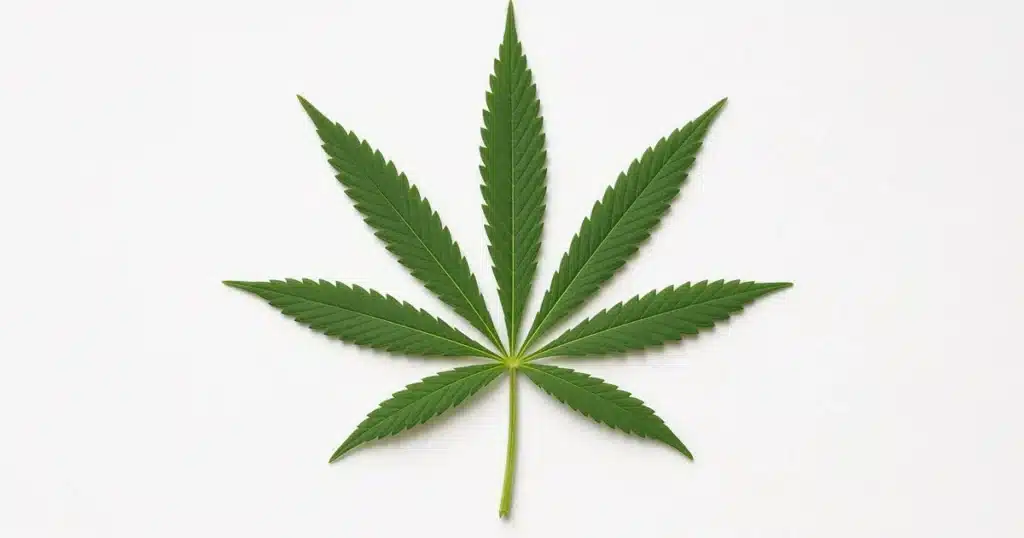
A cannabis leaf is a palmately compound leaf. Several narrow, saw-toothed leaflets spread like fingers from the tip of one stalk, called the petiole. Large fan leaves gather light for growth, while small sugar leaves grow inside the buds. Leaflet count is not fixed. It climbs from one blade on the first true leaves to as many as nine on mature fan leaves, then falls again as the plant flowers. Knowing the parts and that pattern makes it easier to read plant age, spot a phase change and trim with purpose.
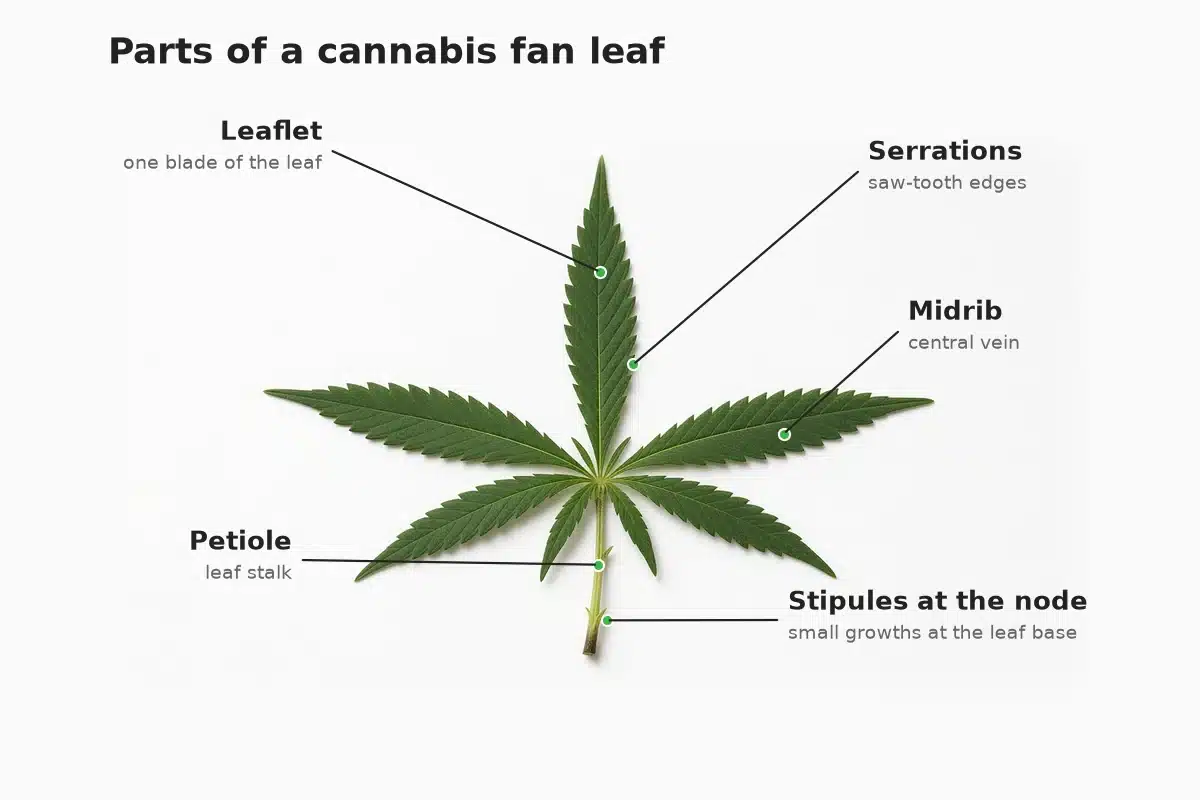
What are the parts of a cannabis leaf?
| Part | What it is | Typical size or count |
|---|---|---|
| Petiole | Stalk joining the leaf to the stem | 3 to 8 cm long |
| Leaflets | Narrow blades spreading from one point, without their own stalks | Usually 3 to 7, up to 11 |
| Single leaflet | One blade | 3 to 18 cm long, 0.3 to 3 cm wide |
| Margins | Coarsely toothed (serrated) edges | Varies by leaf |
| Midrib and veins | A central rib with side veins in each leaflet | Visible on every leaflet |
| Stipules | Small leaf-like flaps at the base of the petiole | Appear as the plant matures |
Sources: University of Florida IFAS Extension, Cannabis sativa Plant Identification (AG476), and Hesami et al., Plants, 2023.
University of Florida IFAS Extension gives the whole leaf as 5 to 18 cm long and 3 to 18 cm wide, with leaflets narrowly lanceolate to linear and tapering to long points at both ends. Most plant parts are covered in fine hairs. The stomata, the tiny pores that let water vapor out and CO2 in, sit in the leaf surface. For more on them, see what stomata are.
How do leaves change as the plant grows?
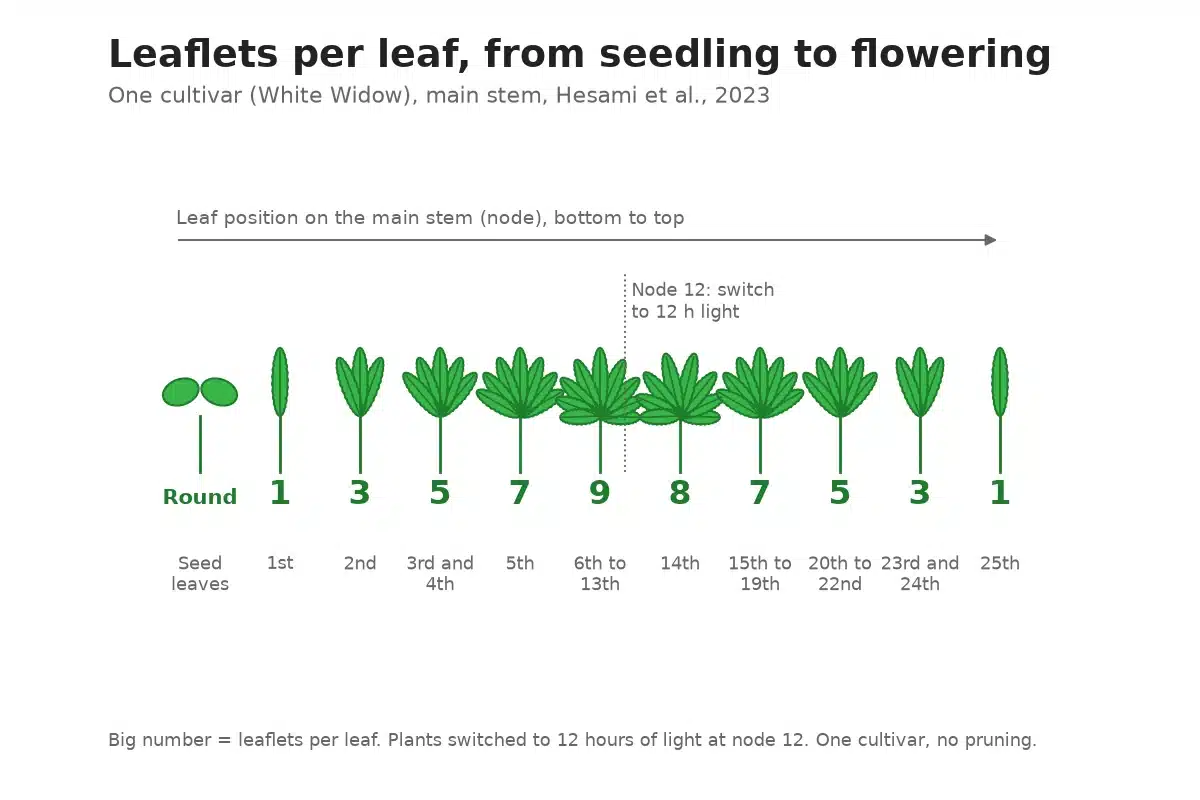
A University of Guelph team followed every leaf on the main stem of one cultivar, White Widow, from germination to harvest. Plants grew under 16 hours of light until node 12, then switched to 12 hours.
| Leaf (node) | Leaflets per leaf |
|---|---|
| Seed leaves (cotyledons) | Round, no serrations |
| 1st true leaves | 1 serrated leaflet |
| 2nd | 3 |
| 3rd and 4th | 5 |
| 5th | 7 |
| 6th to 13th | 9 |
| 14th | 8 |
| 15th to 19th | 7 |
| 20th to 22nd | 5 |
| 23rd and 24th | 3 |
| 25th | 1 |
Source: Hesami et al., Plants, 2023 (one cultivar under controlled conditions).
Leaf size followed the same arc. The center leaflet grew from about 39 mm long on the first true leaves to about 123 mm by leaf 13, then shrank to about 13 mm by leaf 25. Total leaf area peaked at leaf 12. Serrations followed too. The center leaflet carried about 22 teeth on the first true leaves, around 36 by leaf 14 and just 6 on leaf 25.
For the earliest stages, see the Kind Seed Co guides to cotyledons and first true leaves.
What leaf changes mark each growth stage?
Seedling. Round cotyledons open first, then pairs of single-bladed, serrated true leaves. Each new pair adds leaflets.
Juvenile. In the Guelph study, nodes 2 to 4 carried paired leaves with buds in the leaf joints, which the authors read as the juvenile phase.
Mature vegetative. Two small stipules appeared beside the base of the petiole at nodes 5 and 6. The authors treat this as the switch from juvenile to mature growth. Leaves reach their full leaflet count here.
Pre-flowers. At nodes 7 to 12, bracts and single flowers appeared at the nodes even under long days. Growers call these pre-flowers.
Phase change. Leaves grew in opposite pairs up to node 11. From node 12 they alternated, one leaf per node, staggered up the stem. That switch also lined up with the peak in leaf area.
Flowering. After the move to 12 hours of light, each new leaf had fewer, narrower leaflets. Inside the buds, the small branchlets carried single-leaflet leaves along with bracts and flowers.
Why do leaves get smaller once flowering starts?
The Guelph authors suggest a trade-off. Building flowers takes energy and nutrients, so the plant shifts resources from new leaf area toward buds. Leaf area per leaf fell sharply after its peak at leaf 12, and each later leaf had fewer and shorter leaflets.
The same shift shows up in plant height. Under 16 hours of light, the plants grew from about 4 cm as seedlings to about 81 cm by the twelfth true leaf. After the switch to 12 hours, they added only about 32 cm more, finishing near 114 cm. Stem growth slowed at the same time new leaves shrank.
That pattern is useful in practice. The biggest fan leaves on a flowering plant were mostly grown before the switch. They carry the plant through bloom, which is one reason heavy late defoliation can backfire. New leaves will not replace them at the same size.
Side shoots follow their own pattern. In the Guelph plants, the first node of each side shoot carried a pair of three-leaflet leaves, and every node after that carried pairs of five-leaflet leaves, all in opposite pairs. So a side branch tops out at fewer leaflets than the main stem, and its leaves are a poor guide to the plant’s age.
It helps to know how those plants were grown before comparing them with your own. They stayed on 16-hour days for 62 days, until their leaves switched on their own to the alternate pattern, and only then moved to 12 hours. The light delivered about 440 µmol/m²/s at canopy height, and no pruning, training or defoliation was done. Leaf area on the main stem grew more than tenfold from the first true leaves to its peak at leaf 12. A trained or heavily pruned plant will not follow the same counts exactly.
How do leaves relate to buds?
In the Guelph plants, the first true flowering clusters appeared at the top of the main stem 10 days after the light change, at node 15, and on side branches by day 15. Each bud is built from tightly packed small branchlets. Every branchlet repeats the same basic unit as the larger stem below it, with a single-leaflet leaf, a small side shoot, one or two flowers and bracts.
So sugar leaves are reduced leaves, cut down to one small blade and packed into the bud. That also explains why the bud’s leaves sit so close to the resin-heavy bracts.
What do leaves look like under the hand lens?
Close up, each leaflet shows a strong midrib with paired side veins running toward the teeth. The upper surface often looks darker and smoother than the paler underside. Fine hairs cover most of the plant. On sugar leaves and bracts late in flower, the glandular trichomes stand out as tiny stalks with round heads. The Guelph team found those heads grew larger and their stalks longer from week 2 to week 8 of flowering.
What are fan leaves and sugar leaves?
Fan leaves are the big, many-leaflet leaves on petioles that catch most of the light. They are the leaves the counts above describe at their peak.
Sugar leaves are the small, often single-bladed leaves that grow out of the buds. The Guelph team found resin glands (glandular trichomes) packed most densely on the underside of the bracts around each flower, and their density rose from week 2 to week 8 of flowering. Sugar leaves sit right beside those bracts, which is why they look frosted. Many growers trim fan leaves away first and clip sugar leaves close to the bud at harvest.
Why do leaflet shapes differ between plants?
Leaflet width, length and count vary with genetics, age and growing conditions. In the Guelph data, the length-to-width ratio of the center leaflet rose from about 2 on the first leaves to about 5.5 by leaf 15, so the same plant moves from broad, short blades to long, slim ones as it ages. Wide leaflets are often linked with indica-type plants and narrow ones with sativa-type plants, but because one plant shifts so much on its own, leaf shape alone is a weak guide.
How do you read and use leaf anatomy, step by step?
- Pick the youngest fully opened leaf at the top of the main stem. That is the leaf researchers measure.
- Count its leaflets and note whether leaves at that node come in pairs or one at a time.
- Check the base of the petiole for small stipules, a sign of mature growth.
- Look in the leaf joints for single pre-flowers.
- Compare with earlier notes. Rising counts mean the plant is still building, while falling counts and alternate leaves point to the shift toward flowering.
- When trimming, remove large fan leaves with clean snips at the petiole, and trim sugar leaves close to the bud at harvest.
What leaf changes worry growers, and what do they mean?
| What you see | Common meaning | What to do |
|---|---|---|
| An 8-leaflet or other odd count | Normal transition leaf, seen at node 14 in the Guelph study | Nothing |
| Leaves switch from pairs to alternate | Normal phase change as plants mature | Note the date as a growth marker |
| New leaves have fewer leaflets in flower | Normal, the plant is putting effort into buds | Nothing |
| Paired, simpler leaves returning on an older plant | Juvenile-type regrowth, which research links with opposite leaf pairs coming back | Watch new growth and check plant history |
| Uneven or twisted leaflets on one leaf | Often genetic or a one-off growth quirk | Watch new growth before acting |
Based on Hesami et al., 2023 and common grower practice.
What are common mistakes?
- Judging plant type from one leaf, when a single plant changes leaflet shape so much with age.
- Mistaking fewer leaflets in flower for a problem.
- Treating an 8-leaflet leaf as a defect.
- Stripping too many fan leaves at once, which removes the main light-gathering surface.
- Confusing stipules or pre-flowers at the nodes with damage.
To compare plants over time, photograph one mature fan leaf from each plant at the same node.
Sources
- University of Florida IFAS Extension. Cannabis sativa Plant Identification and Its Look-Alikes (SS-AGR-480/AG476). https://ask.ifas.ufl.edu/publication/AG476
- Hesami M, Pepe M, Jones AMP. Morphological Characterization of Cannabis sativa L. Throughout Its Complete Life Cycle. Plants. 2023;12(20):3646. https://www.mdpi.com/2223-7747/12/20/3646
- Open copy of Hesami et al. used to verify figures (the MDPI page blocks automated access): https://pmc.ncbi.nlm.nih.gov/articles/PMC10610221/
FAQ
How many leaflets does a cannabis leaf have?
It changes with age. First true leaves have one blade. In one study, leaves reached nine leaflets by the sixth node, then dropped back toward one in flower. University of Florida IFAS lists 3 to 7 leaflets as usual, with up to 11 possible, so there is no single correct count.
What is the difference between fan leaves and sugar leaves?
Fan leaves are large leaves on stalks that gather light for growth. Sugar leaves are small leaves that grow out of the buds and are often coated in resin. Fan leaves are usually removed before or during harvest, while sugar leaves are trimmed close to the bud.
Can you tell indica from sativa by the leaf?
Wide leaflets are often linked with indica-type plants and narrow leaflets with sativa-type plants. But research shows one plant's leaflets grow longer and slimmer as it ages, and many modern plants are hybrids. Treat leaf width as one clue among several, alongside growth habit and flowering time.
Why do cannabis leaves have serrated edges?
Serrated edges are a normal trait of cannabis leaflets and help make the leaf easy to recognize. The seed leaves are smooth, and teeth appear on the first true leaves. In one study, the center leaflet's tooth count peaked mid-season before falling on the small leaves near the buds.


