Magnesium Deficiency in Cannabis Plants
Magnesium is one of the nutrients cannabis needs in fairly large amounts, and a shortage is one of the more common problems in home grows, especially in coco, sandy soils and heavy flowering plants. The good news is that it is usually easy to spot and easy to correct once you know what you are looking at. Below, you will find what magnesium does, how a shortage looks, what causes it, and a step by step fix. It draws on Mississippi State University Extension, South Dakota State University Extension and University of Delaware Cooperative Extension. Those guides cover tomatoes, ornamentals and field crops, not cannabis, so we apply their nutrient basics with care. Before you grow, check your state’s home grow law.
Why magnesium matters
Mississippi State University Extension explains that “magnesium is the central atom amid four nitrogen atoms in the chlorophyll molecule, so it is involved in photosynthesis.” It also “serves as an activator for many enzymes required in plant growth processes.” No magnesium, no healthy green leaves.
MSU also notes that magnesium “is mobile in plants, moving from the older to the younger leaves.” That one fact explains where symptoms show up first.
Signs of magnesium deficiency
Because magnesium is mobile, the plant pulls it out of older leaves to feed new growth. University of Delaware Cooperative Extension puts it simply: “symptoms of N, P, K, and Mg deficiencies will manifest in the old growth because they are mobile.”
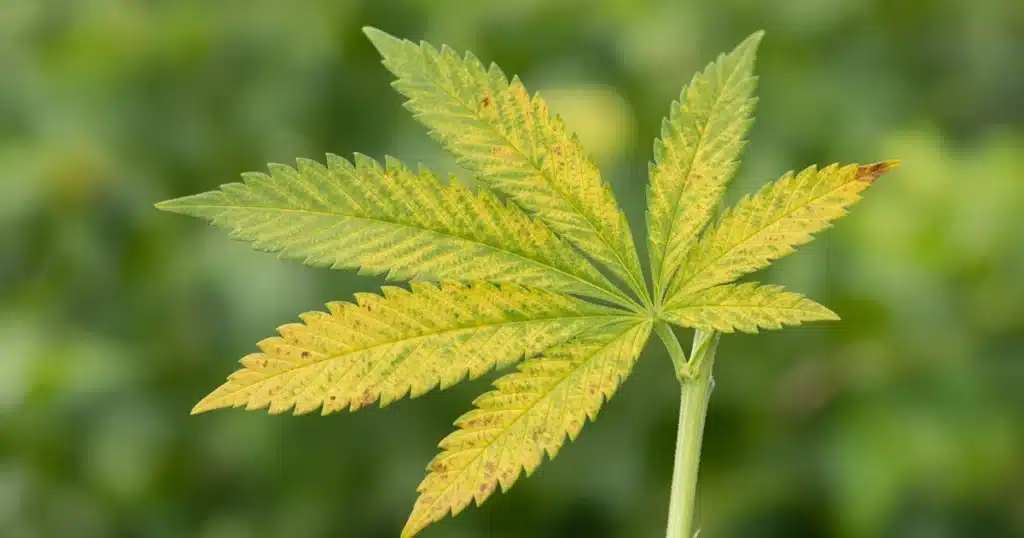
South Dakota State University Extension describes the classic pattern: “deficiency symptoms consist of interveinal chlorosis (leaf veins stay green while the regions between them turn yellow).” It adds that “interveinal chlorosis can lead to necrosis (death of tissue) of the affected areas,” and in tomatoes “advanced magnesium deficiency leads to purpling of the affected areas.”
On cannabis, look for:
- Yellowing between the veins on lower and middle leaves while the veins stay green.
- Rusty brown spots or crispy patches as it gets worse.
- Leaf edges that may curl upward.
- Symptoms that move up the plant over time.
SDSU notes that in high tunnel tomatoes, symptoms normally show up in the middle of the season on plants carrying a heavy fruit load. Growers commonly report a similar pattern in flowering cannabis, likely from heavy demand, but that is grower inference rather than a tested finding.
What causes it
| Cause | Why it happens |
|---|---|
| Low pH in the root zone | UDel notes that when soil is too acidic, K, Ca and Mg “may exist in a chemical form that plant roots cannot absorb.” |
| Too much potassium | SDSU says “excessive levels of potassium can also induce magnesium deficiency.” |
| Sandy or leached media | SDSU: “common in sandy soils that are easily leached.” MSU notes magnesium “leaches from the soil like calcium and potassium.” |
| Coco or soft water | Common grower experience. Coco and very soft or RO water carry little magnesium unless you add it. |
| Root problems | Damaged or rotting roots cannot take up nutrients well. |
How to fix magnesium deficiency: step by step
- Confirm the pattern. Check that yellowing starts on older leaves and sits between green veins. If new leaves at the top are yellow first, it is likely a different problem.
- Check runoff pH. Many soil growers aim for roughly 6.0 to 7.0 and many coco growers for roughly 5.8 to 6.2. These ranges are common grower practice. Correct pH before adding anything.
- Look at your potassium. Heavy bloom boosters high in potassium can block magnesium. Ease back if you have been pushing them.
- Add a magnesium source. SDSU states that “the most common method of correcting magnesium deficiency is applying Epsom salts (magnesium sulfate).” It also advises against applying Epsom salt unless you actually see magnesium deficiency symptoms.
- Use a gentle rate. SDSU gives a field drench rate to “dissolve 1 to 2 pounds in 100 gallons of water.” Field rates do not translate neatly to small containers, so follow the label on your Epsom salt or cal mag product and start at the low end.
- Do not mix blindly. SDSU advises, “Do not mix Epsom salts with another water-soluble fertilizer.” Apply it with plain water or follow your nutrient maker’s directions.
- Watch new growth. Damaged leaves usually will not turn green again. Judge success by whether new leaves stay healthy over the next week or two.
- Keep notes. Record what you changed and when, so you know what worked.
Foliar sprays
Some growers spray a weak Epsom salt solution on leaves for a quicker effect. The Extension guidance we used focuses on soil and drip application, so think of foliar spraying as grower practice rather than a tested method. Strong sprays can burn leaves. If you try it, use a very dilute mix, spray only in veg or very early flower, never on developing buds, and spray when lights are off or low to reduce burn. Wear gloves and eye protection when mixing.
Magnesium, calcium and potassium balance
Magnesium does not act alone. Calcium, magnesium and potassium are all positively charged nutrients, and roots take them up in competition with each other. That is why SDSU flags excess potassium as a cause, and why many nutrient lines sell calcium and magnesium together. If you add a lot of one, you can push the others out of balance. A steady, balanced feed is usually better than big doses of any single nutrient.
How fast will it improve?
Once pH and supply are right, new growth should start to look healthier, though timing varies with the plant, its stage and the medium. Older leaves that already yellowed or spotted usually will not recover, and you can remove the worst of them if they are dying. In late flower, there is little time for recovery, so focus on keeping the rest of the plant healthy rather than chasing perfect leaves.
How to prevent it
- Keep root zone pH in range.
- Use a balanced nutrient line, or a cal mag supplement if you grow in coco or use RO water.
- Avoid heavy potassium bloom boosters.
- For outdoor beds, get a soil test. Mississippi State notes that “dolomitic lime can address magnesium deficiency in soil when lime is required.”
Troubleshooting
Yellowing is between veins, but on the newest leaves. That points to an immobile nutrient such as iron, not magnesium. UDel lists Fe, Mn and Zn among nutrients that show in new growth. See our 8 deficiencies guide.
I added Epsom salt and nothing changed. Check pH again. If pH is off, much of the magnesium you add may stay out of reach of the roots.
Leaves got worse after adding it. You may have overdone it or caused salt build up. In containers with good drainage, water to light runoff with plain, pH adjusted water, then start again at a lower rate. In beds or slow draining mixes, skip the flush and pause feeding for a while instead.
Lower leaves yellowing late in flower. Some fading is normal as harvest nears. Do not chase it with heavy feeding in the final weeks.
Spots look brown and spreading with a ring. That may be a leaf disease, not a deficiency. Remove affected leaves, bag them and throw them away, and improve airflow.
Related guides
See our guides to phosphorus deficiency and feeding cannabis in soil.
Sources
- Mississippi State University Extension, Calcium and Magnesium in Mississippi Crop Production. https://extension.msstate.edu/publications/calcium-and-magnesium-mississippi-crop-production (opened 2026-10-16)
- University of Delaware Cooperative Extension, Identifying Nutrient Deficiencies in Ornamental Plants. https://www.udel.edu/academics/colleges/canr/cooperative-extension/fact-sheets/identifying-nutrient-deficiencies-in-ornamental-plants/ (opened 2026-10-16)
- South Dakota State University Extension, Monitoring and Correcting Magnesium Deficiency in High Tunnels. https://extension.sdstate.edu/monitoring-and-correcting-magnesium-deficiency-high-tunnels (opened 2026-10-16)
FAQ
What does magnesium deficiency look like in cannabis?
It usually starts on older, lower leaves as yellowing between the veins while the veins stay green. As it worsens, rusty brown spots and crispy patches can appear and move up the plant.
Why does magnesium deficiency start on older leaves?
Magnesium is mobile in the plant. When supply runs short, the plant moves it from older leaves to new growth, so older leaves show symptoms first.
Can I use Epsom salt for cannabis?
Epsom salt is magnesium sulfate, and Extension guides name it as the most common way to correct a magnesium shortage. Use it only when you see symptoms, and start at a low rate.
Can pH cause magnesium deficiency?
Yes. When the root zone is too acidic, magnesium can be present but in a form roots cannot absorb. Check and correct pH before adding more magnesium.
Will yellow leaves turn green again?
Usually not. Damaged leaves tend to stay damaged. Judge your fix by whether new growth stays healthy over the next week or so.