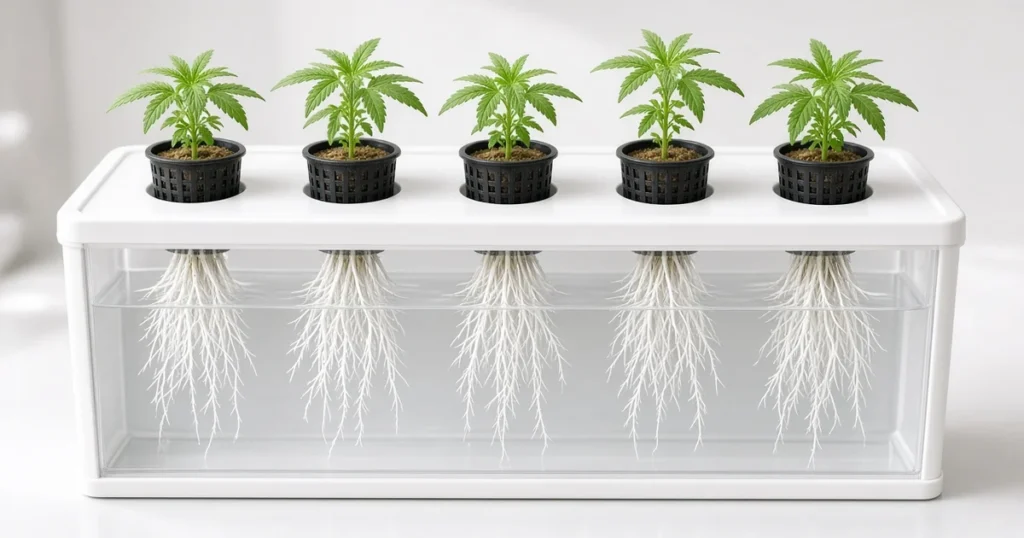
Hydroponic Cannabis Feeding Schedule

Hydroponic cannabis feeding is less about a single magic chart and more about matching strength, ratio, and pH to the plant’s stage while watching how the crop actually responds. Recirculating reservoirs, drain-to-waste runs, coco coir, rockwool, and deep-water culture all behave differently. Treat any schedule as a starting framework, not a guarantee.
Kind Seed Co is a seed reseller and grow-education publisher, not a fertilizer brand or breeding house. Always follow your nutrient label and local cultivation rules. Preferences and results vary by system, water quality, and genetics.
What “feeding schedule” means in hydro

In soil, microbes and media buffer mistakes. In hydro and soilless media, the plant drinks what you mix. A useful schedule usually covers:
- Stage targets (seedling / early veg / late veg / early flower / late flower)
- Solution strength (EC or PPM, know which scale your meter uses)
- pH window for the system you run
- Reservoir change or top-off habits
- When to ease off or pause heavy feeding before harvest
There is no universal “perfect” EC for every cultivar. Autos, photoperiods, and heavy feeders differ. Start conservative, then step up if leaves stay a healthy color and runoff or reservoir readings stay stable.
Stage-by-stage framework (educational ranges)
These are optional educational starting ranges, not lab-proven optima for every setup. Convert carefully if your meter reads 500-scale PPM vs 700-scale PPM.
Seedlings and early rooted cuttings
- Very mild solution or plain pH’d water at first, depending on media charge
- Gentle light and stable root-zone temperature matter as much as nutrients
- Watch for tip burn. Young roots punish strong mixes quickly
Vegetative growth
- Increase nitrogen-forward complete base nutrients as growth accelerates
- A moderate EC band is a common place to land once plants are established. Raise slowly and watch leaf response
- Maintain consistent pH. Wild swings lock out nutrients even when the bottle schedule looks right
- Keep an eye on calcium and magnesium demand under strong LED lighting
Transition and early flower
- Shift toward bloom formulas as stretch begins (photoperiods on a 12/12 flip, autos on their own clock)
- Do not slam strength overnight. Step changes reduce stress
- Support with calcium/magnesium as flowers set if your water is soft or RO-based
Mid to late flower
- Continue bloom-focused feeding while monitoring leaf fade and tip health
- Some growers reduce nitrogen relative to bloom elements. Follow label ratios rather than internet extremes
- Late flower often means holding or gently lowering strength so plants can finish cleanly. Flush debates exist. Prioritize healthy plants and lawful local practice over dogma
If you start from feminized seeds or autoflower seeds, the same hydro logic applies: genetics set appetite, your meter and leaves confirm it.
pH, EC, and water quality
pH influences what the plant can take up. Hydro and coco growers commonly aim for slightly acidic solution ranges suited to soilless culture, soil growers often run differently. Check your media and nutrient brand guidance.
EC/PPM tells you how concentrated the mix is, not whether the ratio is correct. A high EC with the wrong balance still causes problems.
Source water matters. Hard water already carries minerals. RO water may need calcium and magnesium added. Test or at least know your baseline before copying someone else’s schedule.
Reservoir habits that keep schedules honest
- Mix nutrients in the order the manufacturer recommends.
- Measure EC/PPM after the full mix, then adjust pH.
- Top off with pH’d water between changes if the reservoir drops, concentrated leftovers drift.
- Change reservoirs on a cadence that matches your system size, plant count, and how dirty the solution gets, stagnant, warm reservoirs invite trouble.
- Keep root-zone temperatures in a sensible band, hot reservoirs lose dissolved oxygen and stress roots.
- Clean lines, pumps, and buckets between cycles to limit biofilm.
Drain-to-waste growers read runoff, recirculating growers watch reservoir EC drift (plants often pull water faster than salts, so EC can rise). Adjust based on what you measure.
Reading the plant instead of worshipping the chart

- Pale new growth with otherwise healthy roots may need more feed, or better pH.
- Burned tips and clawing often mean too strong or uneven uptake.
- Interveinal yellowing patterns can point to specific elements, confirm with context, not one Instagram post.
- Slow growth under weak light will not be fixed by heavier bottles.
A feeding schedule is a plan. Leaves, roots, and meter logs are the feedback loop.
Common hydro schedule mistakes
- Jumping to “max bottle” rates in week one of flower
- Ignoring different meter scales when copying PPM numbers
- Letting pH wander for days without checking
- Overcomplicating with too many additives before the base feed is stable
- Assuming every cultivar from a pack wants the same EC
For broader grow reading, browse the seed bank blog.
FAQ
Do autoflowers need a different hydro schedule than photoperiods?
Often yes in timing, not always in chemistry. Autos flower on age, so you move through stages on a shorter calendar. Keeping strength moderate and avoiding harsh late swings is a practical habit. Still watch the plant.
Should I flush in hydro before harvest?
Practices differ. Some run lower EC or plain pH’d water near the end, others taper feed. Focus on healthy plants, clean equipment, and whatever your local rules and product goals allow. There is no single proof that one ritual always improves every harvest.
Can I use the same schedule in coco and DWC?
Base ideas transfer, but irrigation frequency, oxygen, and salt management differ. Coco is usually fertigated often with runoff. DWC keeps roots in oxygenated solution. Adapt rather than copy-paste.
What if my EC rises every day in a recirculating reservoir?
Plants may be drinking more water than nutrients, concentrating the solution. Top with plain pH’d water and remonitor. Large jumps can signal imbalance or environmental stress, inspect roots and temperature too.
Is a printed weekly chart enough?
It is a starting map. Water quality, light intensity, pot size, and genetics will push you off the printed line. Log what you mixed and what the plant did.
Bottom line
A hydroponic cannabis feeding schedule works when it is stage-aware, meter-checked, and plant-corrected. Start mild, stabilize pH, know your water, and change strength in small steps based on leaf posture, EC drift, and runoff, not a bottle promise. Results still depend on your room, your water, and your attention.