PGR Weed: 7 Things to Look For
“PGR weed” is slang for cannabis grown with synthetic plant growth regulators, chemicals that change how a plant grows. Growers and buyers talk about PGR buds as dense, rock hard and often low on smell. This guide explains what plant growth regulators are under US law, why they are a concern in cannabis, the signs people look for, and how home growers can keep them out of their garden. It draws on the federal pesticide law (FIFRA) and US EPA guidance. We do not make health claims. Before you grow, check your state’s home grow law.
What a plant growth regulator is
Under federal law, a plant growth regulator is a type of pesticide. The FIFRA definitions, posted by Cornell Law School, define a plant regulator as “any substance or mixture of substances intended, through physiological action, for accelerating or retarding the rate of growth or rate of maturation, or for otherwise altering the behavior of plants or the produce thereof.” The same definition excludes plant nutrients, trace elements, plant inoculants and soil amendments.
EPA’s Label Review Manual says that “although ‘plant regulator’ is the term defined in FIFRA, the term ‘plant growth regulator’ is commonly used interchangeably with it.” It adds that “plant hormones and many other growth-promoting and growth-inhibiting substances, such as auxins, cytokinins, and gibberellins have no other uses except as plant regulators.”
In plain terms: if a product claims to change how a plant grows beyond simple feeding, it may legally be a pesticide that needs EPA registration and must be used exactly as the label says.
Why PGRs are a concern in cannabis
Some PGRs are used legally on other crops and ornamentals to keep plants compact. Concern in cannabis comes from products that promise “rock hard buds” or “explosive bloom” without naming their active ingredients. EPA has published draft guidance to clarify “which biostimulants, biological substances, and mixtures, in addition to the associated product label claims, EPA considers plant regulators,” and those “are subject to regulation under the Federal Insecticide, Fungicide and Rodenticide Act (FIFRA) as pesticides.” Unless an exemption applies, EPA’s Pesticide Registration Manual explains that FIFRA “requires that a registration be obtained from EPA before any person in any state or foreign country can sell or distribute any pesticide in the United States.” A product sold with growth claims but no EPA registration number is one home growers should avoid.
7 things people look for in PGR weed
These are anecdotal signs that buyers and growers commonly describe, not tested criteria. None of them proves PGR use on its own, and only a lab test can confirm it.
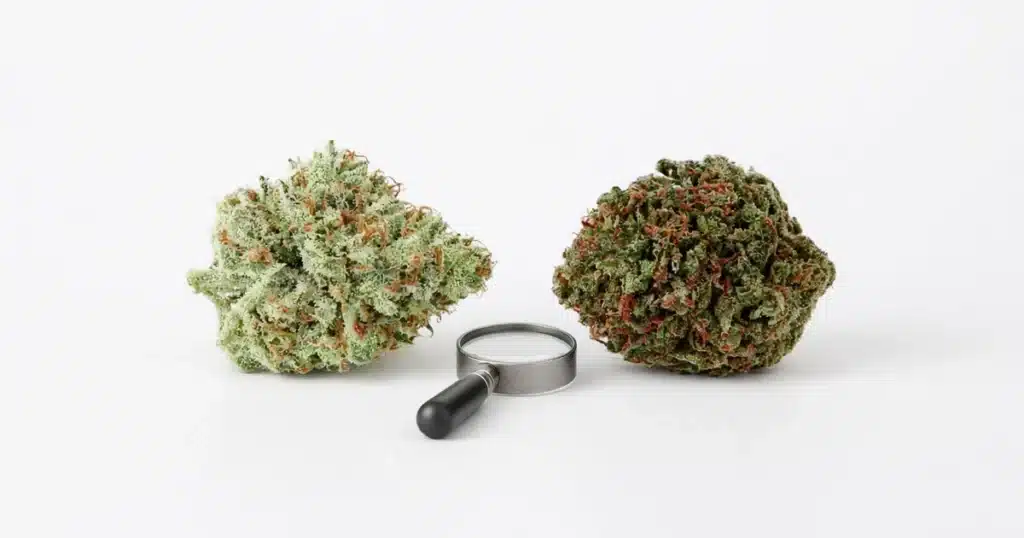
- Unusually dense, rock hard buds. Buds that feel almost solid rather than slightly springy.
- Few visible trichomes. Buds that look less frosty than you would expect for the strain.
- Weak or flat aroma. Little smell even when the bud is broken open.
- Lots of dark, curly pistils. Buds covered in brown or red hairs.
- Oddly compact structure. Very short spacing between bud sites, often with a bulky, uniform shape.
- Harsh smoke or poor burn. Commonly reported, but also caused by poor drying or old flower.
- Labels with vague growth claims. For home growers, the biggest sign is the bottle itself: big bloom claims with no clear ingredient list.
Many of these traits also come from genetics, heat, overfeeding or a bad dry, so see them as reasons to ask questions, not proof.
How to keep PGRs out of your grow: step by step
- Read every label. Look for a full ingredient list and an EPA registration number on any product that claims to change growth.
- Be wary of bloom boosters with hormone claims. Words like “hardens buds,” “stacks nodes” or “stops stretch” may be treated as plant regulator claims under EPA’s definitions.
- Choose plain nutrients. Products that only list nutrients (nitrogen, phosphorus, potassium and trace elements) are fertilizers, not plant regulators.
- Follow pesticide labels exactly. If you use any registered product, the label is the law: follow crop, rate and timing directions, and do not use it on crops it does not list. Few labels list cannabis at all: the Minnesota Department of Agriculture notes that there are no EPA registered pesticide products approved for use on cannabis, and state rules decide which products, if any, may be used on it. Check with your state’s pesticide agency first.
- Wear the protective gear the label requires. That often means gloves and eye protection, and sometimes a mask.
- Control size with training instead. Topping, bending, screens and choosing compact genetics manage height without chemicals.
- Keep good records. Note every product you add, the date and the amount.
What a registered pesticide label looks like
A registered product carries an EPA registration number (often shown as “EPA Reg. No.”), a list of active ingredients with percentages, directions for use, the crops or sites it may be used on, and precautionary statements. EPA notes that every pesticide label carries the statement “It is a violation of Federal law to use this product in a manner inconsistent with its labeling.” If a product makes growth or pest claims but shows none of this, be cautious.
How to look up a product before you buy
EPA’s Pesticide Product Label System (PPLS) lets you search by product name, active ingredient, company name or EPA registration number, and EPA says it has converted “over 170,000 current and historical labels” to searchable PDF files. Type in the EPA Reg. No. from the bottle and compare the label on file with the one in your hand. If nothing comes up, or the two do not match, do not use the product.
Who regulates PGRs in your state
EPA registers pesticides at the federal level, but that is not the whole picture. EPA’s registration manual states that “the registration and use of pesticides are not only regulated by federal laws, but also by state laws and regulations, which differ from state to state.” In most states the lead pesticide agency is the department of agriculture. Rules for cannabis vary a lot. California’s Department of Pesticide Regulation states that “no pesticide product is federally registered for use on cannabis” and allows only products that meet set criteria. Minnesota’s Department of Agriculture explains that most registered products “can only be used on specific crops/sites listed on the label.” If you are unsure whether a product is allowed where you live, ask your state pesticide agency before you use it.
Safer ways to get dense, healthy buds
Bud density comes mostly from genetics, good light, steady temperatures and a careful dry. Our guides on ScrOG training, light intensity in flowering and controlling plant height cover methods that need no growth regulators.
Troubleshooting
My buds are hard and smell weak, but I used no PGRs. Look at drying and storage first. Fast, hot drying and warm storage reduce aroma. Genetics also play a big role.
A nutrient I used promises harder buds. Check the label for an ingredient list and EPA registration. If it has neither, stop using it and keep notes on what you applied.
I want shorter plants. Train early, use a screen, choose compact or autoflowering genetics, and keep lights at a suitable distance.
I bought flower I suspect is PGR. Only a lab test can confirm it. In some state licensed markets, products come with lab testing information, but requirements vary by state. Ask the seller where possible.
Related reading
For general feeding, see our soil feeding schedule. For safe pest control, see our guide to natural pest repellents.
Sources
- Cornell Law School LII, 7 U.S. Code § 136 (FIFRA definitions). https://www.law.cornell.edu/uscode/text/7/136 (opened 2026-10-16)
- U.S. EPA, Label Review Manual Chapter 2: What is a Pesticide?. https://www.epa.gov/sites/default/files/2021-01/documents/lrm_chapter2_final.pdf (opened 2026-10-16)
- U.S. EPA, Introduction to Pesticide Labels. https://www.epa.gov/pesticide-labels/introduction-pesticide-labels (opened 2026-10-16)
- U.S. EPA, Pesticide Registration Manual Chapter 1. https://www.epa.gov/pesticide-registration/pesticide-registration-manual-chapter-1-overview-requirements-pesticide (opened 2026-10-16)
- U.S. EPA, Pesticide Product Label System (PPLS): More Information. https://www.epa.gov/pesticide-labels/pesticide-product-label-system-ppls-more-information (opened 2026-10-16)
- Minnesota Department of Agriculture, Registered Pesticides for Use on Cannabis. https://www.mda.state.mn.us/registered-pesticides-use-cannabis (opened 2026-10-16)
- California Department of Pesticide Regulation, Cannabis Cultivation. https://www.cdpr.ca.gov/cannabis-cultivation/ (opened 2026-10-16)
- U.S. EPA, Draft Guidance for Plant Regulators and Claims, Including Plant Biostimulants. https://www.epa.gov/pesticides/draft-guidance-plant-regulators-and-claims-including-plant-biostimulants (opened 2026-10-16)
FAQ
What is PGR weed?
PGR weed is slang for cannabis grown with synthetic plant growth regulators. Buyers describe it as very dense, hard buds with few visible trichomes and weak smell, though only a lab test can confirm it.
Are plant growth regulators pesticides?
Under federal law, yes. FIFRA defines a plant regulator as a substance meant to speed up, slow down or otherwise change plant growth, and EPA treats plant regulators as pesticides that generally need registration unless an exemption applies.
Can you tell PGR weed by looking at it?
Not for certain. Dense buds, weak aroma and dark pistils are common signs, but genetics, heat and poor drying can cause the same traits.
Are bloom boosters PGRs?
Not always. A product that only supplies nutrients is a fertilizer. A product that claims to harden buds or stop stretch may be making plant regulator claims. Check the ingredient list and label.
How do I control plant height without PGRs?
Use training such as topping and bending, a screen, compact genetics and proper light distance. These shape plants without chemicals.