
Weed Trimming Jobs Humboldt: What the Work Is Really Like
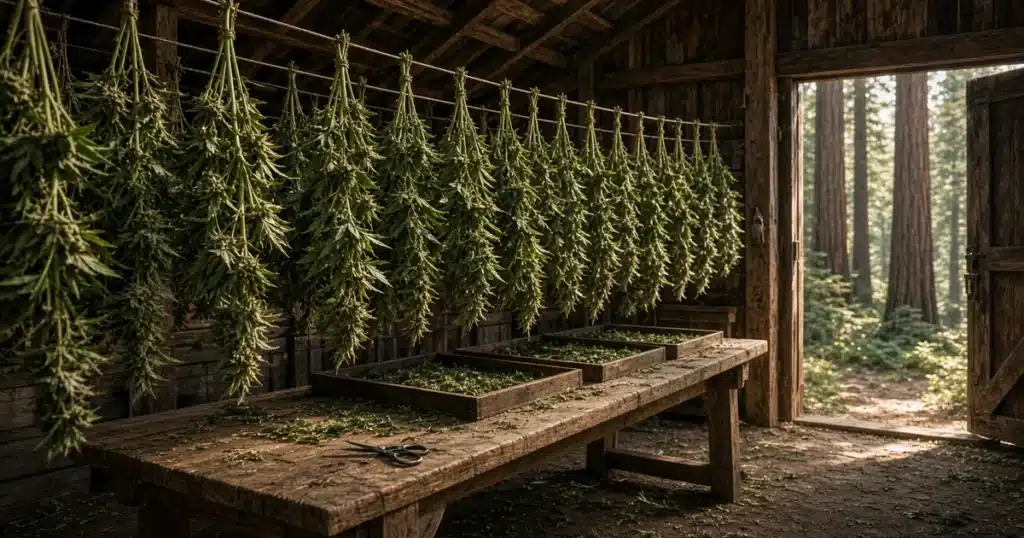
Quick answer: Weed trimming jobs in Humboldt are seasonal jobs that follow the fall harvest. Trimmers sit at a table and clip leaves from harvested cannabis flowers by hand, often for long days. Research from Humboldt State University describes the work as boring and tedious. Before you take a job, get the terms in writing, and ask where you will work and stay.
What Do Trimmers Actually Do?
After cannabis is harvested, the flowers are covered in small leaves. Trimmers remove those leaves with small scissors so the finished flower looks clean and even. The work is careful and repetitive. You hold a branch or a single flower in one hand and clip with the other, turning the flower as you go.
The part trimmers protect is the resin. Utah State University Extension notes that CBD is produced in trichomes, tiny structures that occur in the highest density on unpollinated female flowers. Good trimmers handle flowers gently and clip without crushing them.
Most trimming happens in one of two ways. In wet trimming, leaves are removed soon after the plants are cut. In dry trimming, branches are hung to dry first and trimmed later. A crew may do either, depending on the farm. For the technique itself, our guide on how to trim cannabis flowers walks through each step.
Why Humboldt Became a Trimming Hub
Humboldt County sits in what researchers call California’s Emerald Triangle. A 2016 profile by Fred Krissman of Humboldt State University’s anthropology department and the Humboldt Institute for Interdisciplinary Marijuana Research describes so-called “trimmigrants” who travel to the region for the fall harvest. The author calls his profile provisional and based on limited first-hand research, so read it as an early snapshot, not a full survey.
The university has studied the local industry for years. According to Cal Poly Humboldt, the Humboldt Institute for Interdisciplinary Marijuana Research was established in 2012 as “the first academic research institute devoted to cannabis research.” Its stated purpose is “analysis, not advocacy.”
For the wider story of how cannabis growing spread across the continent, see our article on cannabis culture and history in North America.
When Is Trimming Season?
Trimming follows harvest. Utah State University Extension explains that cannabis is a short day plant that starts to flower when day and night lengths are about equal, so outdoor plants in the region finish in the fall. That is why the Krissman profile ties seasonal trimming work to the fall harvest.
Exact start dates move with the weather and with each farm’s plants. A grower decides when to cut by checking the flowers, as our guide to telling when cannabis is ready for harvest explains. Once the cutting starts, trimmers are needed.
How to Read a Trimming Job Listing
Listings can often be short and vague. Look for these details before you reply.
- Who the employer is. A business name you can look up is better than a first name and a phone number.
- Where the work is. A town or a general area tells you how far you will travel.
- Wet or dry trim. This tells you what kind of work and pace to expect.
- How work is counted. Some listings describe hourly work and some describe work counted by weight. Ask which one applies and how it is measured.
- Hours and length of the job. Look for daily hours and how many weeks the job is expected to last.
- Housing and food. Check whether housing is offered or whether you need to find your own.
- Tools. Check whether scissors, trays and gloves are provided.
If a listing leaves out most of these, ask before you travel. Vague terms are a good reason to slow down.
How to Judge a Trimming Job Offer
- Get the terms in writing. Ask for how the work is paid, the hours, the start date and the expected length of the job in a message or document.
- Ask about hours and breaks. Know how long a normal day is and when breaks happen.
- Ask where you will work and stay. Find out the location of the trim room and whether housing is part of the deal.
- Ask how quality is checked. Most crews have a standard for how clean each flower must be. Ask to see an example.
- Bring your own personal gear. Pack what you need for long days at a table, listed in the FAQ below.
- Talk to people who trimmed there before. Past trimmers can tell you how the job really runs.
- Check your state and local rules before you start.
- Walk away from unclear offers. If the answers stay vague, keep looking.
Troubleshooting
Your pace is slow in the first week. Speed comes with practice. Focus on clean cuts first and let speed build day by day.
Scissors keep gumming up. Resin builds up on blades. Keep a second pair ready and a cleaning cloth nearby. Our list of harvesting tools every home grower needs covers the basics.
Your table setup feels awkward over a long day. Adjust your chair so your tray sits at a comfortable height, keep your elbows close and rest your forearms on the table edge. Stand and stretch at each break.
Trim and finished flowers get mixed up. Use separate containers for finished flowers, trimmed leaves and waste, and keep them in the same spot every day.
You lose track of the day. Long shifts can blur together. Set a timer for breaks and drink water at each one.
The job does not match the listing. Compare what you were told with what you find. If the terms change, ask again and decide whether to stay.
Sources
- Cal Poly Humboldt, Humboldt NOW, Cannabis Research Connects Many Disciplines: https://now.humboldt.edu/news/cannabis-research-connects-many-disciplines
- Fred Krissman, Humboldt State University and HIIMR, America’s Largest Cannabis Labor Market: A Provisional Profile and Proposal for New Research (2016, PDF): https://www.humboldt.edu/sites/default/files/hiimr/2024-10/mjlabormarket.pdf
- Utah State University Extension, Ten Frequently Asked Questions About Growing Cannabis: https://extension.usu.edu/crops/research/ten-frequently-asked-questions-about-growing-cannabis
FAQ
What does a weed trimming job involve day to day?
Most of the day is spent at a table clipping small leaves from harvested cannabis flowers with scissors. You turn each flower, trim it clean and place it in a container. Research from Humboldt State University describes trimming as boring and tedious, so expect repetitive work and long stretches of focus.
When is trimming season in Humboldt County?
Trimming season follows the fall harvest. A 2016 Humboldt State University profile describes seasonal workers traveling to the Emerald Triangle for the fall harvest. Exact dates change each year with the weather and with when each farm decides to cut.
Do you need experience for weed trimming jobs in Humboldt?
Not always. Some crews train new trimmers, and others want people who already trim cleanly. If you have trimmed your own plants at home, say so. Either way, ask the employer what they expect and how they check quality.
What should you bring to a Humboldt trimming job?
Bring comfortable clothes you do not mind getting sticky, a hair tie or cap, a refillable water bottle, snacks and layers for a cool room. Ask whether scissors and gloves are provided, and bring your own pair if they are not.
What should you ask before accepting a trimming job in Humboldt?
Ask how the work is paid and measured, the daily hours and breaks, the start date and expected length of the job, where the work takes place and whether housing is offered. Ask for the terms in writing and keep a copy.


