Wet to Dry Weight: How Much Cannabis Shrinks
Quick answer: Expect dried buds to weigh roughly a quarter to a third of their fresh weight. Oregon State says fresh hemp tissue is 70 to 80 percent water, and Missouri’s drying target is 10 to 12 percent moisture. Working from those figures, dry buds come out at about 22 to 34 percent of wet weight, a loss of about two thirds to three quarters. That range is our estimate from Extension numbers, not a measured cannabis ratio, so your plants may land outside it.
How Much Weight Does Cannabis Lose When It Dries?
Most of the weight of a fresh bud is water, and drying removes most of it. UVM Ag Engineering defines moisture content as the share of a plant’s weight that is water, which is the figure all the numbers below use. It adds that drying lowers water activity, a measure of how much water is actually available in the product, and that lower water activity makes it harder for spoilage organisms to survive.
Oregon State University Extension says fresh hemp tissue contains 70 to 80 percent water. The University of Missouri Extension says to dry CBD hemp to 10 to 12 percent moisture within 48 hours. The UVM Extension Ag Engineering guide gives a similar span for herbs, hops and hemp. It says drying typically lowers moisture content from 80 percent to about 10 percent, and that as the water leaves, the weight of the crop goes down with it.
Here is the math. A bud that is 80 percent water has 20 percent dry matter. Dry it to 10 percent moisture and that dry matter now makes up 90 percent of the weight. So the dry bud weighs about 22 percent of its fresh weight. A bud that starts at 70 percent water and ends at 12 percent comes out near 34 percent. UVM Ag Engineering runs the same kind of math for hops. It starts with 50 pounds at 80 percent moisture, which holds 40 pounds of water, and says drying that batch to 10 percent means removing 39 pounds of water. That leaves about 11 pounds, or 22 percent of the starting weight.
That puts the usual loss at about two thirds to three quarters of the fresh weight. Those numbers come from hemp sources. Hemp and home grown cannabis are one species, Cannabis sativa, but the exact water content of your plants hasn’t been measured.
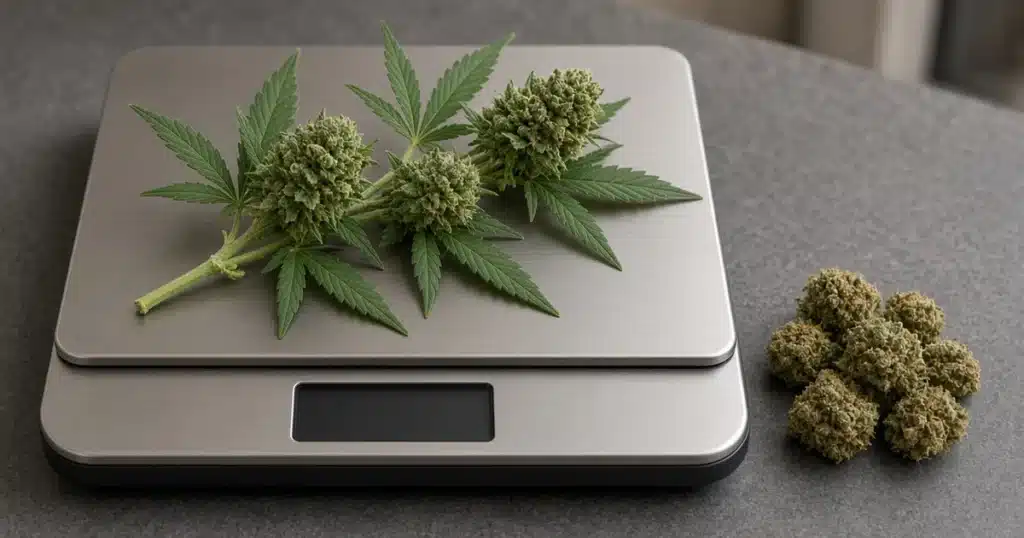
The loss does not happen at once. In the UVM drying trial, buds dried at 80°F took about 1 to 2 days, while buds at room temperature took several days longer. UVM Extension explains that weight drops steadily as water leaves the plant, so a scale is one simple way to follow drying progress over those days.
For converting grams, ounces and pounds, see our guide to understanding weed weights.
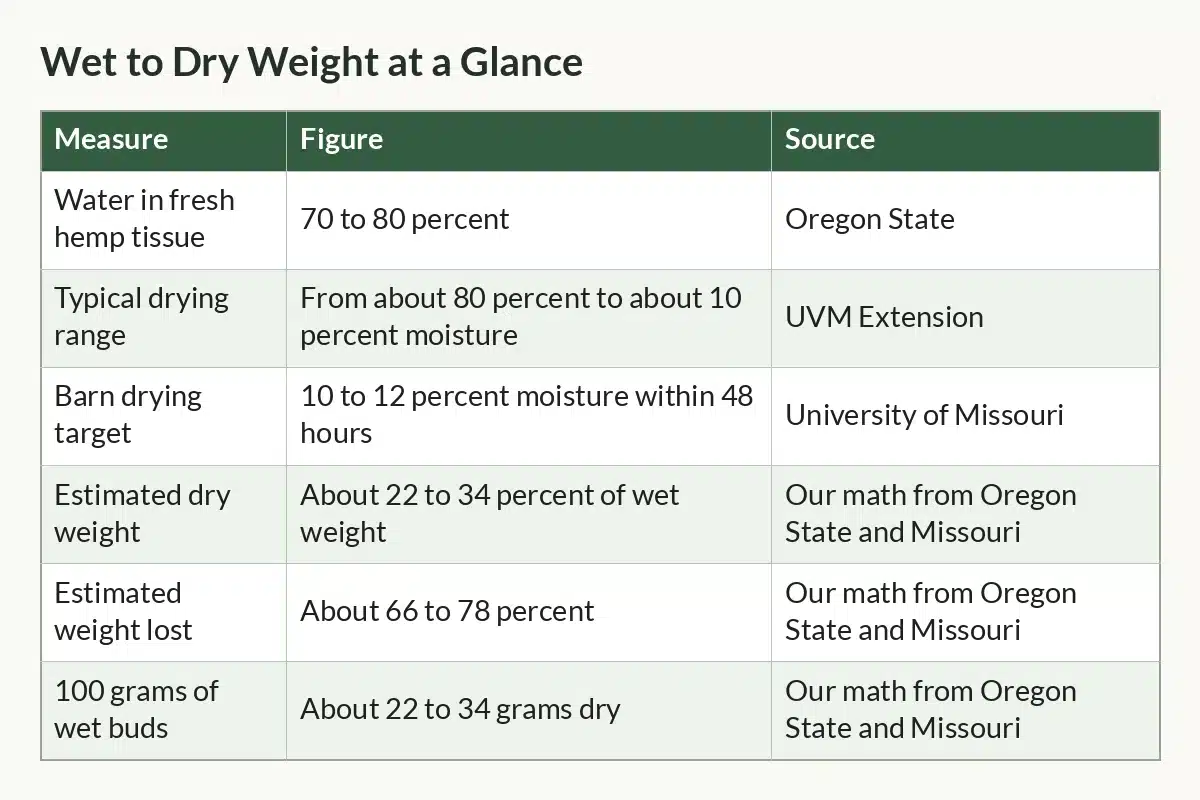
Wet to Dry Weight at a Glance
| Measure | Figure | Source |
|---|---|---|
| Water in fresh hemp tissue | 70 to 80 percent | Oregon State |
| Typical drying range | From about 80 percent to about 10 percent moisture | UVM Extension |
| Barn drying target | 10 to 12 percent moisture within 48 hours | University of Missouri |
| Estimated dry weight | About 22 to 34 percent of wet weight | Our math from Oregon State and Missouri |
| Estimated weight lost | About 66 to 78 percent | Our math from Oregon State and Missouri |
| 100 grams of wet buds | About 22 to 34 grams dry | Our math from Oregon State and Missouri |
Why the Ratio Changes From Plant to Plant
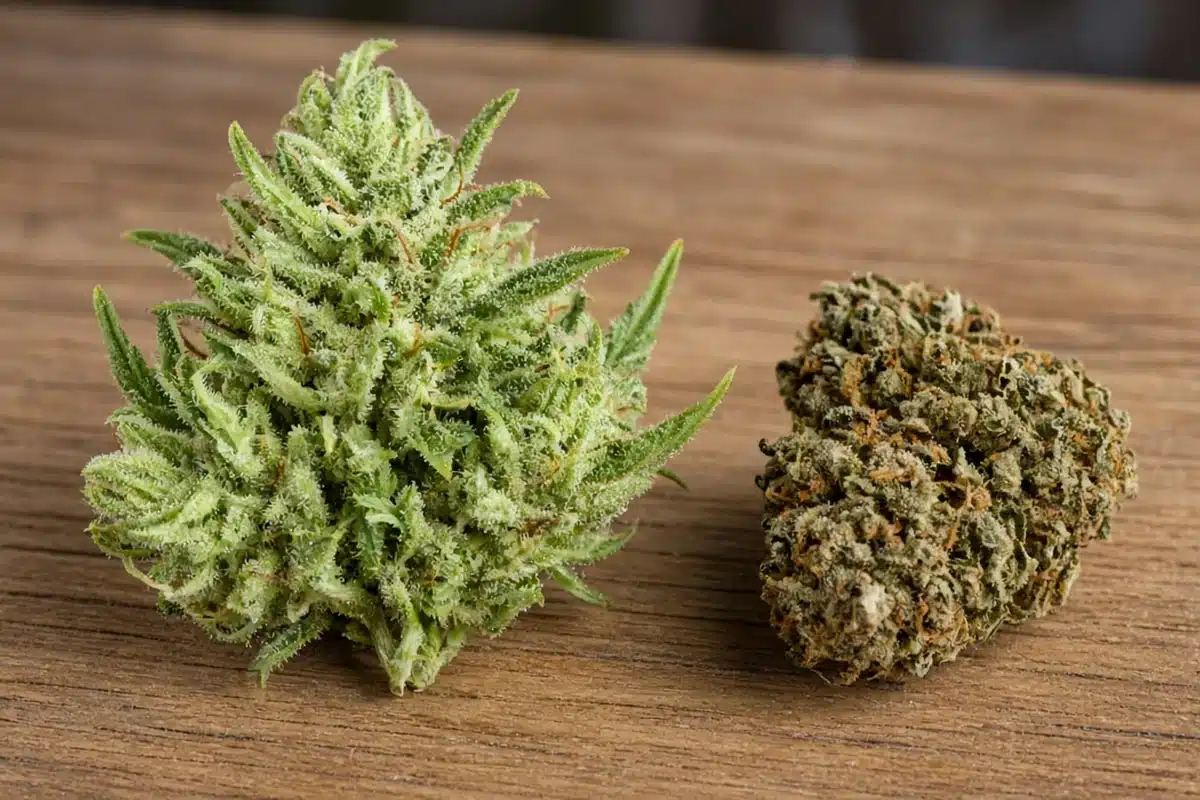
Two numbers drive the ratio: how wet the buds start and how dry they end.
Starting water. Oregon State gives a range of 70 to 80 percent, not a single figure. That spread alone moves the dry weight by several points. The UVM Extension guide to hemp for flower production also notes that trimming buds can be easier on plants that have gone without water for the past two days, which suggests that recent watering and rain change how wet plants are at harvest.
Ending moisture. Missouri’s target is 10 to 12 percent. Buds dried a bit more or a bit less than that will weigh a bit less or more. UVM’s 2021 drying trial dried buds until they were dry enough to store without molding, and noted that over dried flower is more likely to shed bits of leaf and trichomes when handled.
Moisture after drying. NC State Extension notes that dried hemp takes moisture back in when it is not kept dry. A batch weighed a few days after drying, in a humid room, may weigh more than it did when it first came off the line.
Trim level. What you leave on the bud changes what you weigh. Oregon State’s 70 to 80 percent figure is for fresh hemp tissue in general, not buds alone, and the University of Vermont drying trial weighed wet buds only after the plants were bucked and run through a trimmer.
How to Estimate Dry Weight From Wet Weight
- Weigh the buds right after harvest. Weigh trimmed buds, as the UVM trial did, so stems and leaves don’t skew the number.
- Pick a starting water level. Use Oregon State’s 70 to 80 percent. If you don’t know, use the middle, 75 percent. UVM Ag Engineering gives a similar example for hops, which start near 80 percent moisture and dry to about 10 percent.
- Pick an ending moisture. Use Missouri’s 10 to 12 percent.
- Do the math. Multiply the wet weight by the dry matter share, then divide by the dry share at the end. For 75 percent water and 11 percent ending moisture, that is wet weight times 0.25, divided by 0.89.
- Use the quick range. Or just multiply wet weight by 0.22 and 0.34 for a low and high estimate.
- Weigh again when dry. Compare the real number with the estimate. That tells you where your own plants land in the range. UVM Ag Engineering suggests a microwave method for measuring moisture, and notes that 100 gram samples make the math easy.
Example: 500 grams of wet trimmed buds would come out at about 110 to 170 grams dry using the 0.22 to 0.34 range. Our post on how much marijuana you can yield per plant covers yield planning before harvest.
Should You Weigh Branches or Buds?
Weigh buds if you can. The sources that report weights work with trimmed buds. The UVM drying trial recorded wet bud weight after bucking and trimming. UVM’s hemp guide measures labor in pounds of wet trimmed flower bud per hour, about a quarter to half a pound per person.
Branches add stems and leaves that you won’t keep. No source here gives a wet to dry ratio for whole branches, so a branch weight can’t be turned into a dry bud estimate with any confidence.
If you dry on the branch, you can still weigh before and after. Just know the before number includes stem weight, and the after number is only useful once you buck and weigh the buds alone.
Troubleshooting Weight Loss
Buds lost more than 78 percent, the top of the range. They may be over dried. UVM’s trial links over drying to more shedding when the flower is handled. Check the next batch a little sooner.
Buds lost far less than two thirds. They may still hold too much water. Missouri’s target is 10 to 12 percent moisture, and NC State cautions that damp hemp may mold. Our post on how to deal with wet weed covers next steps.
Dry weight went up after a few days. Moisture creeps back into dried hemp that isn’t kept dry, NC State says. Store it in a dry space.
Your numbers don’t match the estimate. The range is built from hemp figures. Your own plants, trim level and drying room will all move it. UVM also notes that larger buds can take 4 or more extra days to dry.
The estimate was too high for whole branches. Branch weight includes the stems, which you won’t keep. Weigh trimmed buds instead.
Sources
- Oregon State University Extension, Post harvest processing of hemp flowers: https://extension.oregonstate.edu/catalog/post-harvest-processing-hemp-flowers
- University of Missouri Extension, MX79 Harvesting Industrial Hemp: https://extension.missouri.edu/publications/mx79
- University of Vermont, 2021 Hemp Cannabidiol Drying Trial: https://www.uvm.edu/d10-files/documents/2024-08/2021_Hemp_Cannabidiol_Drying_Trial.pdf
- UVM Extension Ag Engineering, Drying and Curing Herbs and Flowers (Hops, Hemp, and Everything Else!): https://blog.uvm.edu/cwcallah/2021/02/23/drying-and-curing-herbs-and-flowers-hops-hemp-and-everything-else/
- UVM Extension, Industrial Hemp for Flower Production: https://www.uvm.edu/d10-files/documents/2024-06/2020_Hemp_101.pdf
- NC State Extension, Hemp Harvest Timing and Drying: https://hemp.ces.ncsu.edu/hemp-harvest-timing-and-drying/
FAQ
What is the typical wet to dry ratio for cannabis?
Our estimate from Oregon State and Missouri figures is that dry buds weigh about 22 to 34 percent of wet weight.
How much water is in a fresh bud?
Oregon State says fresh hemp tissue is 70 to 80 percent water.
How dry should buds get?
Missouri's target for CBD hemp is 10 to 12 percent moisture within 48 hours.
How much will 1 pound of wet buds weigh dry?
About 3.5 to 5.4 ounces, using the 0.22 to 0.34 estimate.
Why did my buds gain weight after drying?
NC State says dried hemp absorbs moisture if it isn't kept dry.