Humidifiers for Grow Tents: Sizing and Placement
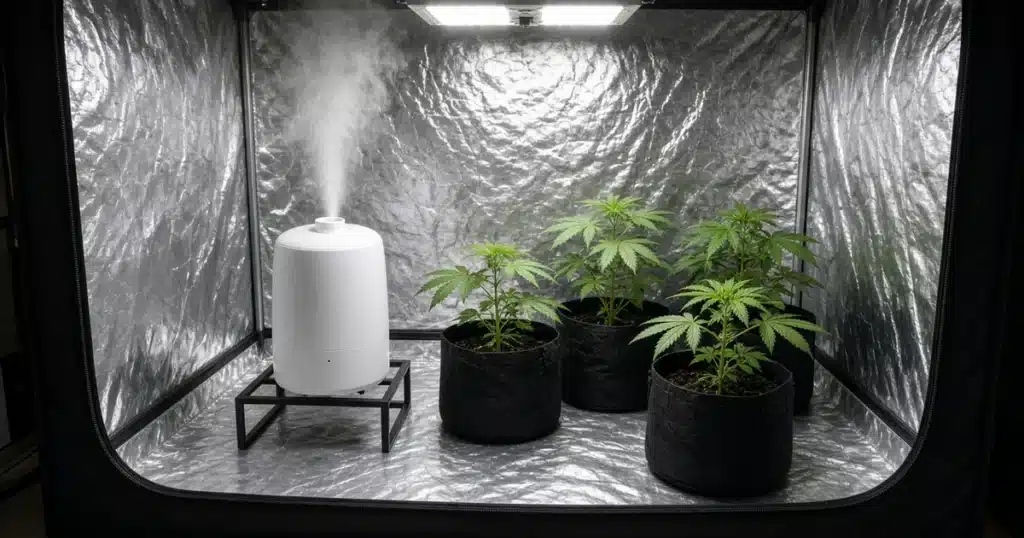
Quick answer: A humidifier for a grow tent should add water vapor without wetting the plants. Pick one with a built in humidistat or plug it into a separate humidity controller, set it near the intake side of the tent, and aim the output into open air rather than at leaves. Size it by watching how far your readings fall when the lights warm the tent. Extension greenhouse guides from UMass Amherst and the University of Florida explain why the finest droplets work best and why soaked leaves and saturated soil invite gray mold.
When Does a Grow Tent Need a Humidifier?
A tent needs one when its readings stay below the range you want for your plants and the gap does not close on its own. Dry air is most common in winter, in heated homes and in arid regions. It also shows up in young setups where small plants give off little moisture of their own.
Heat is the usual reason the numbers fall. The UMass Extension guide to reducing greenhouse humidity explains that air at 70°F can carry double the moisture of 50°F air. It adds that each 20°F rise doubles the water holding capacity of the air and cuts relative humidity in half. So when a grow light heats a tent, the reading falls even though no water has left.
That link between heat and moisture is why the same tent can read fine at lights off and far too dry at midday. Before you buy anything, log readings through a full light cycle. Our guide to what affects relative humidity control for cannabis covers the other factors that push those numbers around.
Young plants and fresh cuttings tend to need the most help. The UMass Extension fact sheet on mist and fog equipment lists rough humidity guidelines for propagation: 60 to 80 percent while plants establish, 55 to 70 percent during rapid growth and 45 to 50 percent while hardening. Those figures come from general greenhouse propagation, not cannabis trials, so use them as a starting frame and not as a cannabis rule.
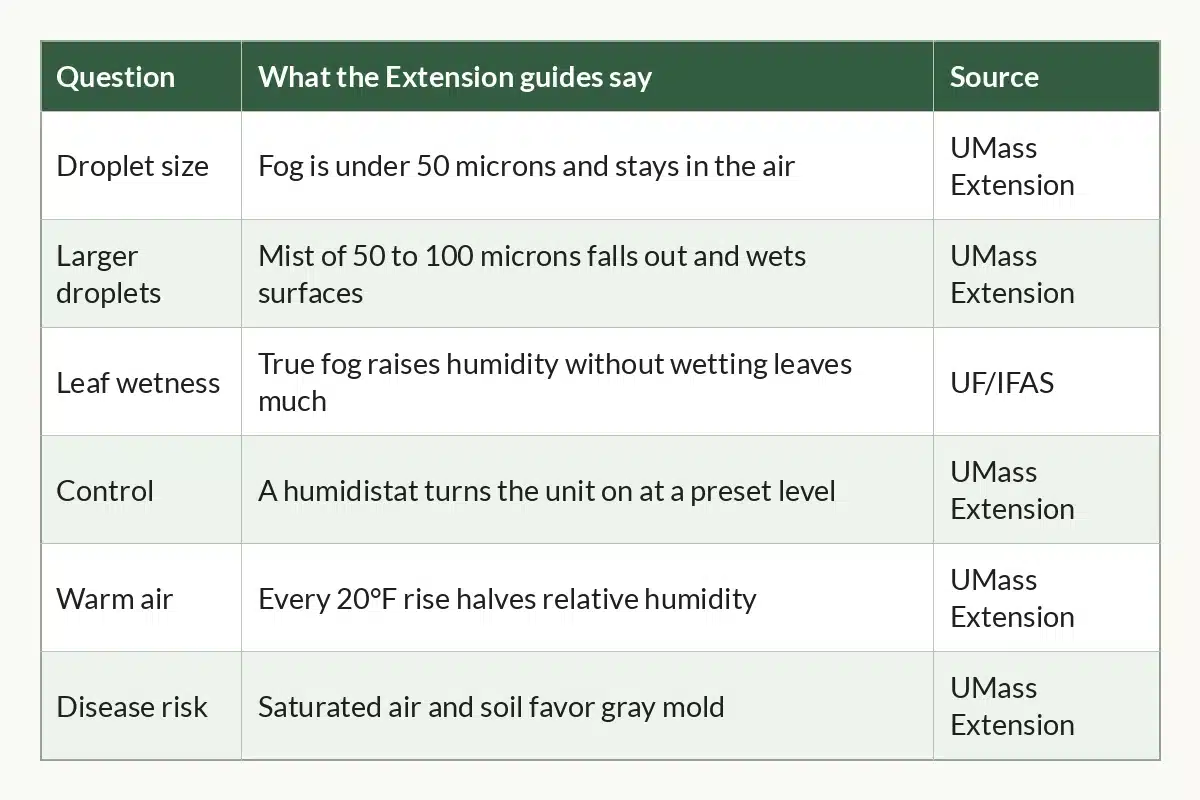
Humidifier Choices at a Glance
| Question | What the Extension guides say | Source |
|---|---|---|
| Droplet size | Fog is under 50 microns and stays in the air | UMass Extension |
| Larger droplets | Mist of 50 to 100 microns falls out and wets surfaces | UMass Extension |
| Leaf wetness | True fog raises humidity without wetting leaves much | UF/IFAS |
| Control | A humidistat turns the unit on at a preset level | UMass Extension |
| Warm air | Every 20°F rise halves relative humidity | UMass Extension |
| Disease risk | Saturated air and soil favor gray mold | UMass Extension |
What Size Humidifier Does a Tent Need?
Size it to the job, not to a box label. No Extension guide gives a capacity chart for grow tents, so the practical method is to measure first. Note how many points your tent sits below target at the driest part of the day. A small gap in a sealed tent calls for a small unit. A large gap in a tent with strong exhaust calls for more output.
Exhaust matters because every cubic foot of air the fan pulls out takes its moisture with it, and the room air that replaces it has to be humidified all over again. A tent with a powerful inline fan running hard will need more output than the same tent with the fan on a low setting. If your fan runs on a speed controller, the cheapest fix is often to slow it during dry stretches while keeping temperature in check.
Heat matters for the same reason. Because warming air drops relative humidity so sharply, a hot tent asks more of any humidifier. Cooling the tent a few degrees can do as much as a bigger unit. Our cannabis VPD chart shows how temperature and humidity work together, which helps you decide which one to change.
A unit that runs nonstop and still falls short is too small. A unit that overshoots in minutes and cycles constantly is oversized or set too close to the sensor.
Where Should a Humidifier Sit Inside the Tent?
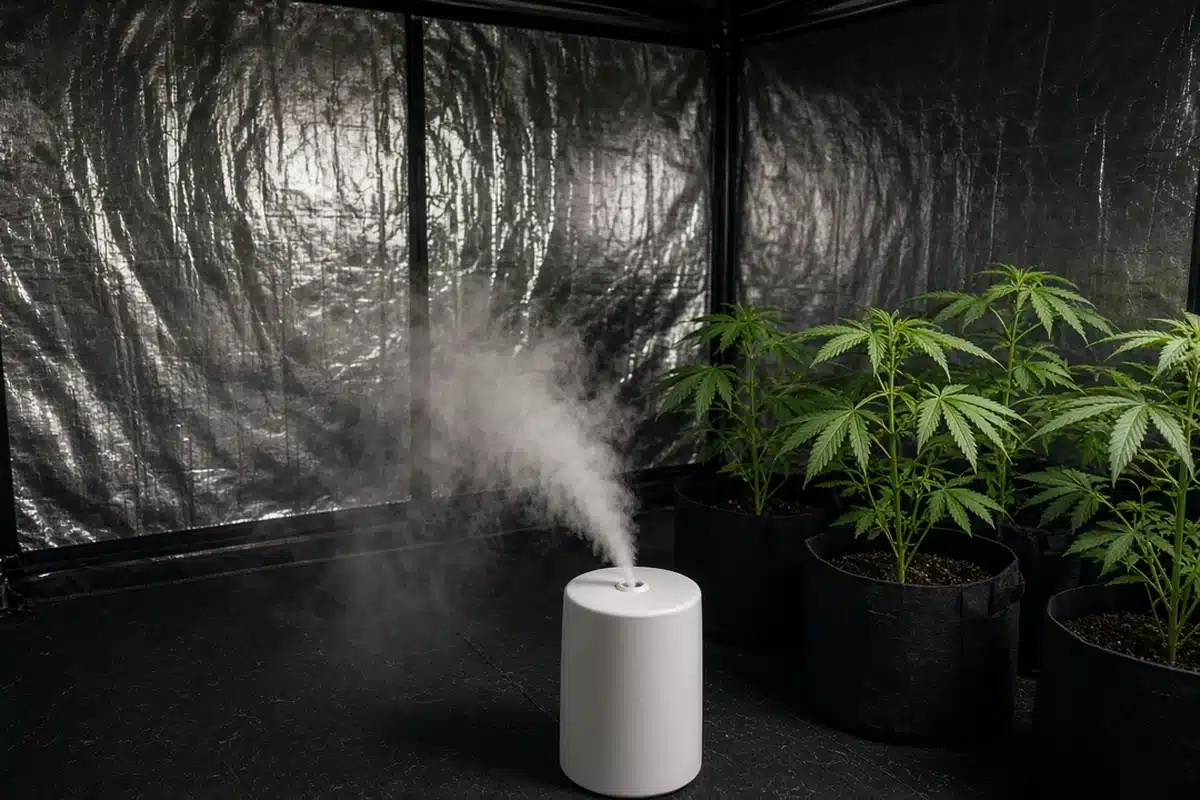
- Set the unit on a stable, level spot off the tent floor liner. A tray or small stand keeps any drips away from cords and pots.
- Put it near the intake or a circulation fan. Moving air carries the vapor through the tent before it can settle on one plant.
- Point the output into open space. UMass notes that mist sized droplets take longer to evaporate and are more likely to wet plant surfaces or saturate the growing medium.
- Keep it clear of the canopy. Never aim vapor straight at leaves or buds.
- Use a humidistat or separate controller. UMass describes a humidistat as a switch that senses the humidity level and turns the unit on when it falls to a preset point.
- Place the sensor away from the output. A probe sitting in the vapor stream reads high and shuts the unit off too soon.
- Fill it with clean water. Clogged nozzles from mineral and particle buildup top the UMass list of fog system troubles, and it suggests rain water or bottled water.
For the bigger picture on fans, ports and layout, see our complete grow tent setup guide.
Why Does Droplet Size Matter?
Small droplets vanish into the air. Large ones land. The UMass fact sheet explains that fog particles are generally under 50 microns, while mist runs from 50 to 100 microns. Fog stays suspended until it evaporates, and the smallest particles turn to vapor almost at once.
Mist is another story. Its heavier droplets take longer to evaporate, so they drift down onto leaves, pots and the floor. UMass warns that if that moisture is still there at nightfall, the potential for disease goes up.
The University of Florida PropG guide to fogging systems makes the same point. It says fog can come from high pressure atomizers, centripetal foggers or humidifiers, and that a true fog raises humidity without wetting the leaves much compared with misting. So in a tent, the finest output you can get is the safest choice.
Both guides were written for commercial greenhouse propagation. A small home unit will not match a high pressure fog line, but the principle carries over. Less visible wetness on surfaces is better.
How Do You Avoid Mold When Adding Humidity?
Keep air moving and never let the canopy stay saturated. UMass explains that a dense canopy with little air movement traps a layer of nearly saturated air right around the plants. Add a soaked growing medium to that, and it lists fungi, moss, gray mold and fungus gnats as likely problems.
The same guide on reducing humidity says condensation forms on the coldest surfaces first as air cools to the dew point. That is why a humidifier left running into lights off can backfire. As the tent cools, the extra vapor you added may turn into droplets on walls and leaves.
Three habits lower the risk. First, run a small circulation fan whenever the humidifier runs. Second, let the controller shut the unit off well before lights off. Third, check pots and trays for standing water each day, since a wet floor adds humidity you did not plan for.
If your readings climb too high instead, you need the opposite tool. Our grow room dehumidifier guide covers that side of the problem, and the condensation risks above apply in reverse.
Troubleshooting Grow Tent Humidifier Problems
The reading barely moves. The exhaust may be pulling vapor out faster than the unit adds it. Slow the fan a little, close unused ports and check the reading again after an hour.
Leaves look wet or spotted. The output is too coarse or too close. Mist sized droplets fall out and wet surfaces, as UMass explains. Move the unit back and point it into open air.
White crust builds up on surfaces. That crust is mineral residue left by the water. UMass links mineral deposits to clogged nozzles and suggests rain water or bottled water.
Walls drip after lights off. The air cooled to its dew point, as the UMass humidity guide describes. Set the controller to stop the unit earlier in the evening and keep air moving.
The unit cycles on and off every few minutes. The sensor is probably sitting in the vapor stream. Move it to plant height on the far side of the tent.
Sources
- UMass Extension, Mist and Fog Equipment for Propagation: https://www.umass.edu/agriculture-food-environment/greenhouse-floriculture/fact-sheets/mist-fog-equipment-for-propagation
- University of Florida IFAS PropG, Fogging Systems: https://propg.ifas.ufl.edu/02-environment/02-water/02-water-fog.html
- UMass Extension, Reducing Humidity in the Greenhouse: https://www.umass.edu/agriculture-food-environment/greenhouse-floriculture/fact-sheets/reducing-humidity-in-greenhouse
FAQ
Where should a grow tent humidifier go?
Near the intake or a circulation fan, aimed into open air. Keep it away from leaves and set the sensor across the tent from the output.
Is a warm mist or cool mist unit better for a tent?
The Extension guides do not compare those types for tents. What they stress is droplet size. Finer output that evaporates fast is less likely to wet plants.
Can I leave the humidifier on all night?
It is safer to let a humidistat stop it before lights off. As air cools to the dew point, UMass explains, water condenses on the coldest surfaces first.
Why does humidity drop when the lights come on?
Warm air holds more water. UMass says each 20°F rise in temperature cuts relative humidity in half when the moisture in the air stays the same.
Will clones need a humidifier?
Cuttings often benefit from higher humidity. UMass gives 60 to 80 percent as a general greenhouse guideline while cuttings establish, and that range comes from propagation of other crops.