
What Happens If You Eat Raw Weed?
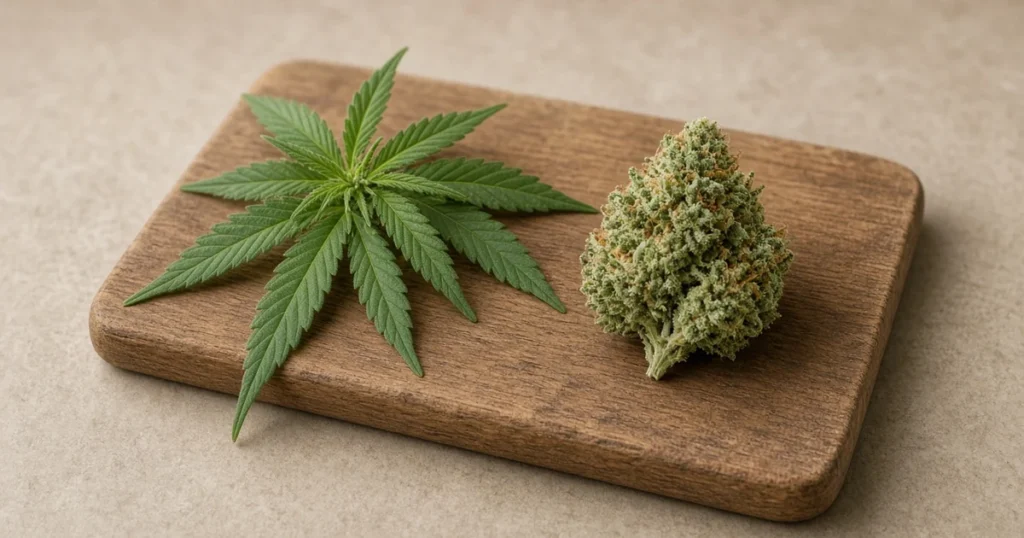
Eating a raw cannabis bud or leaf is not the same as eating a cooked edible, and the reason is chemistry. Fresh cannabis holds most of its THC in an acid form called THCA, and THCA does not cause the familiar high. Heat changes it into THC. Below, you will find what is in raw weed, why heat matters, what labs and regulators measure, and the safety points to keep in mind. It is not medical advice. If you have a health question about cannabis, talk to a doctor.
Can you get high by eating raw weed?
Usually not in any strong way. Colorado State University’s Food Source Information page on edibles explains that THC “is the major psychoactive ingredient that causes the marijuana ‘high'” but that in the plant this chemical sits “in its nonpsychoactive acid form,” THCA. It then says plainly that “THCA is then heated, in order to convert it into THC.” In other words, the plant makes the acid, and heat makes the compound that people associate with a high.
That is why chewing a fresh bud is not the same as eating a homemade edible. Edibles start with cannabis that has been heated in fat or oil. Raw plant material skips that step.
A small amount of THC can already be present in dried flower, because some conversion happens slowly with time, light and warmth during drying and storage. So “nothing at all” is not a promise. Effects vary from person to person, and anyone who could be drug tested, is pregnant, takes medication or has a health condition should talk to a doctor before eating any cannabis, raw or cooked.
What is in raw cannabis?
Raw cannabis flowers carry cannabinoid acids, terpenes, plant fiber and water. The main cannabinoid acids are THCA and CBDA. NC State Extension, writing about hemp testing, shows how closely labs link each acid to its active form. It calculates total CBD as CBD plus 0.877 times CBDA, and total THC as delta-9 THC plus 0.877 times THCA. The 0.877 factor accounts for the weight the molecule loses when it gives up its acid group.
Terpenes are the aroma compounds. They are what make one plant smell like pine and another like citrus. They are present in raw and dried plants alike. For more on one common terpene, see our guide to pinene at https://kindseed.com/top-10-facts-about-pinene-terpene/.
Decarboxylation: why heat changes everything
Decarboxylation is the name for the reaction that removes the acid group from THCA and leaves THC. Heat drives it. Smoking and vaping heat flower almost instantly. Baking or simmering in oil heats it more slowly. Colorado State University describes the home and commercial edible process as “heating the flowers from the female plant in an oil-based liquid,” which both converts THCA and pulls the cannabinoids into the fat.
This also explains a very common surprise. A raw smoothie with fresh leaves tastes grassy and does very little, while a small piece of a properly made brownie can be strong. The difference is not the plant. It is the heat and the fat.
What labs and regulators measure
Because THCA can turn into THC, US hemp rules do not just look at THC on its own. The USDA laboratory testing guidelines say compliance tests must use “post-decarboxylation or other similarly reliable methods” that consider “the potential to convert delta-9-tetrahydrocannabinolic acid (THCA) into THC.” The result has to reflect “the total available THC derived from the sum of the THC and THCA content.”
These USDA rules cover hemp compliance testing, not consumer product labels. The same chemistry still matters at home: THCA can become THC once heated, so where a lab report lists total THC, that figure is the more useful one to read.
How to think it through before eating raw cannabis
If you are curious about raw cannabis, work through these steps first.
- Check your state and local law. Possession and home growing rules differ across the US.
- Talk to a doctor, especially if you take medication, are pregnant or nursing, or have a health condition.
- Know the source. Only consider plant material you grew yourself or that comes from a licensed, lab tested source.
- Do not count on washing. Rinsing can take off soil and dust, but it does not remove pesticides, mold or bacteria, so skip any plant material you are unsure of.
- Read the lab report if there is one, and look at total THC, not only THC.
- Keep all cannabis, raw, dried or cooked, away from children and pets, and store it clearly labeled. Do not take more too soon: effects can be delayed, so wait instead of eating more. If a child or pet eats cannabis, or someone feels very unwell, call Poison Control at 1-800-222-1222, or a veterinarian for a pet. In an emergency, call 911.
- Do not drive or operate machinery if you feel any effect.
Raw vs dried vs heated cannabis
| Form | Main THC form | What to expect |
|---|---|---|
| Fresh raw leaf or bud | Mostly THCA | Usually little or no high |
| Dried, cured flower eaten raw | Mostly THCA, some THC | Possible mild effect, varies |
| Smoked or vaped flower | THC, converted by heat | Effects felt quickly |
| Cooked in oil or butter | THC, converted by heat | Effects can be delayed and strong |
Troubleshooting
Use this section if something did not go the way you expected.
| What happened | Likely reason | What to do |
|---|---|---|
| Ate raw bud and felt nothing | THCA is not converted without heat | Nothing to fix. This is the expected result |
| Ate raw bud and felt a mild effect | Dried flower can hold some THC | Stop, rest, and avoid driving |
| Upset stomach after eating raw plant | Tough plant fiber or contamination | Stop eating it, and talk to a doctor if it continues |
| Saw fuzz or smelled must on the bud | Possible mold | Do not eat it, and see our guide below |
| Worried about a drug test | Some THC may be present | Talk to a doctor or your employer’s policy contact |
If the plant looks or smells off, do not eat it, and do not try to rescue it. Not every mold makes aflatoxins, but you cannot tell which by looking, so discard suspect material. On its edibles page, Colorado State University warns that “improper growing conditions cause mold growth which, in turn, creates aflatoxins that can cause serious health problems.” Our guide to moldy cannabis at https://kindseed.com/stoner-alert-smoking-moldy-cannabis/ shows what to look for.
Growing your own raw cannabis
Some readers want fresh leaves from their own garden. If home growing is legal where you live, a single plant is a simple start, and our guide at https://kindseed.com/grow-one-single-cannabis-plant/ covers the basics. Grow without pesticides you would not want on food, and keep fresh plant material out of reach of kids and pets.
Sources
- Colorado State University, Food Source Information, Marijuana Edibles (https://www.chhs.colostate.edu/fsi/food-articles/complex-food/marijuana-edibles/)
- NC State Extension, Avoiding a Hot Crop: Minimizing the Risk of Non-compliant THC Tests (https://content.ces.ncsu.edu/avoiding-a-hot-crop-minimizing-the-risk-of-non-compliant-thc-tests-through-proper-harvest-timing)
- USDA Agricultural Marketing Service, Laboratory Testing Guidelines, U.S. Domestic Hemp Production Program (https://www.ams.usda.gov/rules-regulations/hemp/information-laboratories/lab-testing-guidelines)
FAQ
Can you get high from eating raw weed?
Usually not in any strong way. Raw cannabis holds most of its THC as THCA, which is not psychoactive. Heat converts THCA into THC. Dried flower may contain a small amount of THC, so effects vary. Talk to a doctor before eating any cannabis.
What is THCA?
THCA is the acid form of THC that the cannabis plant makes on its own. It does not cause the familiar high. When it is heated by smoking, vaping or cooking, it loses its acid group and becomes THC.
Does cooking weed make it stronger?
Cooking converts THCA into THC, which is why edibles can have strong effects while raw cannabis usually does not. Effects from edibles can also take longer to start, so people should be careful and talk to a doctor with any questions.
Is it safe to eat raw cannabis?
We do not give medical advice. Only consider clean plant material from a known, lab tested source, never eat anything that looks or smells moldy, and talk to a doctor first, especially if you take medication or have a health condition. If a child or pet eats cannabis, call Poison Control at 1-800-222-1222.
Why do lab reports list total THC?
Because THCA can turn into THC when heated. USDA hemp testing rules require results that reflect the total available THC from the sum of THC and THCA, so total THC gives a better picture than THC alone.


