Top 10 Facts About Pinene Terpene

Pinene is one reason some cannabis smells piney. It is one of the most common terpenes in nature and one of the most talked about in cannabis. Here we stick to chemistry and plant facts from university and government sources. This page does not cover effects or health claims, because effects vary from person to person and the research does not support promises.
1. Pinene is a terpene
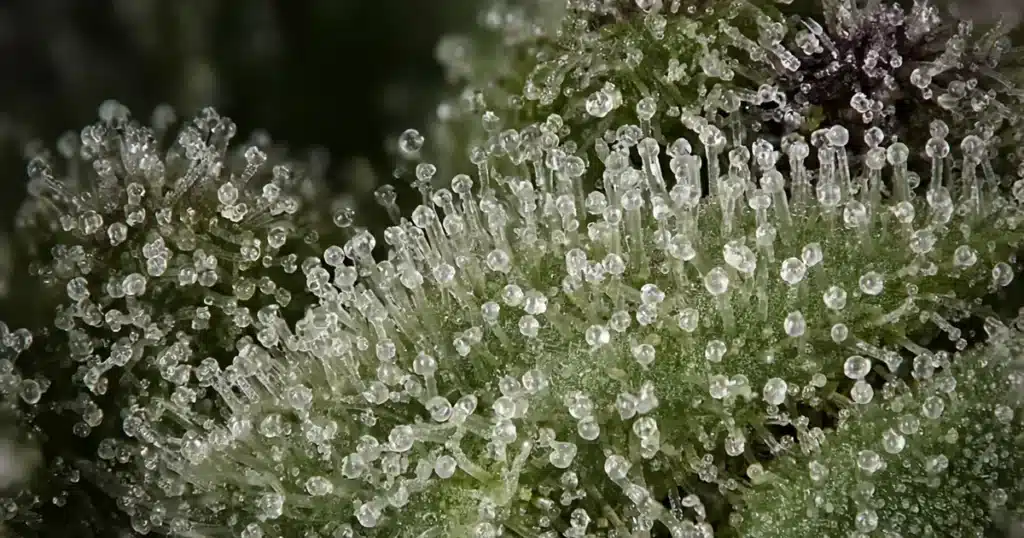
Terpenes are aroma compounds plants make. Cornell University’s hemp program describes terpenes as “fragrant compounds produced by the hemp plant for defense against insects and pathogens that give hemp its distinctive smell and taste.” Pinene is one of them.
2. Its formula is C10H16
A review hosted by the National Library of Medicine (NIH) describes pinene as “(C10H16),” a member of the “well-known group of monoterpenes.” Monoterpenes are built from ten carbon atoms.
3. There are two main forms: alpha and beta
The same NIH hosted review says pinene “can be divided into two structural isomers,” alpha-pinene (α-pinene) and beta-pinene (β-pinene). Isomers share a formula but differ in structure, and the two forms can differ in other properties too.
4. Pinene is a major part of turpentine
Pinene is “the main component of turpentine,” according to that review, a fluid “obtained by the distillation of resin harvested from coniferous trees.” Chemists have studied it for a long time. A 1992 University of Mississippi doctoral dissertation focused on the “qualitative and quantitative determination of pinenes in gum turpentine.” A 2017 study in BioResources, a journal published by NC State University, found black spruce bark oil “turpentine-like with the predominance of α-pinene (40.6% SD; 40.5% WD) and β-pinene (33.9% SD; 25.9% WD),” where SD and WD stand for steam distillation and water distillation, the two methods the study compared. For comparison, the paper cites earlier work by Borg-Karlson and colleagues (1993) that found a Norway spruce (Picea abies) turpentine with “a predominance of α-pinene (54.3%) and β-pinene (25.3%).”
5. Pine trees are not the only source
Alpha and beta-pinene are “mainly produced by pine trees and many other conifers, as well as a wide range of herbs such as rosemary, parsley, basil, and even orange peel,” the NIH hosted review notes. Cornell’s terpene table lists pinene’s sources as “Pine needles, Rosemary, Basil, Parsley, Dill.”
6. It smells like pine
Cornell’s table sums up pinene’s aroma in one word: “Pine.”
7. Cornell lists it as vaporizing around 311°F
Cornell’s terpene chart lists pinene as vaporizing at 311°F. That is lower than myrcene (332°F) and limonene (348°F) in the same table, though higher than caryophyllene (266°F).
8. Alpha-pinene shows up across cannabis cultivars
A Plant Physiology commentary hosted by the NIH summarizes work that profiled terpenes in eight cannabis cultivars. It found 48 different terpenes, with “three monoterpenes (myrcene, α‐pinene, and limonene)” and two sesquiterpenes “present in all cultivars.”
9. Cannabis makes more than 100 terpenes
The same commentary notes that “more than 100 different terpenes have been identified that define odor and flavor of different cultivars.” Pinene is one note in a large chord, and the overall smell depends on the mix.
10. Growing conditions shape terpene levels
Cornell’s hemp program says “plant variety, health, production method, stage and pathogen infection influence terpene production.” The NIH hosted commentary adds that monoterpenes accumulated over the plant’s life in leaves and flowers in the cultivars studied.
Pinene in the wider world
Pinene is also common outdoors. The NIH hosted review notes that alpha-pinene is “the most abundant monoterpene in the atmosphere,” accounting for “more than 50 % of global monoterpene emissions.” That fresh smell on a hot day in a pine forest is partly pinene evaporating from needles and resin.
How cannabis makes pinene
Terpenes and cannabinoids share a starting point. The Plant Physiology commentary explains that both depend on a five carbon building block called IPP, and that enzymes called terpene synthases produce the final terpene structures. The work it summarizes identified “19 TPS gene models” in the Purple Kush cannabis reference genome, in work by Booth and colleagues published in 2020, bringing the total to “30 known TPSs across 14 different cannabis cultivars.” Different mixes of these enzymes help explain why two plants can smell so different.
What about pinene effects?
You will see many claims online about what pinene does for people. Most come from lab and animal studies, and the NIH hosted review lists those as reported activities, not proven human results. We do not make effect or health claims. Effects vary from person to person, and anyone with a health question should talk to a doctor.
How to protect pinene and other terpenes in your harvest
Aroma can fade with rough handling. These steps can help.
- Grow healthy plants. Cornell’s hemp program lists plant health and pathogen infection among the factors that affect terpenes.
- Harvest at the stage you want and handle buds gently to avoid crushing resin glands.
- Dry slowly in a cool, dark room with steady airflow and moderate humidity.
- Cure in airtight glass jars, opening them briefly in the first weeks to release moisture.
- Store jars away from heat and light.
- Grind just before use rather than days ahead.
Alpha vs beta-pinene at a glance
| Feature | Alpha-pinene | Beta-pinene |
|---|---|---|
| Formula | C10H16 | C10H16 |
| Type | Monoterpene | Monoterpene |
| Common sources | Conifers, rosemary, basil | Conifers, many herbs |
| Aroma (Cornell lists pinene overall) | Pine | Pine |
Troubleshooting
| Problem | Likely cause | What to do |
|---|---|---|
| Buds lost their pine smell | Drying too hot or too fast | Dry cooler and slower next harvest |
| Hay or grass smell after drying | Drying too fast, chlorophyll not broken down | Slow the dry and cure in jars |
| Aroma fades in storage | Heat, light or air exposure | Use airtight glass in a cool, dark spot |
| Musty smell | Moisture and possible mold | Inspect buds, then see our mold guide |
| Smell differs from the strain description | Genetics and conditions vary | Expect some variation between plants |
For more on spotting mold, see https://kindseed.com/stoner-alert-smoking-moldy-cannabis/. For harvest prep, our flushing guide at https://kindseed.com/everything-you-need-to-know-about-flushing-cannabis/ explains what research says about the final weeks.
Sources
- Cornell University Hemp Program, Characterizing terpenes and other natural products in CBD hemp (https://hemp.cals.cornell.edu/resource/characterizing-terpenes-natural-products-cbd-hemp/)
- Park, An and Park, Recent studies on pinene and its biological and pharmacological activities, hosted by the NIH National Library of Medicine (https://pmc.ncbi.nlm.nih.gov/articles/PMC8222632/)
- Roell, Terpenes in Cannabis: Solving the Puzzle of How to Predict Taste and Smell, Plant Physiology, hosted by the NIH National Library of Medicine (https://pmc.ncbi.nlm.nih.gov/articles/PMC7479895/)
- Francezon and Stevanovic, Chemical Composition of Essential Oil and Hydrosol from Picea mariana Bark Residue, BioResources 12(2), NC State University, 2017 (https://bioresources.cnr.ncsu.edu/wp-content/uploads/2017/03/BioRes_12_2_2635_Francezon_S_Chemical_Comp_Essential_Oil_Hydrosol_Bark_Residue_11147.pdf)
- Scott, Qualitative and quantitative determination of pinenes in gum turpentine, University of Mississippi dissertation, 1992 (https://egrove.olemiss.edu/etd/3057/)
FAQ
What is pinene?
Pinene is a monoterpene with the formula C10H16. It is a fragrant compound found in pine trees, many herbs and cannabis, and it gives a pine aroma.
What is the difference between alpha and beta-pinene?
They are simply two structural isomers. Both have the formula C10H16, but their structures differ slightly.
Where is pinene found besides cannabis?
Pine trees and other conifers, plus herbs such as rosemary, parsley, basil and dill, and even orange peel. It is also a major component of turpentine.
What does pinene do in cannabis?
In the plant, terpenes like pinene help defend against insects and pathogens and shape aroma and taste. Effects on people vary, and we do not make health claims about pinene.
How do I keep pinene in my buds?
Grow healthy plants, handle buds gently, dry slowly in a cool dark room, cure in airtight glass jars and store them away from heat and light.