
What total THC means in the new federal hemp definition
General information only, not legal advice. The law described here is changing. Kind Seed Co sells only to adults 21 and older.
Total THC is a measure that counts both delta-9 THC and THCA, the acid form of THC found in raw cannabis. The new federal hemp definition, scheduled to take full effect on December 11, 2026, uses total THC, including THCA, instead of delta-9 THC alone. That change matters because raw cannabis contains far more THCA than delta-9 THC, so plants that once passed a delta-9 test can fail a total THC test. This guide explains the measure, how labs calculate it, and why it matters for hemp, CBD plants and seeds.
Delta-9 THC vs THCA
Living cannabis plants make cannabinoids mostly in acid form. THCA is the acid form of THC. When THCA is exposed to heat, for example during drying or lab testing, it loses a carboxyl group and becomes delta-9 THC. This process is called decarboxylation.
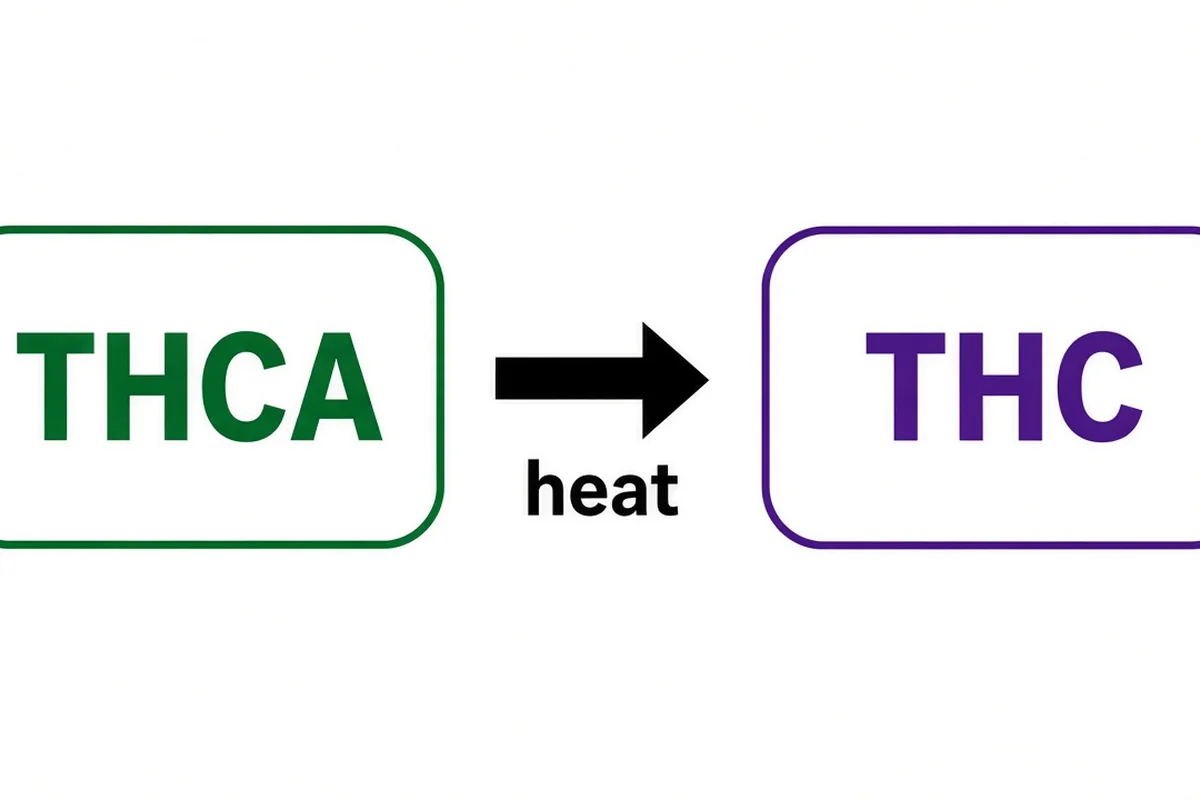
That is why a fresh plant sample can show low delta-9 THC but high THCA. Under the old 2018 farm bill wording, the definition looked at “delta-9 tetrahydrocannabinol concentration.” That left room for products high in THCA but low in delta-9 THC, which is how THCA flower became a market in many states.
What the new definition says
Public Law 119-37, Division B, section 781, rewrote the hemp definition at 7 U.S.C. 1639o. The new text refers to a “total tetrahydrocannabinols concentration (including tetrahydrocannabinolic acid)” of not more than 0.3 percent on a dry weight basis. In plain terms:
- Total, not delta-9 only. The measure includes THC in acid form.
- Tetrahydrocannabinols, plural. The wording reaches beyond delta-9 to the THC family more broadly. Exactly which compounds count is something regulators and courts will work out.
- Dry weight basis. The percentage is measured against dried plant material.
According to the Congressional Research Service (In Focus IF13136), the same law also sets limits on hemp derived products. Intermediate products above 0.3 percent combined total THC are excluded, and final consumer products with more than 0.4 milligrams of combined total THC and similar cannabinoids per container are excluded. Products with cannabinoids synthesized outside the plant are also excluded.
How labs calculate total THC
The USDA’s hemp production rule at 7 CFR Part 990 already required a total THC approach for pre harvest testing of hemp crops. The common formula is:
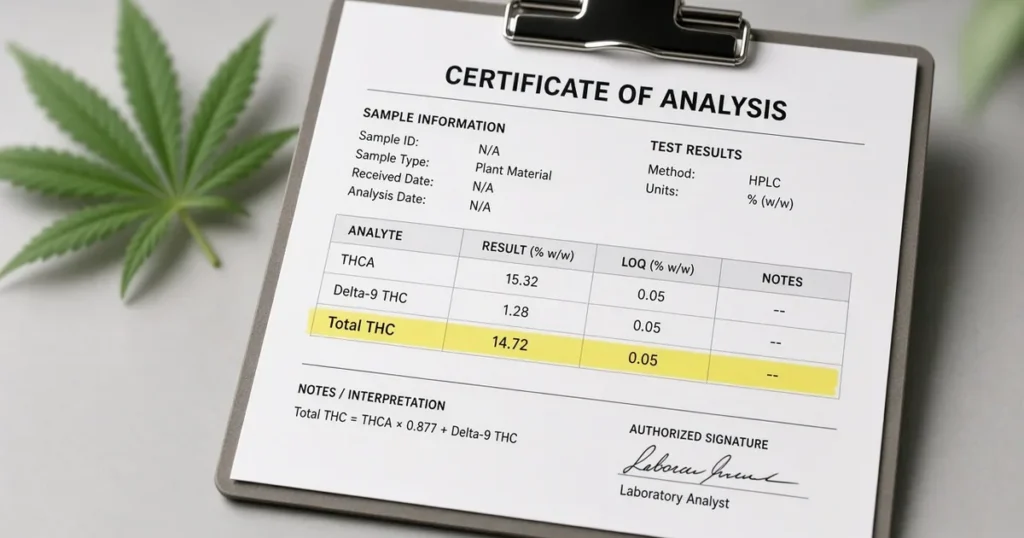
Total THC = delta-9 THC + (0.877 × THCA)
The 0.877 factor accounts for the weight THCA loses when it converts to THC. A lab measures both compounds and combines them. Some labs measure after heating the sample, which converts THCA during testing. Either way, the result reflects the material’s potential THC content once all THCA is converted.
The new statute writes the total THC idea directly into the definition, rather than leaving it to testing rules alone.
Reading a certificate of analysis
If you look at a lab report, often called a certificate of analysis or COA, a few lines matter for total THC.
- Delta-9 THC. Usually listed as a percentage or milligrams per gram.
- THCA. Listed separately on most reports.
- Total THC. Some labs print it directly. If not, you can apply the formula above.
- Moisture or dry weight note. The statute uses a dry weight basis, so check how the lab reported the sample.
- Sample date. Cannabinoid levels change as a plant matures, so an early test may not match a late one.
A COA is a snapshot of one sample. It is not a legal ruling on a product.
When the total THC standard applies
CRS reports the new definition was first set to begin on November 12, 2026. Public Law 119-103, section 2019, then delayed most of it, including the total THC standard, to December 11, 2026. Only the exclusion for certain products with cannabinoids the plant cannot naturally produce is scheduled for November 12. Our hub on the federal cannabis seed rule taking effect December 11 2026 has the full timeline.
Why it matters for seeds
The seed exclusion in the new definition depends on total THC. It removes from hemp “any viable seeds from a Cannabis sativa L. plant that exceeds a total tetrahydrocannabinols concentration (including tetrahydrocannabinolic acid) of 0.3 percent in the plant on a dry weight basis.”
So the question for a seed is not how much THC the seed holds. It is the total THC of the plant it came from. Read the short version in are cannabis seeds hemp under federal law after December 11 2026.
Why it matters for CBD plants
Many home growers choose CBD rich strains. It is tempting to assume those plants are automatically hemp. That is not safe to assume. A plant bred for high CBD can still carry enough THCA to land above 0.3 percent total THC, especially late in flower. Ratio strains, which are bred to carry both CBD and THC, are designed to sit well above that line.
Whether a specific plant or seed falls inside the new definition depends on lab results and the statute, not on a strain name or a marketing label. If you grow CBD strains, treat them under your state’s cannabis rules unless an attorney tells you otherwise. Our CBD seeds collection lists the CBD focused genetics we carry for adults 21 and older where home growing is legal.
What it means for THCA flower
Under the old delta-9 wording, THCA flower sold as hemp relied on low delta-9 numbers. Under a total THC standard, that approach no longer fits the hemp definition, per CRS. We do not sell THCA flower, and we are not giving advice on how to sell or buy it. We mention it because it is the most visible place where the total THC change shows up.
What it does not change
- State law. States set their own cannabis and home grow rules.
- Industrial hemp. CRS notes the new definition expressly includes industrial hemp grown for fiber, grain, oil and other non cannabinoid uses.
- How plants grow. The plant does not care about the statute. What changes is how it is classified.
Sources
- 7 U.S.C. 1639o, as amended by Public Law 119-37, Division B, section 781
- Public Law 119-103, section 2019
- Congressional Research Service, In Focus IF13136 (congress.gov)
- USDA Agricultural Marketing Service, Domestic Hemp Production Program, 7 CFR Part 990
Frequently asked questions
What is total THC in simple terms?
It is the THC a sample contains plus the THC it would produce if its THCA were converted by heat. Labs usually calculate it as delta-9 THC plus 0.877 times THCA.
When does the total THC standard take effect?
Under Public Law 119-103 it is scheduled for December 11, 2026. Check congress.gov for any newer law.
Are CBD seeds hemp under the new definition?
Not automatically. The seed test looks at the total THC of the parent plant. Many CBD rich plants can test above 0.3 percent total THC. Ask an attorney about specific products.
Why does the 0.877 number matter?
THCA is heavier than THC. When THCA converts, it loses part of its weight, so labs multiply THCA by 0.877 to estimate the THC it would become.
Does this affect my state’s home grow law?
No. Your state’s law still sets home grow rules. Federal and state law are separate.
Learn more
Browse our CBD seeds for adults 21 and older where home growing is legal, check your state on our USA hub, or visit the Kind Seed Co shop. This article is not legal advice.