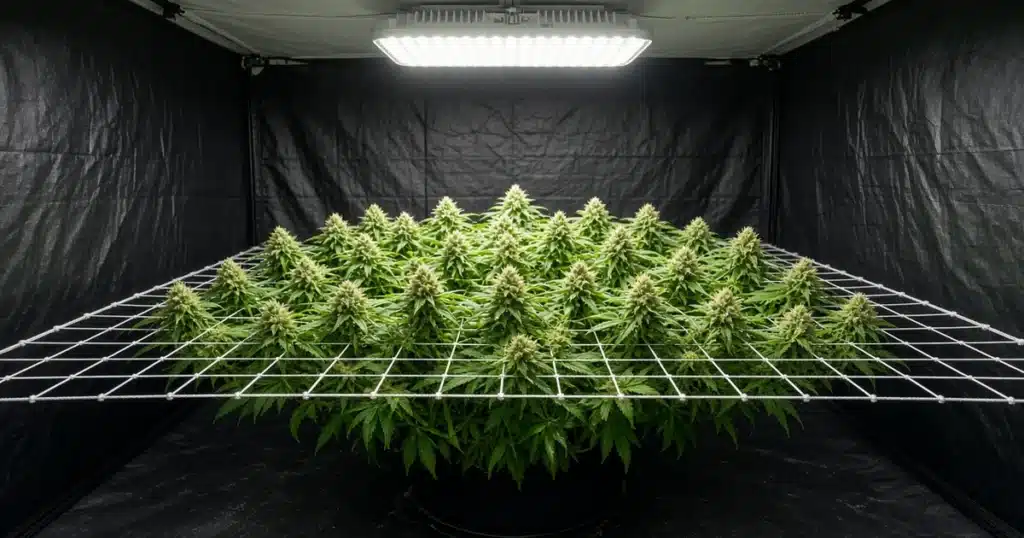
A Guide to Cannabis Defoliation

Defoliation means removing selected leaves, usually large fan leaves, so light and air can reach shaded bud sites. Work only on healthy plants, take a small share of leaves in one session, and wait for new growth before taking more. Defoliation is optional, and many healthy plants do fine with light leaf tucking and selective pruning instead.
Some growers remove selected leaves to open the canopy, but results vary and defoliation does not guarantee larger yields. Your cultivar, pot size and room matter more than any checklist.
What defoliation is, and what it is not
Defoliation means taking leaves off a living plant on purpose. It is not the same as these related techniques.
Lollipopping means trimming weak lower shoots that never get good light. Tucking means bending a fan leaf under a branch instead of cutting it. Pruning a damaged or diseased leaf is simple cleanup. Schwazzing is an aggressive strip that removes most fan leaves at set points, and it is a higher stress method, not a beginner default.
Leaves make energy. Removing them usually costs the plant something in the short term. The bet growers make is that better airflow and light on the remaining sites is worth that cost. Sometimes it is. Other times you have just stressed a plant that was doing fine on its own.
Why growers remove leaves
The reasons are mostly practical. Inner sites stay damp and still once the canopy closes. Large fans shade bud sites you already trained into the light. You need to see stems and soil to check for pests, moisture and structure. And a few yellowing, crowded leaves may be blocking airflow more than they feed the plant.
Airflow is usually the big one. Fruit growers thin canopies for airflow too. Prevention still beats a late panic strip, though. An even canopy, a sensible number of plants and good exhaust all reduce how much leaf you need to take.
How much to remove
There is no universal percentage. As a grower rule of thumb, new growers stay around 10 percent or less of the foliage in one session and do not go past about 20 percent. Count yellow and damaged leaves toward that limit.
Grow guides also suggest leaving at least a week between sessions, and never taking so many leaves that you can see straight through the plant. A useful check when you finish is that the plant should still look full and green on its main sites, with clear gaps opened up, not a bare frame.
If you are unsure, take less. You can always remove another leaf later, but you cannot put one back.
Step by step: which leaves first
- Only work on a healthy plant that is not freshly transplanted or stressed.
- Wipe shears with rubbing alcohol.
- Remove yellow or damaged leaves first.
- Then take big fan leaves that overlap or shade bud sites, from the inside and bottom.
- Stay around 10 percent or less in one session if you are new, and do not go past about 20 percent.
- Wait until the plant has recovered and new growth looks healthy before removing more.
Water on your normal schedule beforehand, so the plant is firm rather than floppy while you work. Cut at the leaf stem close to the branch, and support the branch so you do not twist it. Work in good light. Prefer older, large fans over new growth at the tops. When you finish, keep airflow, temperature and light distance steady and leave the plant alone for several days.
When to defoliate
Timing matters more than the number of leaves. Many grow guides suggest late veg, before the flip. A second, lighter pass around the start of flower, while the plant is still stretching and sites are easy to see, is also common. Small cleanup passes are safer than one big strip.
Avoid heavy removal late in flower, when the plant is putting energy into buds and has little time to recover. Avoid seedlings and early veg, when every leaf is doing real work. And only defoliate healthy plants. If a plant is wilted, short on nutrients, hit by pests or just transplanted, fix that first.
If stretch is a problem, see https://kindseed.com/how-to-control-and-prevent-stretching-in-cannabis-plants/ for other ways to manage it.
Autoflowers
Autoflowers follow a fixed timeline and have little time to recover from a setback. A stall in veg can cost them a lot. If you defoliate an auto at all, keep sessions very light and spaced a few days apart, and favor tucking leaves out of the way instead of cutting them. Many growers skip defoliating autos entirely. For more on autos, see https://kindseed.com/autoflower-seeds/.
Outdoor plants
Outdoor plants in wind and full sun often need their leaves more than tent plants do. Leaves shade buds and help the plant handle heat. Do not copy an indoor strip onto a backyard plant.
That said, dense outdoor plants in humid weather can trap moisture in the center, which raises the risk of mold. Thinning a few inner leaves to let air move through can help. Focus on airflow rather than light. For more on humidity, see https://kindseed.com/what-factors-affect-relative-humidity-control-for-cannabis/.
Risks
Stripping too much slows growth and can stall bud sites. It can also make the plant more sensitive to light and heat, since there is less leaf to buffer the canopy. Fresh cuts plus high humidity can invite problems, so keep air moving and do not soak foliage after a big pass. Autos and small plants can lose days they will not get back. Sick plants need care, not a haircut, so fix water, pH, pests or climate first. And stripping late in flower can suddenly expose buds to light intensity they were not grown under.
If leaves curl, bleach or droop after you defoliate, you took too much, the light is too close, or both. Raise or dim the light and stop cutting.
Defoliation vs training
Defoliation is a poor substitute for topping, low stress training or a screen. If the canopy is a dark forest of uneven tops, removing leaves alone will not even it out. Shape the plant in veg and use leaf removal as a finishing tool, not the whole plan. Small, carefully shaped plants such as bonsai style grows are a different case again, see https://kindseed.com/growing-cannabis-bonsai/.
Troubleshooting
| Sign | Likely cause | What to do |
|---|---|---|
| Growth stalls after leaf removal | Too much taken at once | Pause, keep feed and light steady, and wait until new growth looks healthy before removing more |
| Lower buds stay airy | Light still not reaching | Lollipop weak lower shoots instead of more leaves |
| Leaf spots or mold in dense center | Poor airflow | Thin inner leaves, add a fan, lower humidity |
| Autoflower stays small | Defoliated an auto too hard | Tuck leaves instead next time |
If you took too much, stop. Keep light, water and climate steady. Do not add a strong feed to push recovery. Give the plant time, and judge progress by new growth.
Sources: University of Maryland Extension, Canopy Management: Shoot Thinning and Positioning (https://extension.umd.edu/resource/canopy-management-shoot-thinning-and-positioning). Oregon State University Extension EM 9071, The Role of Canopy Management in Vine Balance (https://extension.oregonstate.edu/catalog/em-9071-role-canopy-management-vine-balance). MSNL, Grow Weed Easy, Mephisto Genetics and HWGrow grow guides.
FAQ
Does defoliation increase yield?
Not as a rule. Some growers remove selected leaves to open the canopy and see more even buds, but results vary and defoliation does not guarantee larger yields. Treat it as canopy management.
Can I defoliate in late flower?
You can remove a dying leaf or one that raises mold risk. A big strip late in flower is risky, because the plant has little time to recover. Keep late work minimal.
Is defoliation required indoors?
No. Plenty of healthy harvests come from plants that were barely touched. If light and air already reach your bud sites, leaving the fan leaves on is a valid choice.
Should I defoliate and lollipop on the same day?
Some growers combine a light leaf pass with lower shoot cleanup around the flip. Doing both heavily at once adds stress. If the plant is small or an autoflower, split the work or skip one.
What if I already took too many leaves?
Stop. Keep light, water and climate steady, and do not add a strong feed to push recovery. Give it time, and judge progress by healthy new growth.
How many leaves can I remove at once?
There is no universal percentage. As a grower rule of thumb, new growers stay around 10 percent or less in one session and do not go past about 20 percent, counting yellow and damaged leaves. Wait for new growth before removing more.
Should I defoliate autoflowers?
Only lightly, if at all. Autoflowers have little time to recover, so keep sessions small and spaced a few days apart, and tuck leaves instead of cutting them where you can.
Should I defoliate a plant that was just transplanted or is already stressed?
No. Let it recover first. Defoliation adds stress, so wait until the plant is growing well again and new leaves look healthy before you remove any.