Growing Cannabis Bonsai

A cannabis bonsai is a small, heavily trained plant kept compact with a small pot, soft ties and steady pruning. Most are photoperiod plants held in veg as mother plants for cuttings, though you can also flower one for a small harvest. Start from a seed or clone in a small pot with drainage holes, train the main stem early, and prune often to hold the shape.
Home growing is legal only in some states, and each state sets its own rules. Check your state’s current home grow law before you start. A bonsai plant still counts toward your state’s home grow plant limit.
What people mean by cannabis bonsai
Cannabis bonsai usually means one of three things: a mother plant that stays small while producing healthy cuttings, a decorative mini plant for a shelf or cabinet, or a way to practice topping and training. It is not the same as classic woody bonsai. Cannabis is soft stemmed and grows fast, so you are shaping a short lived plant, not an ancient tree.
Photoperiod plants suit bonsai best because they stay in veg under long days. Autoflowers flower on their own schedule, so they make poor long term mothers.
Pot size
Root space limits how much top growth you get. Small pots keep the plant small, but they also dry out faster and can stay soggy if drainage is poor. Virginia Cooperative Extension notes that bonsai training pots need “good drainage holes,” and advises growers to water but “do not let it become waterlogged.” Fabric pots help with air around the roots. Hard pots work if you water carefully.
Light and photoperiod
For a mother, keep a veg schedule of 18 hours of light a day so the plant does not flower. Moderate light is plenty for this. A tiny plant under very strong flower lighting spends its energy on stress repair. Rotate the pot if light comes from one side.
Training and pruning
Topping early creates several short branches instead of one tall stem. Low stress training spreads the canopy sideways. Light defoliation opens airflow, but never strip the plant bare. For more on removing leaves, see https://kindseed.com/a-guide-to-cannabis-defoliation/. Remove weak inner shoots that will never get light, and keep a clear frame of main branches you can take cuttings from.
Wire can mark soft cannabis stems, so soft ties are the safer choice. If a stem bends too far or cracks, see https://kindseed.com/how-to-fix-broken-and-bent-cannabis-stems/.
Nutrition
Small pots tend to build up salts faster than large ones do. Feed lighter than you would for a big plant, and give plain water now and then if leaf tips start to burn.
How to grow a cannabis bonsai, step by step
- Start from a seed or clone in a small pot with drainage holes.
- Stake the main stem and tie branches with soft ties.
- Pinch or prune new tops to keep the shape.
- Optional: if roots circle the pot, slip the plant out and trim the outer roots lightly.
- Repot in fresh mix and keep light gentle for a few days.
- Keep it in veg on 18 hours of light a day, or flower it on 12 hours light and 12 hours dark (12/12).
Autoflowers do not use a light switch. They flower by age, so step 6 applies to photoperiod plants only.
Optional: root pruning
Root pruning is not required for a bonsai style plant. Some growers who keep a mother in the same small pot for a long time use it to refresh the root ball. Whether it helps depends on the plant’s health and its container, so go slowly and only try it on a strong plant.
The University of Washington Miller Library gives general advice for container plants, which is not specific to cannabis: “You will need to remove the container in order to prune the roots. Don’t leave cut roots in the container.” It suggests cutting large roots back “by 1/3 to 1/2,” then repotting with fresh mix.
For cannabis, a lighter trim of the outer roots is the cautious approach. Use clean scissors, remove only roots circling the outside, and repot in fresh mix. Keep light gentle for a few days while the plant recovers. If the roots are brown and slimy instead of white and firm, fix the root problem before you think about pruning.
Choosing seeds for a bonsai
Look for traits first: compact size, bushy growth and short gaps between nodes. These plants are easier to keep small and fill out a tiny canopy.
One seed bank, Kannabia, suggests Super OG Kush, describing it as a compact plant with dense, bushy foliage, along with Silver Widow and Gelato K. Treat those as one company’s picks, not a rule. Check our current catalog for compact photoperiod strains before you buy, and if you want a short, quick plant you do not plan to keep as a mother, see https://kindseed.com/autoflower-seeds/.
A simple mother workflow
Top the plant once it has enough nodes to spare, then train branches outward into a flat or slightly domed canopy. Take cuttings from strong, clean growth, but never strip the mother to stubs in one session. Refresh the mix or trim roots on a schedule that matches how often you take cuttings. Retire mothers that turn hermaphrodite, grow weak, or pick up pests you cannot clear. Label everything so you never lose track of which plant is which.
Flowering a bonsai style plant
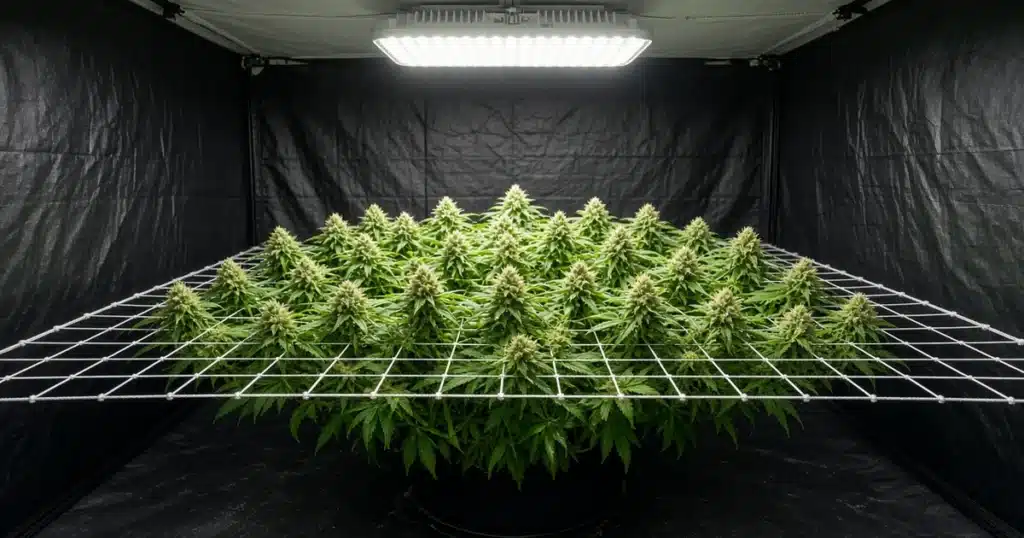
You can flip a compact photoperiod plant to 12/12 for a small harvest. Expect a harvest in line with the plant’s size. Support branches if buds get heavy for the thin stems, and see https://kindseed.com/thick-cannabis-stems/ for more on stem strength.
Troubleshooting
| Sign | Likely cause | What to do |
|---|---|---|
| Leaves yellow after root pruning | Too much root removed | Lower light briefly, mild feed |
| Plant outgrows shape | Too much light or feed | Prune more often, lower feed |
| Soil stays wet | Small pot, poor drainage | Use airier mix, check holes |
| Bark marks from ties | Ties too tight | Loosen and move ties |
Small plants in warm cabinets also attract pests like spider mites and fungus gnats. Check the leaves often and keep a small fan on low for airflow.
Common mistakes and helpful tools
The most common mistake is treating cannabis like a desert bonsai that wants to stay dry. Cannabis in a small pot needs steady, careful watering. Other mistakes include using full strength bloom nutrients on a small vegging mother, taking so many cuttings that the plant never recovers its leaves, and trying to keep an autoflower as a long term mother.
A few simple tools make the job easier: soft plant ties and bamboo skewers for support, clean scissors kept just for your mother plant, a small fan on low, a tray to catch runoff, and a notebook to log feeding and cutting dates.
Legality and practicality
Only grow where it is allowed, and respect plant count rules. A bonsai shape does not create a legal exception. Training does not remove smell in flower, so plan for odor control if you need it.
Sources: University of Washington Miller Library, Root Pruning Container Plants (https://depts.washington.edu/hortlib/pal/root-pruning-container-plants/). Virginia Cooperative Extension SPES 800, The Art of Bonsai (https://www.pubs.ext.vt.edu/content/dam/pubs_ext_vt_edu/426/426-601/SPES-800.pdf). Herb, Kannabia, Blimburn Seeds and Premium Cultivars grow guides.
FAQ
Can I bonsai an autoflower?
You can keep an autoflower short with a small pot and gentle training, but it will flower on its own schedule and will not work as a long term mother plant.
How long can a cannabis mother stay as a bonsai?
Mothers can last a long time with good care, but results vary. Take spare cuttings before a favorite plant declines.
Do I need special bonsai pots?
Drainage matters most. Traditional bonsai pots can work if the holes stay clear and the mix drains well. Plain plastic nursery pots work fine too.
Will extreme pruning increase potency?
No. Pruning has no proven effect on potency. Pruning shapes the plant, but it does not make it stronger.
How small can a cannabis bonsai stay?
That depends on the strain, the pot size and how often you prune. Size and lifespan vary from plant to plant, and results are not guaranteed. Compact, bushy strains in small pots with regular pruning stay smallest.