
Grow Light Watts per Square Foot for Cannabis Tents
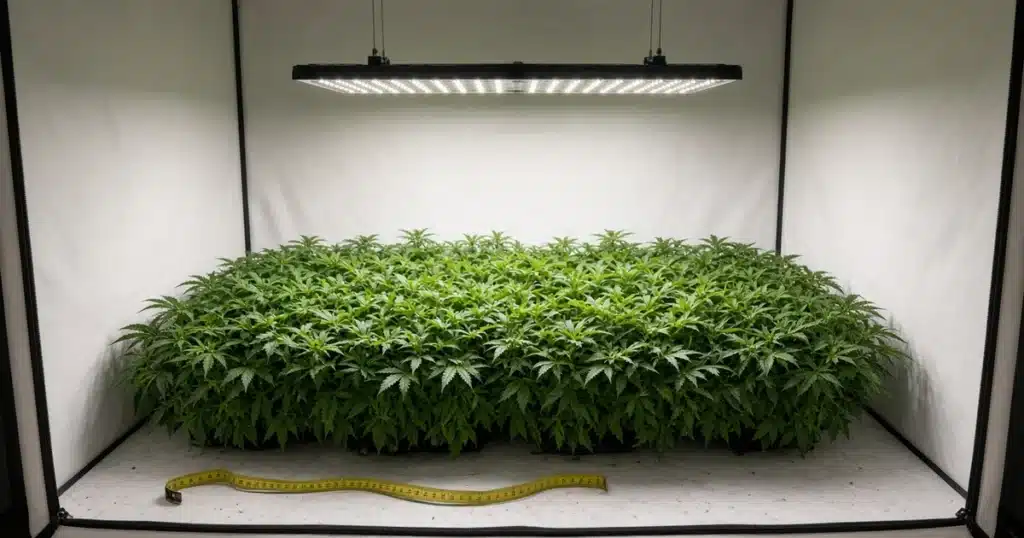
Watts per square foot is a quick way to size a grow light to a space, but it only measures power drawn, not light delivered. A study with older HID-style lamps found plants under 600 W per square meter (about 56 W per square foot) yielded more per plant than under 400 W per square meter (about 37 W per square foot). Modern LEDs make more light per watt, so measure light at the canopy too.
What did research find on lamp power?
Vanhove and colleagues grew indoor cannabis under two lamp power levels and two plant densities.
| Lamp power per m² | Per ft² (approx.) | Average yield per plant |
|---|---|---|
| 400 W | 37 W | 11.7 g |
| 600 W | 56 W | 20.1 g |
Source: Vanhove et al., Forensic Science International, 2011 (first grow cycle, assimilation lamps). 1 m² = 10.76 ft².
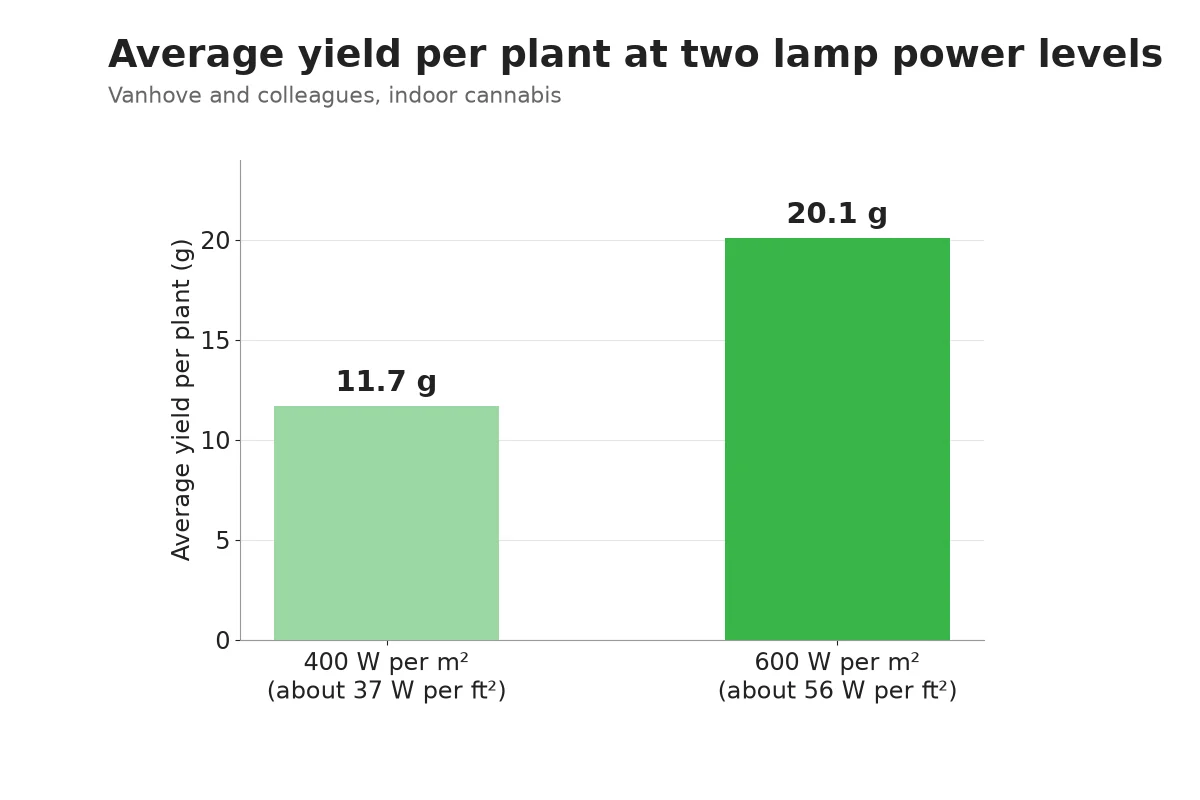
Moving from 400 to 600 W per square meter raised the average yield per plant from 11.7 g to 20.1 g. The same trial also compared 16 and 20 plants per square meter. Each plant gave more when there were fewer of them, about 17.6 g per plant at 16 plants per square meter against 14.5 g at 20. Total yield per square meter showed no significant difference between the two densities.
Why are watts not the whole story?
Two lights with the same wattage can put out very different amounts of usable light. Growers now use PPFD, which measures how much usable light reaches the canopy. See the best PAR for cannabis. A study with LEDs found yield kept rising up to a canopy PPFD of 1,800 µmol/m²/s (Rodriguez-Morrison et al., 2021).
So use watts per square foot as a rough first check and let canopy light have the final say. More watts also bring more heat and a higher power bill, which adds up fast in a small tent.
The key number is efficacy: how many micromoles of light a fixture makes for each joule of electricity, written as µmol/J. A Utah State University study compared fixtures for growing cannabis and measured efficacy from 1.7 µmol/J for an HPS lamp up to 2.5 µmol/J for the best LED. That LED gave 4.6 percent less flower per square meter than the HPS but 27 percent more flower per dollar of electricity.
| Fixture (Westmoreland et al., 2021) | Efficacy | Result |
|---|---|---|
| HPS | 1.7 µmol/J | Baseline |
| White and red LED | 2.5 µmol/J | 4.6% lower yield per m², 27% more yield per dollar of power |
Source: Westmoreland, Kusuma and Bugbee, PLOS ONE, 2021.
In plain terms, a 2.5 µmol/J LED turns the same watts into about 1.5 times as much light as a 1.7 µmol/J lamp. That is why a watts-per-square-foot target taken from older lamp research will overshoot when used with an efficient LED.
The same Utah State work also tested the color mix of the light. Across three studies, yield fell in a consistent, linear way by 12 percent as the share of blue light rose from 4 to 20 percent. Even so, the authors concluded that fixture efficacy matters more than spectrum for the cost of each harvest. When comparing two lights, check the µmol/J figure before the color mix.
How does more light change yield?
Research keeps finding that more light at the canopy brings more flower, within the ranges tested.
- In the Rodriguez-Morrison trial, doubling light to the highest level raised yield by 70 percent but cut energy efficiency by about 15 percent.
- A second University of Guelph trial found flower yield at 1,000 µmol/m²/s was 1.6 times the yield at 600. Each extra 100 µmol/m²/s added about 4.6 g of dry flower per plant.
- The Rodriguez-Morrison authors also pointed out that installed wattage was long used in place of a real light measurement, which overlooks how efficient each fixture is.
The takeaway is that more light usually pays off in yield, but each step up costs more power for a smaller gain per watt. Where to stop depends on your budget and how well you can remove the extra heat.
How do you size a light for your tent?
- Measure the tent floor in square feet.
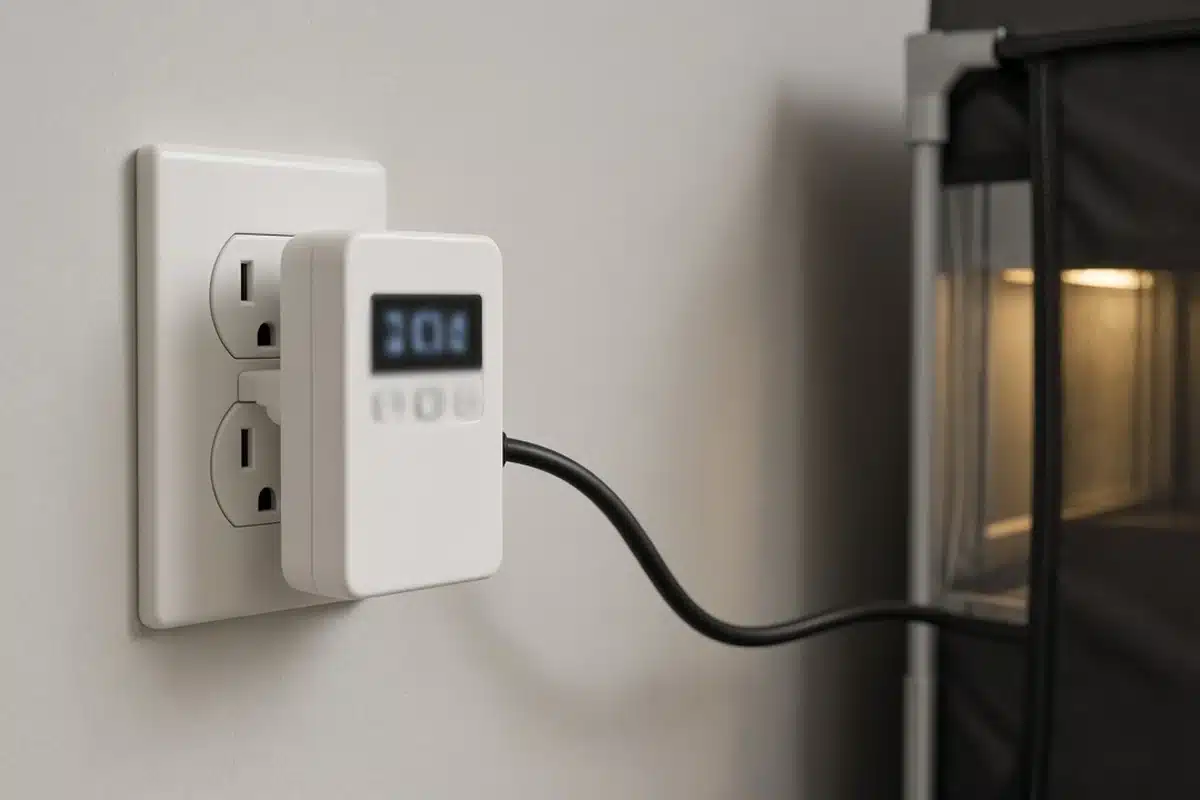
- Check the light’s real draw with a plug-in power meter.
- Divide watts by square feet as a rough check.
- Confirm with a PPFD map or meter at canopy height.
- Set hanging height. See LED light distance.
Plant count matters too. See how many plants per square metre. Label numbers often differ from what a light really draws, so Kind Seed Co suggests writing down the wattage measured at the wall. Compact autoflower seeds suit small tents with limited lamp height.
What does a worked example look like?
Say you have a 2×4 foot tent, which is 8 square feet, and a light that measures 240 W at the wall.
- 240 W divided by 8 square feet is 30 W per square foot.
- That is below the 37 W per square foot of the lower power level in the Vanhove trial.
- But that trial used older lamps. If the light is an efficient LED, its output per watt may be about 1.5 times higher, based on the efficacy figures above.
The watts alone cannot say whether that light is enough. A PPFD reading at canopy height can. If the center reads well and the corners fall far below, the light is too small for the space or hung too high. If the whole canopy reads evenly, the wattage is likely fine for that tent.
Do light hours change how much power you need?
Yes. Plants respond to total daily light, called the daily light integral or DLI. It is the light level multiplied by the hours the light is on. In the Rodriguez-Morrison trial, 1,800 µmol/m²/s on a 12-hour day gave about 78 mol/m²/day. In the Moher trial, 135 to 1,430 µmol/m²/s on a 16-hour day gave about 8 to 80 mol/m²/day.
Hours also drive the power bill. The same light run 18 hours a day uses 50 percent more electricity than when it runs 12 hours. That is simple math, not a study result, but it shows why veg on long days can cost as much as flowering.
Research also links light to yield directly. In the Utah State trials, dry flower yield ranged from 500 to 750 g/m², which worked out to 0.22 to 0.36 grams of dry flower for each mole of light. A light that delivers more moles for the same power gives more flower per dollar.
How do you read a PPFD map?
A PPFD map is a grid of light readings taken at a set distance below the fixture. Look at three things: the center number, the corner numbers, and the distance the map was measured at. If your hanging height differs from the map, your readings will differ too, so treat the map as a starting point and confirm with your own meter.
How much light does each stage need?
Seedlings and clones. Young plants need far less light than flowering plants. Run a dimmable light low and raise it as plants grow. The research above gives no watts-per-square-foot figure for seedlings, so start gentle and adjust as the plants respond.
Vegetative growth. In a University of Guelph trial on a 16-hour day, about 900 µmol/m²/s gave compact, sturdy plants, and about 600 gave taller, more open plants. Plants reached 90 percent of their maximum dry weight gain at about 900. In the Guelph veg trial, about 900 µmol/m²/s at the canopy gave compact, sturdy plants, so a light that reaches that level is a good sign for veg.
Flowering. Yield kept rising up to 1,800 µmol/m²/s in research. Most home growers size for the flowering stage, since it is the most demanding, and dim the light for earlier stages.
What are common light-sizing mistakes?
- Using the label wattage. "Equivalent" or maximum numbers on the box are not what the light draws. Measure at the wall.
- Copying old HID rules for LEDs. Watts-per-square-foot rules from HPS days overestimate what an efficient LED needs.
- Ignoring coverage. A light can be powerful in the center and weak at the edges. A PPFD map shows the spread.
- Buying for the tent size alone. Lamp height, plant count and stage all change what the canopy receives.
- Forgetting heat. More watts mean more heat to remove, so size the exhaust along with the light.
Sources
- Vanhove W, Van Damme P, Meert N. Factors determining yield and quality of illicit indoor cannabis (Cannabis spp.) production. Forensic Science International. 2011;212(1-3):158-163. https://doi.org/10.1016/j.forsciint.2011.06.006
- Rodriguez-Morrison V, Llewellyn D, Zheng Y. Cannabis Yield, Potency, and Leaf Photosynthesis Respond Differently to Increasing Light Levels in an Indoor Environment. Frontiers in Plant Science. 2021;12:646020. https://pmc.ncbi.nlm.nih.gov/articles/PMC8144505/
- Westmoreland FM, Kusuma P, Bugbee B. Cannabis lighting: Decreasing blue photon fraction increases yield but efficacy is more important for cost effective production of cannabinoids. PLOS ONE. 2021;16(3):e0248988. https://doi.org/10.1371/journal.pone.0248988
- Rodriguez-Morrison V, Llewellyn D, Zheng Y. Indoor grown cannabis yield increased proportionally with light intensity, but ultraviolet radiation did not affect yield or cannabinoid content. Frontiers in Plant Science. 2022;13:974018. https://pmc.ncbi.nlm.nih.gov/articles/PMC9551646/
- Moher M, Llewellyn D, Jones M, Zheng Y. Light intensity can be used to modify the growth and morphological characteristics of cannabis during the vegetative stage of indoor production. Industrial Crops and Products. 2022. Preprint opened and checked: https://pdfs.semanticscholar.org/98d2/4468c4b9cb43abd4da11e7ad25bc7a9c4a94.pdf
- Open copy used to verify the Vanhove figures (Ghent University repository, YILCAN report): 20.1 g vs 11.7 g per plant, 17.6 g vs 14.5 g per plant, no significant difference per m². https://backoffice.biblio.ugent.be/download/4256480/4256507
FAQ
How many watts do I need for a 4x4 grow tent?
A 4x4 tent is 16 square feet. At the 56 watts per square foot used in one study, that is about 900 W of older-style lamps. Efficient LEDs need fewer watts for the same light, so check the light's PPFD map rather than wattage alone before buying or hanging it.
Is more wattage always better?
More light usually means more yield up to a point, as research shows. More watts also mean more heat and higher power bills. The number that matters is light at the canopy, so an efficient light with fewer watts can match a less efficient one that draws more from the wall.
How many watts per plant should I use?
Per-plant watts depend on how many plants share the space. Yield is better planned per square foot of canopy than per plant. In the Vanhove study, total yield per square meter did not differ much between 16 and 20 plants per square meter, but each plant yielded more at the lower density.
Do autoflowers need fewer watts?
Autoflowers are often smaller, so they fit tents with less height. They still respond to light like other cannabis. Many growers run them on longer daily light hours, which raises total daily light. Size the light to the tent area, then adjust height and dimming for the plants.


