
Cannabis Taproot vs Fibrous Roots: What Growers Should Know
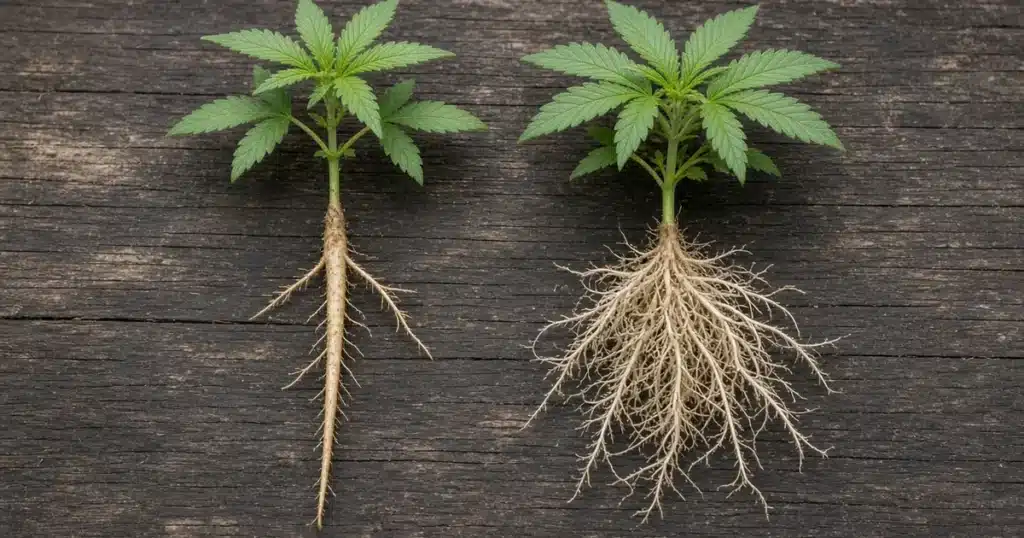
Quick answer: A cannabis plant grown from seed starts with a taproot, a single main root that dives straight down, with side roots branching off it. NC A&T Cooperative Extension reports that direct seeded hemp roots can reach about 6.5 feet deep, while plants started from clones or transplanted seedlings lose their taproot and stay shallower. NC State Extension explains that when a taproot is cut early in life, the plant switches to a fibrous root system of many branching roots. In containers, that fibrous pattern is what most growers end up with, and it suits pots well.
What Is a Taproot?
The botany chapter in NC State’s Extension Gardener Handbook defines two main root types: taproot and fibrous. A taproot forms when the primary root keeps lengthening downward and becomes the central feature of the whole system. Side branching off a taproot is somewhat limited.
Every cannabis seed starts this way. The first structure to emerge from a sprouting seed is the radicle, the embryonic root, and it grows straight down into the soil. If nothing interrupts it, that radicle becomes the taproot.
Carrots and parsnips are the textbook taproots, because the part we eat is the swollen taproot itself. Cannabis does not store food in its taproot that way, but it uses the same basic plan: one deep anchor with smaller roots spreading out from it.
What Is a Fibrous Root System?
A fibrous root system has no single main root. NC State describes it as a system of many lateral roots that keep branching until they make up the plant’s feeding network. Grasses are a classic example.
The Virginia Cooperative Extension Master Gardener botany chapter explains how one becomes the other. When the primary root stops lengthening, numerous lateral roots take over and branch again and again. Both chapters note that nurseries take advantage of this. Undercutting young trees severs the taproot early, which forces a compact, fibrous system and raises the success rate when the trees are moved.
Keep that nursery trick in mind when you look at cannabis grown from clones and transplants.
Does Cannabis Have a Taproot or Fibrous Roots?
It depends on how the plant starts. NC A&T’s All About Hemp guide gives the clearest picture for this species. On plants sown straight into the field, the primary roots may reach roughly 6.5 feet down, with secondary roots extending up to 2.5 feet. Even so, the highest root density is in the top four inches of soil.
The same guide states that floral hemp started from clones or seedling transplants loses its taproot, so those roots do not reach as deep as roots on direct seeded plants. A clone never had a taproot to begin with, because its roots form from stem tissue. A transplanted seedling often has its taproot bent, broken or stopped by the bottom of a small container.
The Missouri Extension hemp publication credits hemp with a deep root system that helps it handle dry spells, which fits the deep taproot of a field plant that was never moved.
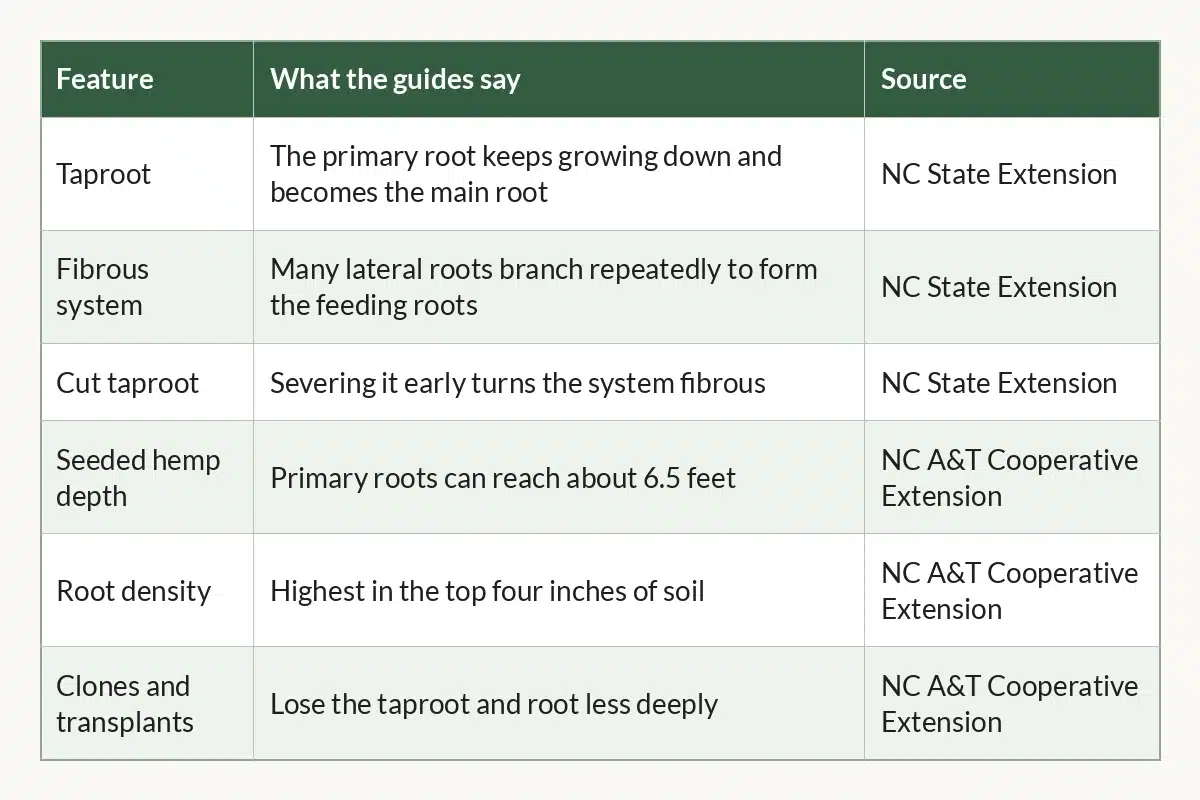
Taproot vs Fibrous Roots at a Glance
| Feature | What the guides say | Source |
|---|---|---|
| Taproot | The primary root keeps growing down and becomes the main root | NC State Extension |
| Fibrous system | Many lateral roots branch repeatedly to form the feeding roots | NC State Extension |
| Cut taproot | Severing it early turns the system fibrous | NC State Extension |
| Seeded hemp depth | Primary roots can reach about 6.5 feet | NC A&T Cooperative Extension |
| Root density | Highest in the top four inches of soil | NC A&T Cooperative Extension |
| Clones and transplants | Lose the taproot and root less deeply | NC A&T Cooperative Extension |
Which Root System Is Better for Growing Cannabis?
Neither wins every time. Each one suits a different way of growing.
A deep taproot helps an outdoor plant in the ground. It anchors a tall plant against wind and can reach water far below the surface during dry weeks. If you sow seeds directly where they will finish and have deep, loose soil, a taproot is an advantage.
Some growers split the difference. Some outdoor growers start seeds in deep, narrow pots and plant them out while the taproot is still short. Others sow two or three seeds where a plant will finish and keep the strongest. Both aim to keep as much of that first root intact as possible.
A fibrous system suits containers. A pot has limited depth, so a taproot quickly hits the bottom and turns. A dense web of branching roots fills the whole volume of mix instead and explores it evenly. That is why clones, which are fibrous from the start, do so well in pots.
Most of the feeding happens near the surface either way. NC A&T’s note that root density peaks in the top few inches shows where the bulk of the system sits, even on a field plant with a deep taproot. That taproot is more about anchoring and drought insurance than daily feeding.
Root depth also shapes how often a plant needs water. A field plant with a deep taproot can pull moisture from layers the surface never shows. A container plant, with every root inside a few gallons of mix, depends entirely on what you give it. That difference is one reason pots dry out so much faster than garden beds and need closer attention in hot weather.
Our guide to why cannabis roots matter goes further into how roots support everything growing above them.
How Does Transplanting Change Cannabis Roots?
Every move affects the root system. When a seedling goes from a small cup into a bigger pot, the tip of the first root has often already reached the bottom and turned. That bend stops the root from heading straight down, and the plant responds by sending out more side roots. Over a few transplants, a seedling that started with a clear taproot ends up with a root ball that looks much like a clone’s.
NC State describes the same response in nursery trees. Cutting or stopping the main root early pushes the plant toward a branching, fibrous pattern. In a container that is not a problem. A fibrous root ball holds the mix together, comes out of the pot in one piece and settles into a new container with less shock.
Timing matters more than the method. Transplanting a seedling while its roots are still small and white causes less disturbance than moving a plant whose roots have circled for weeks. Each move also disturbs the youngest roots around the rim of the root ball, so plants usually pause briefly while those roots regrow.
NC A&T adds one more detail. The guide reports that male hemp plants tend to root less vigorously than females. That matters mainly to growers working with regular seeds who keep males for breeding.
How to Manage Cannabis Root Systems

- Sow outdoor plants in place when practical. Direct sowing keeps the taproot intact for deep rooting.
- Use deep starter pots. If you transplant, give the first root room to grow down before moving.
- Transplant early and gently. Move seedlings before roots circle, keeping the root ball whole.
- Choose pot size for the plan. Larger containers let a fibrous system spread and support bigger plants.
- Plan for the start type. Seedlings headed for beds benefit from taller pots than clones bound for containers.
- Keep records. Note which plants began as seed and which as cuttings, since their root systems will differ.
- Watch for circling roots. Move plants up before roots wrap the container.
Our post on the cannabis root zone covers moisture, temperature and air around the roots.
Troubleshooting Root System Problems
Transplanted seedling stalls. The taproot may have been bent or broken. Keep conditions steady while new side roots form.
Outdoor transplant wilts in dry weather. Without a deep taproot, it depends on shallow roots. Water deeply and mulch.
Roots circle the inside of the pot. The plant is getting root bound. Our guide to root bound cannabis explains what to do.
Roots only grow at the top of the pot. The lower mix may be too wet or compacted. Improve drainage.
Tall outdoor plant leans after storms. Shallow roots offer less anchoring. Stake the main stem.
Sources
- NC State Extension, Extension Gardener Handbook, Chapter 3 Botany: https://content.ces.ncsu.edu/extension-gardener-handbook/3-botany
- NC A&T Cooperative Extension, All About Hemp: https://www.ncat.edu/caes/cooperative-extension/files/all-about-hemp.pdf
- Virginia Cooperative Extension, Master Gardener Handbook, Chapter 1 Botany: https://pressbooks.lib.vt.edu/emgtraining/chapter/1/
- University of Missouri Extension, Industrial Hemp (MX80): https://extension.missouri.edu/publications/mx80
FAQ
Do cannabis plants have a taproot?
Plants grown from seed start with one. Clones never form a taproot, and transplants often lose theirs.
How deep can cannabis roots grow?
NC A&T reports that roots on direct seeded hemp can reach about 6.5 feet.
Do clones have a taproot?
No. Clone roots grow from stem tissue and form a fibrous system.
Is a taproot better in a pot?
Not usually. A fibrous system fills a container more evenly.
Where do most cannabis roots grow?
Most root density sits near the surface, within the top few inches of soil.


