
How Fast Does Cannabis Grow? Growth Rates by Stage
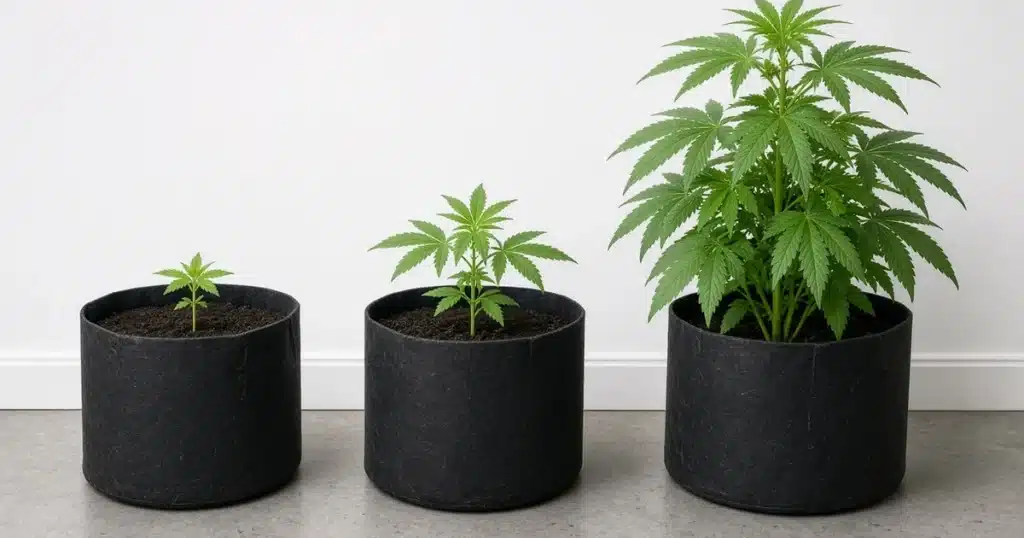
Quick answer: Cannabis grows slowly at first and then very fast. University of Illinois Extension figures for field hemp show about a quarter to half an inch of height per day during the first 30 days, then 1 to 3 inches per day from roughly day 30 to day 60. NC A&T Cooperative Extension describes an early stage where young hemp builds roots more than shoots and reaches one to two feet in about three weeks after emerging. Growth then speeds up until flowering. Indoor plants follow the same pattern, but light, pot size and strain change the pace.
How Fast Does Cannabis Grow Each Day?
Daily growth depends on the stage. The best public numbers come from hemp research, which studies the same species, Cannabis sativa, grown as a field crop.
In its industrial hemp basics presentation, University of Illinois Extension splits vegetative growth into two phases. During a slow phase from day 1 to day 30, plants add about a quarter to half an inch per day. In a rapid phase from day 30 to day 60, they add 1 to 3 inches per day. Those figures describe outdoor field hemp, so use them as a general guide rather than a forecast for any single plant.
Indoors, the pattern often looks much the same. Seedlings seem to sit still for the first couple of weeks while roots develop. Then, once a plant has several sets of leaves and a solid root system, new growth appears almost overnight.
Why the slow start? A young plant has only a few small leaves, so it makes little sugar to fuel new growth. Each new leaf adds more surface to capture light, and that extra energy builds still more leaves. Growth compounds in the same way savings do. The early weeks feel slow because the plant is building the base that makes later speed possible.
What Are the Growth Stages of Cannabis?
NC A&T Cooperative Extension lays out the stages of fiber and seed hemp in its All About Hemp guide. The early stages translate well to any cannabis plant:
- Emergence. From sowing until the seed leaves appear, which takes about four to ten days depending on soil moisture.
- Implantation. Roots develop faster than the stem and leaves. About three weeks after emerging, plants stand one to two feet tall with three pairs of leaves.
- Active growth. This runs until the first flowers form, and most stem and leaf mass builds here.
- Flowering. The first flowers appear, then more open over the following weeks.
The guide also notes that floral hemp started from clones skips the seed and implantation stages. A rooted clone begins life already past the slowest part of the curve, which is one reason cuttings can seem to grow faster than seedlings at first.
Autoflowering types are the main exception to the day length rule. They move into flower on their own schedule rather than waiting for longer nights, so their total time from sprouting to harvest is often shorter. The Extension figures above describe photoperiod hemp, so expect autoflowers to run on a tighter clock.
Height is not the only measure of speed either. A plant can add width, leaf area and root mass without gaining much height, especially under strong light. Judge progress by height alone and you will likely underestimate how much growth is really happening.
How Long Does Each Stage Take?
Timing varies widely, though the published ranges give you a rough frame. The Missouri Extension industrial hemp guide describes hemp as an annual that usually finishes in 60 to 120 days from planting, with variety and conditions setting the exact span.
For outdoor cannabis, day length sets the schedule. NC A&T explains that hemp is a short day plant and that field hemp starts to form flowers after June 21, once days begin to shorten. The same guide gives a critical photoperiod of about 14 hours once the juvenile phase is complete. Indoors, the grower controls that switch with the light timer. The cannabis light cycle guide covers how light hours drive each stage.
NC A&T adds that growing degree days, a measure of heat over time, predict hemp development more reliably than calendar days. A cool spring slows plants down, and a warm one speeds them up.
Indoor growers can shape that timeline more than outdoor growers. A short vegetative period under an 18 hour light schedule, followed by a switch to 12 hours of light, produces a smaller, faster crop. A long vegetative period produces a larger plant that takes more time from start to finish. Neither choice suits every grow. The right one depends on space, light and how many plants share the room.
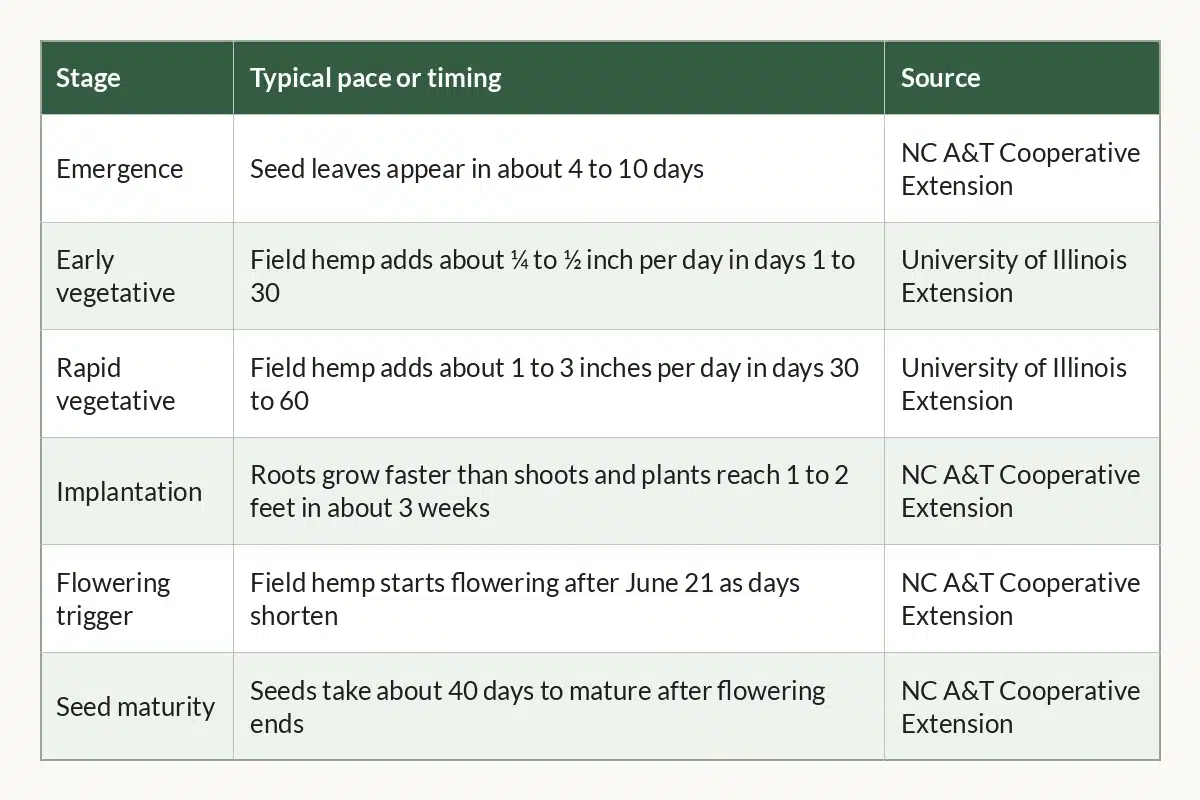
Cannabis Growth Rate at a Glance
| Stage | Typical pace or timing | Source |
|---|---|---|
| Emergence | Seed leaves appear in about 4 to 10 days | NC A&T Cooperative Extension |
| Early vegetative | Field hemp adds about ¼ to ½ inch per day in days 1 to 30 | University of Illinois Extension |
| Rapid vegetative | Field hemp adds about 1 to 3 inches per day in days 30 to 60 | University of Illinois Extension |
| Implantation | Roots grow faster than shoots and plants reach 1 to 2 feet in about 3 weeks | NC A&T Cooperative Extension |
| Flowering trigger | Field hemp starts flowering after June 21 as days shorten | NC A&T Cooperative Extension |
| Seed maturity | Seeds take about 40 days to mature after flowering ends | NC A&T Cooperative Extension |
What Makes Cannabis Grow Faster or Slower?
Light is the biggest factor indoors. Strong, even light drives photosynthesis and compact, steady growth. Weak light produces tall, thin plants that look fast but are stretched. That is different from real growth, and our post on preventing stretch in cannabis explains how to tell them apart.
Temperature matters too. Illinois Extension lists an optimum air temperature range of 66 to 77°F for field hemp, along with soil temperatures above 50°F at planting. Cold roots and cold air both slow growth.
Root space sets a ceiling. Small containers limit root growth, and the shoot cannot outpace the roots for long. According to NC A&T, direct sown hemp roots can reach deep into the soil, with most root density in the top few inches.
Genetics and spacing shape final size. NC A&T reports field hemp heights from three to 19 feet, and it notes that uncrowded plants branch widely while dense stands grow tall with few branches. Missouri lists heights of 4 to 15 feet, varying with the cultivar and its end use.
Water and nutrients round out the list. A plant that wilts often or runs short of nitrogen grows more slowly no matter how good the light is.
Training throws off the numbers too. Topping or bending a plant pauses upward growth for a few days while side branches catch up. The plant may look slower on a tape measure, but it is adding growth across more tops. Measure canopy width as well as height when you train, or the numbers will mislead you.
How to Track Cannabis Growth
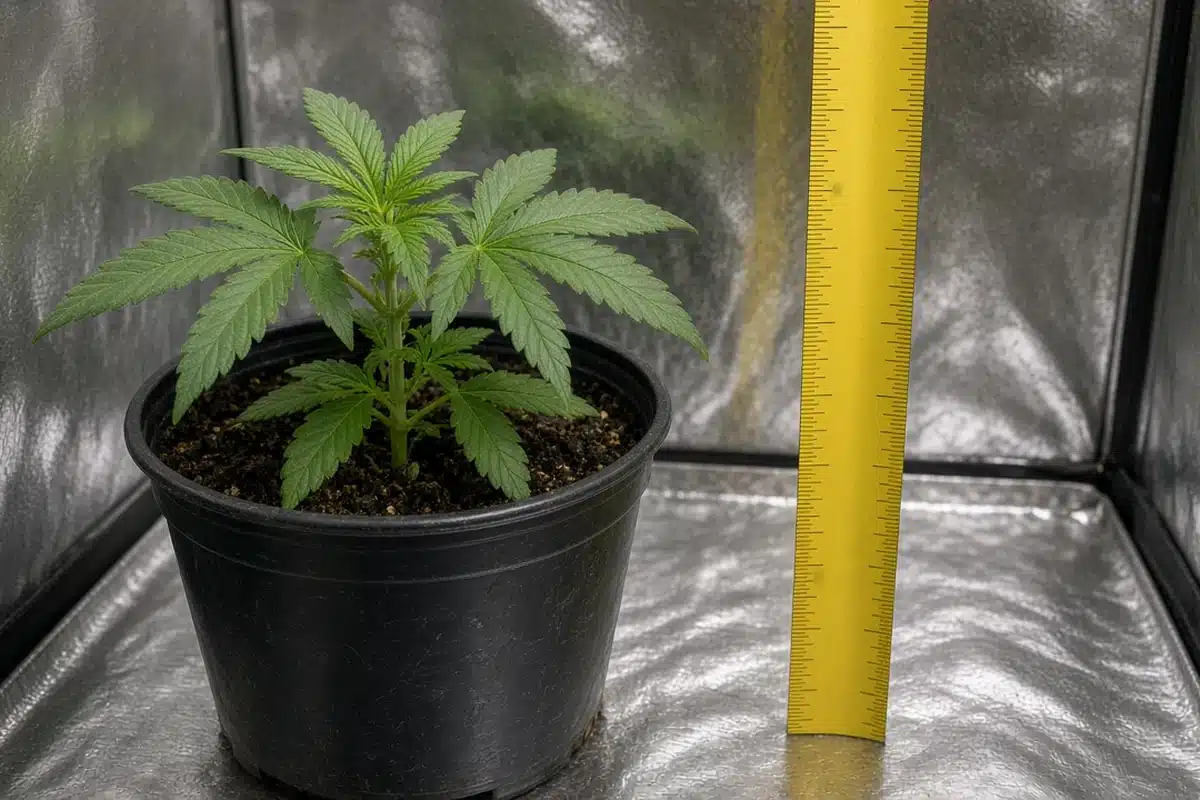
- Measure on a schedule. Check height on the same day each week from the soil line to the top.
- Count nodes. Node count shows real development better than height alone.
- Note the stage. Record emergence, first true leaves and first flowers.
- Log the conditions. Write down light hours, temperature and watering.
- Take photos. Use the same angle and distance each time for fair comparisons.
- Compare plants. Side by side records show which plants or setups grow best.
- Adjust one thing at a time. Change a single factor so you can see its effect.
Our guide to documenting cannabis plant growth walks through keeping a simple grow journal.
Troubleshooting Slow Cannabis Growth
Seedlings look stuck for two weeks. This is often normal root building. Keep conditions steady and avoid overwatering.
Tall, thin plants with long gaps between nodes. Light is too weak or too far away. Move it closer or add intensity.
Growth stalls after a burst. Roots may have filled the pot. Check for circling roots and repot if needed.
Plants grow slowly in a cool room. Raise air and root temperatures toward the mid 70s °F.
Outdoor plants flower while still small. Late planting shortens the vegetative period before days shorten.
Sources
- University of Illinois Extension, Industrial Hemp Basics: https://extension.illinois.edu/sites/default/files/industrial_hemp_basics.pdf
- NC A&T Cooperative Extension, All About Hemp: https://www.ncat.edu/caes/cooperative-extension/files/all-about-hemp.pdf
- University of Missouri Extension, Industrial Hemp (MX80): https://extension.missouri.edu/publications/mx80
FAQ
How many inches does cannabis grow per day?
Field hemp figures from Illinois show about a quarter to half an inch per day early on and 1 to 3 inches per day during rapid growth.
How long does cannabis take to grow from seed to harvest?
Missouri Extension puts the hemp life cycle at roughly 60 to 120 days from planting, varying by cultivar and conditions.
Why does my seedling grow so slowly?
Young plants put their energy into roots first. Shoot growth speeds up after a few weeks.
Do clones grow faster than seeds?
Clones skip the seed stages, so they often start growing quickly once rooted.
When does outdoor cannabis start to flower?
Field hemp in North Carolina starts flowering after the June solstice as days shorten.


