Monoecious Cannabis: Plants With Male and Female Flowers
Quick answer: A monoecious cannabis plant grows both pollen flowers and seed flowers on a single plant. In the words of Oregon State Extension, cannabis is naturally dioecious, meaning males and females grow as separate plants, but that people have bred some monoecious hemp types over a long history of selection. Those types are mainly grown for edible seed and seed oil. NC A&T Cooperative Extension and University of Kentucky Extension both note that some commercial hemp cultivars are monoecious. A monoecious cultivar is a stable, bred trait, which sets it apart from a female plant that unexpectedly makes pollen.
What Does Monoecious Mean?
The word comes from Greek roots meaning one house. In Oregon State’s Hemp Sex Ed publication, the authors explain that a monoecious plant bears both flower types on one individual, so a single plant can reproduce on its own. They add that botanists estimate 90 to 95 percent of all flowering plants work this way.
Think of corn. The tassels at the top produce pollen, which falls and drifts onto the silks below. Each fertilized ovule becomes a kernel. Squash and cucumbers also carry separate male and female flowers on one vine.
The opposite arrangement is dioecious, from the Greek for two houses. Dioecious species grow male and female flowers on separate plants. Oregon State lists hops, asparagus, spinach, dates and persimmon among the few crops that work this way.
Is Cannabis Monoecious or Dioecious?
In its natural state, cannabis is dioecious. Oregon’s publication describes wild Cannabis sativa as splitting into two kinds of plants, each bearing only one flower type. Planting regular seed usually gives a mix of both. University of Vermont Extension, in its Hemp 101 presentation, notes that unfeminized hemp seed often produces a roughly even split of males and females.
Monoecious cannabis is the product of breeding. Oregon State explains that people have been selecting and crossbreeding cannabis for around 10,000 years for seed, oil and fiber, and that some monoecious hemp types came out of that history. NC A&T’s All About Hemp guide states that while hemp is naturally dioecious, some commercial cultivars are monoecious, and University of Kentucky Extension describes several monoecious commercial varieties in its hemp overview.
So the answer is both. The species is dioecious by nature, and certain bred cultivars are monoecious by design.
Why would a plant evolve to keep the sexes apart? Separate plants force cross pollination, which mixes genes from two parents every generation. That mixing keeps a population variable and adaptable. The tradeoff is that male plants never set seed, and Oregon State reports that open pollinated seed typically gives about 30 to 50 percent males. Breeders who wanted more grain per acre had a clear reason to select plants that broke that pattern.
Why Do Farmers Grow Monoecious Hemp?
The main reason is seed. When every plant carries both flower types, pollen is everywhere in the field and nearly every plant can set seed. There is no need to keep a share of the field as male plants that produce no grain.
The Oregon publication says these monoecious types are grown chiefly for food seed and pressed oil, and that they usually carry only small amounts of essential oils. That makes them a poor fit for flower production, where growers want unpollinated female plants.
Uniformity is another draw. Dioecious hemp fields can be uneven, because the Missouri Extension hemp guide reports that male plants have fewer leaves and thinner stems and fade after releasing pollen. A monoecious stand avoids that split, which can make harvest timing more predictable for fiber and grain crops.
NC A&T adds a detail about the seed itself: monoecious cultivars produce smaller seeds than dioecious cultivars.
Monoecious hemp still needs careful handling. Because the plants pollinate themselves and their neighbors so freely, keeping a cultivar true to type takes isolation from other cannabis. Seed producers work hard to stop stray pollen from dioecious plants drifting in and changing the line over time.
Home growers rarely come across monoecious genetics. Most seeds sold for flower production are either regular, giving males and females, or feminized, giving mostly females. A monoecious line would fill a garden with seeds, which is the opposite of what most flower growers want.
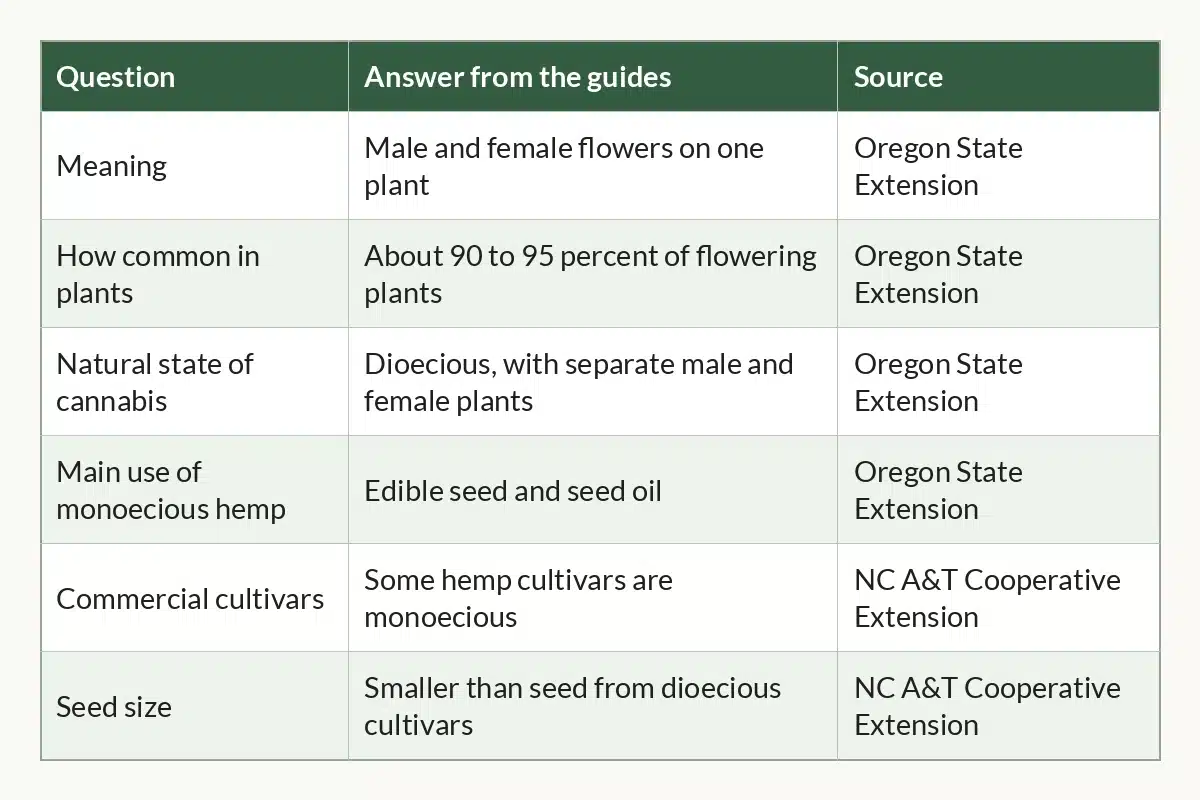
Monoecious Cannabis at a Glance
| Question | Answer from the guides | Source |
|---|---|---|
| Meaning | Male and female flowers on one plant | Oregon State Extension |
| How common in plants | About 90 to 95 percent of flowering plants | Oregon State Extension |
| Natural state of cannabis | Dioecious, with separate male and female plants | Oregon State Extension |
| Main use of monoecious hemp | Edible seed and seed oil | Oregon State Extension |
| Commercial cultivars | Some hemp cultivars are monoecious | NC A&T Cooperative Extension |
| Seed size | Smaller than seed from dioecious cultivars | NC A&T Cooperative Extension |
How Can You Spot a Monoecious Plant?
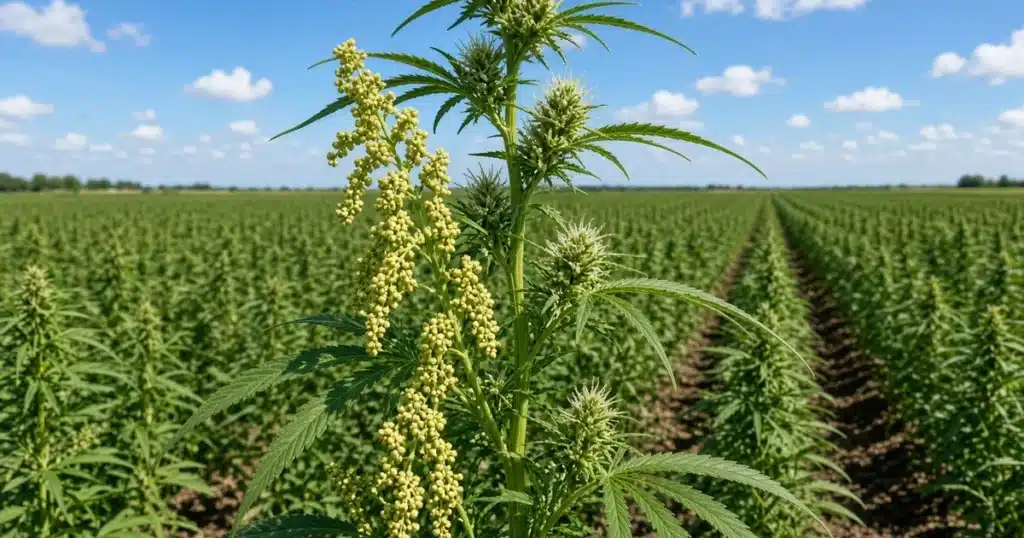
Look closely at where each flower type appears. Male flowers hang in loose clusters with small, rounded pollen sacs that open to release dust like pollen. Female flowers form tighter clusters with white or cream hairs, the pistils, reaching out from small green bracts. A monoecious plant shows both types, often with pollen flowers in some parts of the plant and seed flowers in others.
Timing helps too. The Oregon guide reports that male plants tend to show their flowers before females and can often be recognized from several feet away. On a monoecious plant, both flower types tend to develop within the same flowering period rather than as a late surprise.
Consistency is the best clue. A true monoecious cultivar shows both flower types on nearly every plant, season after season, under good conditions. A plant that suddenly grows a few pollen sacs late in flowering, after stress, points to a reversion on a female rather than a monoecious variety.
How Is Monoecious Cannabis Different From a Hermaphrodite?
The difference is whether both flower types are bred in or show up by accident. A monoecious cultivar is bred to carry both flower types every time, as a stable trait of that variety. Its pollen flowers are expected and planned for.
An unplanned plant with both flower types is a different situation. Oregon State explains that genetically female plants can spontaneously produce male flowers at any point in the season. Growers often call these plants hermaphrodites. The hermaphrodite cannabis guide explains how to spot one early and what to do with it.
Why does it matter? If you grow for flowers, a female plant that throws pollen can seed your crop. If you grow a monoecious seed variety, pollen on every plant is the goal.
Our guides to identifying cannabis gender and understanding gender in cannabis plants show how to tell male and female flowers apart.
What Monoecious Hemp Means for Nearby Growers
- Know what is planted nearby. Ask neighbors or local farm groups about hemp fields in your area.
- Remember cannabis is wind pollinated. Missouri Extension lists hemp as wind pollinated.
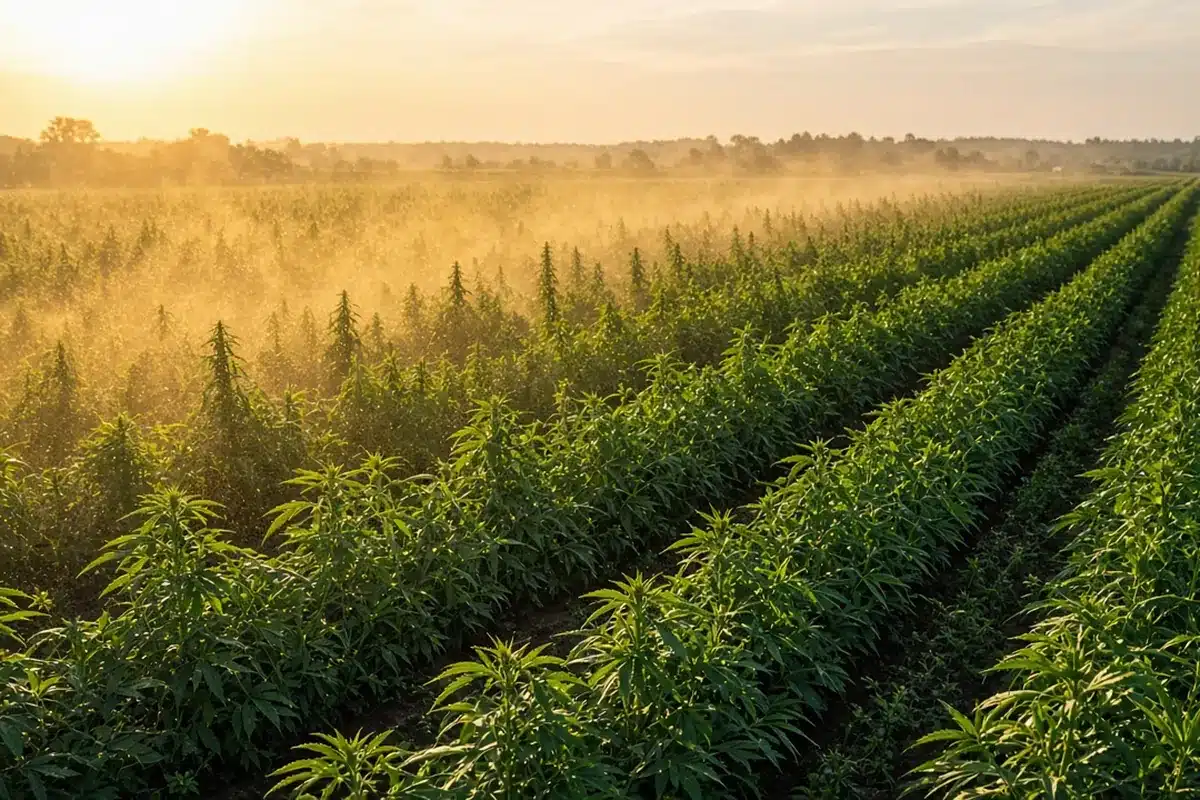
- Expect pollen from every plant. A monoecious field sheds pollen from the whole stand, not just male plants.
- Grow indoors if seeds are a problem. Walls and filters help keep stray pollen out.
- Scout outdoor plants. Check for seeds forming in buds late in flowering.
- Choose your own genetics carefully. Pick dioecious feminized or clone stock for flower production.
- Save seed with care. Pollen from a nearby field can change the next generation.
Our article on hemp pollen drift explains how far pollen can travel and what outdoor growers can do.
Troubleshooting Monoecious Confusion
You see pollen sacs on a plant sold as female. It may be a stressed female, not a monoecious type. If only one plant in the batch does it, stress is the likely cause. If every plant does, look at the genetics.
Seeds appear in outdoor buds with no males nearby. Pollen may have drifted from a hemp field or a stressed plant.
A seed packet lists monoecious. That variety is bred for both flower types and suits seed production.
Regular seeds give mixed males and females. That is normal for dioecious cannabis.
Plants show both flower types every season from the same seed line. The line may carry monoecious traits.
Sources
- Oregon State University Extension, Hemp Sex Ed (EM 9279): https://extension.oregonstate.edu/catalog/em-9279-hemp-sex-ed
- NC A&T Cooperative Extension, All About Hemp: https://www.ncat.edu/caes/cooperative-extension/files/all-about-hemp.pdf
- University of Vermont Extension, Hemp 101: https://www.uvm.edu/d10-files/documents/2024-06/2020_Hemp_101.pdf
- University of Kentucky Extension, Hemp (ID-250): https://publications.mgcafe.uky.edu/id-250
- University of Missouri Extension, Industrial Hemp (MX80): https://extension.missouri.edu/publications/mx80
FAQ
What is a monoecious cannabis plant?
A plant that carries both male and female flowers on the same individual.
Is cannabis naturally monoecious?
No. Cannabis is naturally dioecious, with separate male and female plants. Monoecious types come from breeding.
What is monoecious hemp used for?
Mostly food seed and pressed seed oil, per the Oregon State guide.
Is a monoecious plant the same as a hermaphrodite?
Not quite. Monoecious cultivars carry both flower types by design, while hermaphrodites are usually unexpected and often linked to stress.
Can monoecious hemp pollinate my plants?
Yes. Every plant in a monoecious field sheds pollen that can travel on the wind.