Drying Cannabis in a Garage or Shed: Cold, Damp and Pests
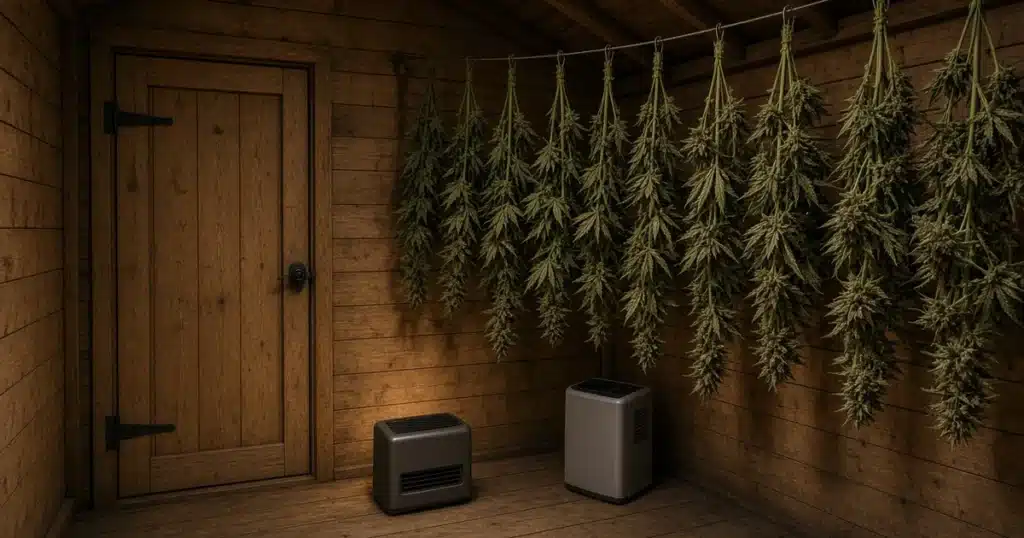
Quick answer: A garage or shed can work as a drying room after harvest. Hemp farms dry in barns, sheds and shipping containers. The trick is control. Hold the space near 60 to 70°F with humidity at 60 percent or less, add a small heater for cold nights and a dehumidifier for damp weather, and keep air moving. Seal gaps bigger than a quarter inch so mice can’t get in.
Can You Dry Cannabis in a Garage or Shed?
Yes. Outbuildings are a normal place to dry hemp. The University of Missouri Extension harvest guide says CBD hemp is hang dried in barns or sheds. The Oregon State University Extension review says a simple structure, such as a barn or a shipping container, is enough for slow drying. The North Carolina A&T hemp program dries its plants hung upside down inside a shipping container.
What those spaces have in common is control. NC A&T runs its container at 60 to 70°F with one air exchange per hour. Oregon State asks for a well ventilated room at 64 to 70°F (18 to 21°C) with 50 to 55 percent humidity. A garage or shed starts out at the mercy of the weather, so your job is to close that gap.
The payoff is space. Whole field plants need 3 to 5 square feet apiece, according to NC A&T, unless you buck them first. A big outdoor harvest can outgrow a closet or tent fast, and a garage gives you room to hang it all with air between the branches.
This post covers drying a harvest only. If you are thinking about growing in an outbuilding, our guide on how to build a grow room in a detached garage or shed covers that project.
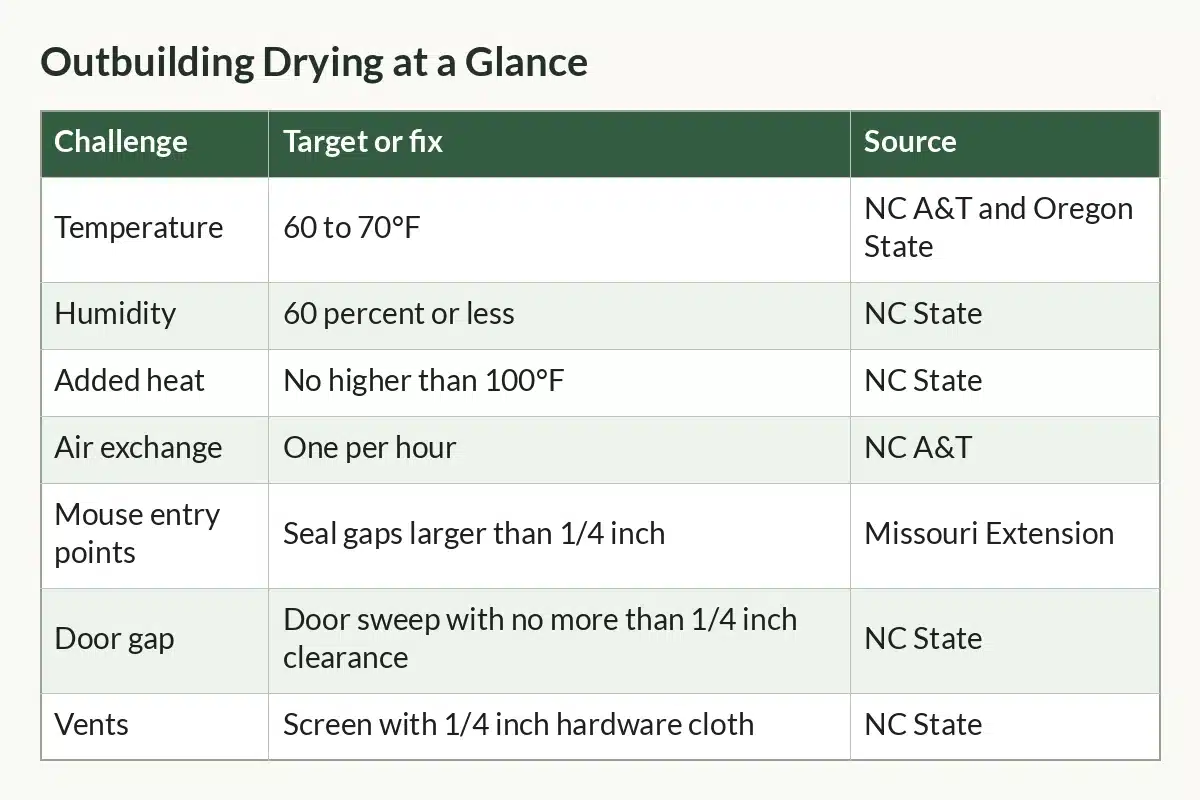
Outbuilding Drying at a Glance
| Challenge | Target or fix | Source |
|---|---|---|
| Temperature | 60 to 70°F | NC A&T and Oregon State |
| Humidity | 60 percent or less | NC State |
| Added heat | No higher than 100°F | NC State |
| Air exchange | One per hour | NC A&T |
| Mouse entry points | Seal gaps larger than 1/4 inch | Missouri Extension |
| Door gap | Door sweep with no more than 1/4 inch clearance | NC State |
| Vents | Screen with 1/4 inch hardware cloth | NC State |
How to Set Up a Garage or Shed for Drying
- Clear and clean the space. Missouri’s guide to controlling house mice says good sanitation and removing places where mice can hide are part of control. Clear clutter, old feed and nesting material.
- Seal it up. See the pest section below. Do this before the harvest comes in. NC State’s mouse guide says windows should close properly and have intact screens, preferably metal, and that cracks around window and door frames can be sealed with caulk.
- Hang lines high and spaced. Hang branches upside down with room between them, as NC A&T does in its container. Plan on 3 to 5 square feet for most unbucked field plants, per NC A&T.
- Keep it dark. Oregon State’s slow drying setup is a dark room. Cover windows if the space gets direct light.
- Add a fan and plan air exchange. NC State Extension says growers succeed in buildings and barns when they keep good airflow. NC A&T gives one air exchange per hour. NC State calls tobacco barns probably the best system for drying hemp.
- Put a thermometer and hygrometer at bud height. You will need readings morning and night.
- Have a heater and a dehumidifier ready. Oregon State lists fans, dehumidifiers and heaters as normal slow drying tools.
How to Handle Cold Nights and Damp Air
Cold and damp often arrive together in fall, right at harvest. Each needs its own fix.
Damp air. NC State says drying works when humidity stays at 60 percent or less. Run a dehumidifier sized for the space, and keep the doors shut on wet days. NC State also cautions that hemp has to stay dry once dried, because moisture it takes on can lead to mold. Our guide to choosing a dehumidifier for a grow room covers capacity.
Cold nights. NC State says some growers add heat with success and some do without it. A common suggestion is heat to about 20 degrees above the outside air, but NC State would hold the line at 100°F while research is still thin. Oregon State’s target of 64 to 70°F is a better goal for a home dry.
Cold slows more than drying. For tobacco, the University of Kentucky curing guide says temperatures under 60°F early in curing slow the chemical changes in the leaf. It also notes that cool spells can bring low humidity that dries leaves too fast. That is tobacco research, but it shows why a cold barn can be a problem in two ways.
Big swings. An uninsulated shed can swing from warm afternoons to cold nights. Kentucky’s tobacco advice for barns drying too fast is to close vents and doors during the day and open them at night. Read your gauges and adjust the same way.
How to Keep Mice and Insects Off Drying Buds
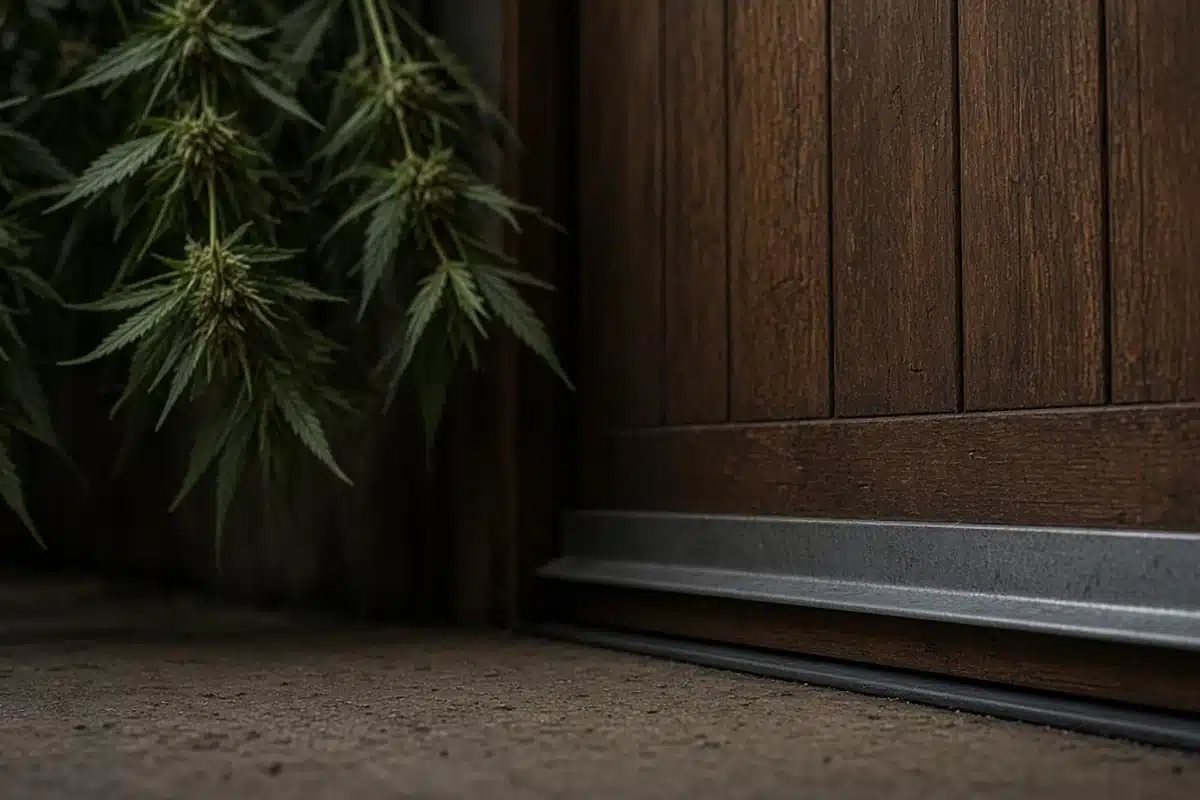
Keep them out rather than chase them later. Exclusion and sanitation are the core of both Extension mouse guides.
Seal the gaps. The University of Missouri Extension guide to controlling house mice says a mouse can get through an opening only slightly larger than a quarter inch. It says to seal any opening larger than that. Steel wool works as a temporary plug. Missouri also warns that plastic sheeting, wood, rubber and other materials mice can chew are poor choices for plugging holes. Check where pipes, wires and vents pass through the walls. NC State lists gaps around electrical lines, plumbing, drainpipes and exhaust vents, along with cracks in foundations, as common ways in. Missouri says to seal those openings tightly with metal or concrete.
Fix the doors. The NC State Extension guide to structure invading mice recommends metal kick plates, metal thresholds or rodent proof door sweeps that leave no more than a quarter inch between door and floor. It also points out that weather stripping is not a rodent proof sweep.
Cover the vents. NC State says openings can be screened with quarter inch mesh hardware cloth. It also says expanding foam is not recommended, because mice can chew through it.
Keep it clean. Missouri says good sanitation alone rarely removes mice, but poor sanitation attracts them and lets them thrive. Remove food, birdseed and pet food from the building.
Know the signs. Missouri lists droppings, fresh gnawing, tracks and a musky odor as signs of mouse activity.
Insects are harder to wall out of a busy garage. A paper bag over small batches can help. The University of Maryland Extension says drying herbs in a paper bag reduces the chance of dust and pests landing on them.
Troubleshooting Garage and Shed Drying
Humidity climbs over 60 percent at night. Run the dehumidifier on a schedule that covers the night. NC State ties drying success to 60 percent or less. Missouri’s hemp guide notes that hemp can be hung in barns or sheds, or dried with forced air dryers.
The space drops below 60°F. Add gentle heat. Stay at or below the 100°F NC State gives.
You find droppings near the buds. Mice are getting in. Missouri says to seal openings larger than a quarter inch. Missouri notes that mice contaminate the food they get into, so throw out any buds they have touched. Missouri says doors, windows and screens should fit tightly as part of keeping mice out.
Buds dried fine, then turned soft. NC State says hemp that isn’t kept dry pulls moisture back in. Jar the buds and store them indoors. Oregon State points to a cold, dry spot near 64°F (18°C) with 45 to 55 percent humidity for long storage. Our guide to curing and storing cannabis flowers covers the next step.
Sources
- University of Missouri Extension, MX79 Harvesting Industrial Hemp: https://extension.missouri.edu/publications/mx79
- Oregon State University Extension, Post harvest processing of hemp flowers: https://extension.oregonstate.edu/catalog/post-harvest-processing-hemp-flowers
- North Carolina A&T, Hemp harvest and post harvest considerations: https://ncat.edu/caes/agricultural-research/industrial-hemp-program/hemp-conference/files/ivey.pdf
- NC State Extension, Hemp Harvest Timing and Drying: https://hemp.ces.ncsu.edu/hemp-harvest-timing-and-drying/
- University of Missouri Extension, G9442 Controlling House Mice: https://extension.missouri.edu/publications/g9442
- NC State Extension, Surveillance and Management of Common Structure Invading Mice: https://content.ces.ncsu.edu/surveillance-and-management-of-common-structure-invading-mice
- University of Kentucky, AGR 177 Proper Curing Management to Minimize Green Tobacco: https://darktobacco.mgcafe.uky.edu/sites/darktobacco.ca.uky.edu/files/agr177.pdf
- University of Maryland Extension, Harvesting and Preserving Herbs: https://extension.umd.edu/resource/harvesting-and-preserving-herbs
FAQ
Is a garage too cold for drying buds?
It can be. NC A&T dries at 60 to 70°F, so add heat if nights fall below that.
What humidity should a shed hold for drying?
60 percent or less, based on NC State.
How small a gap can mice get through?
Missouri says openings slightly larger than a quarter inch.
Should I use expanding foam to seal gaps?
No. NC State says mice can chew through it.
How long does drying take in a shed?
It depends on the weather inside the building. NC A&T reports 1 to 12 days for plants hung in its container, depending on how wet, big and dense the buds are at the start. A cold, damp shed sits at the slow end.
Can I dry in a shed with no power?
It is harder. Without a fan, heater or dehumidifier, you can't hold the targets these sources give.