Freeze Drying Cannabis: How It Works
Quick answer: Freeze drying freezes fresh material solid, then uses a vacuum and gentle heat to turn the ice straight into vapor without melting it. Home machines run about 20 to 48 hours a batch and remove most of the water. Oregon State University Extension lists freeze drying as a way to cut drying time and protect flower quality. The tradeoffs are a machine that costs thousands of dollars, a long cycle, noise and power use.
What Is Freeze Drying?
It is drying by sublimation. The University of Minnesota Extension explains that freeze drying removes water by turning it from solid ice straight into vapor, without passing through a liquid stage. Minnesota adds that the ice crystals leave quickly and in a way that doesn’t damage cell walls. The machine freezes the material first, then pulls the water out as vapor under a vacuum.
Most of what we know about home freeze dryers comes from food safety research. Minnesota, Penn State, Arizona and Utah State all describe the process for food, not cannabis. Their numbers on time, cost and storage are the best guide available, but none of them tested buds.
For hemp, the Oregon State University Extension review of post harvest work names freeze drying, along with convection and infrared drying, as a viable way to decrease drying times while preserving quality. It also warns that these technologies need capital, equipment space and maintenance, and that they can use a lot of energy.
Freeze drying starts with fresh buds, not dried ones. Oregon State says fresh hemp tissue is 70 to 80 percent water. That water is what the machine has to freeze and pull out, so the cycle replaces the whole hang dry, not just the last few days of it.
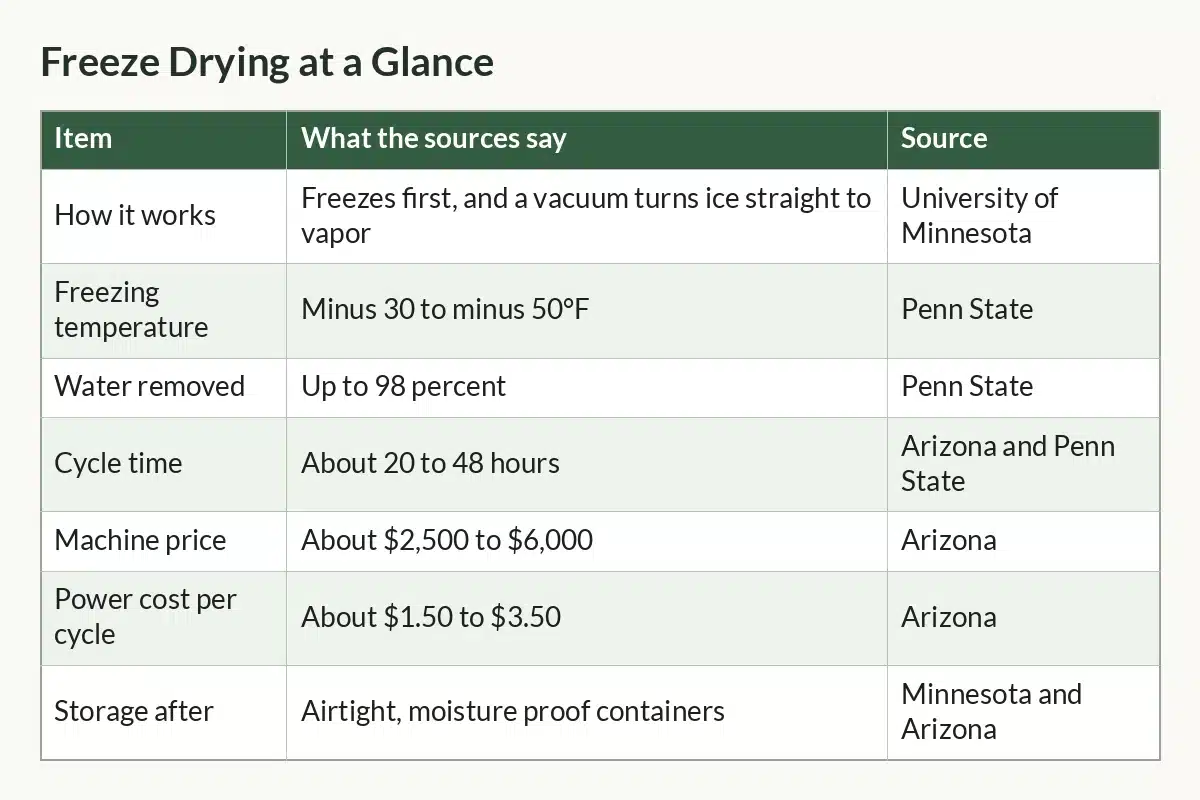
Freeze Drying at a Glance
| Item | What the sources say | Source |
|---|---|---|
| How it works | Freezes first, and a vacuum turns ice straight to vapor | University of Minnesota |
| Freezing temperature | Minus 30 to minus 50°F | Penn State |
| Water removed | Up to 98 percent | Penn State |
| Cycle time | About 20 to 48 hours | Arizona and Penn State |
| Machine price | About $2,500 to $6,000 | Arizona |
| Power cost per cycle | About $1.50 to $3.50 | Arizona |
| Storage after | Airtight, moisture proof containers | Minnesota and Arizona |
How a Home Freeze Dryer Works
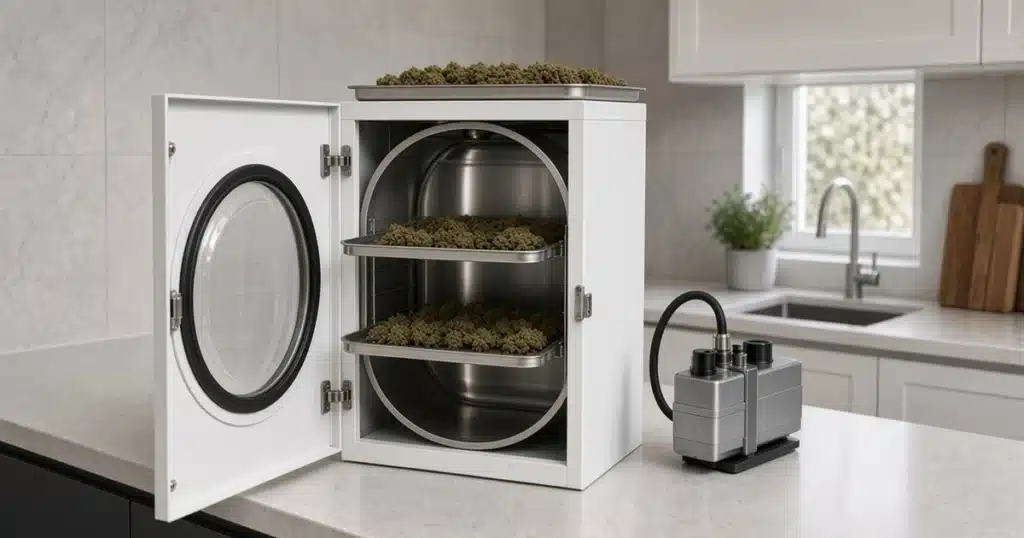
A home unit has two main parts: the freeze dryer and a vacuum pump. Penn State Extension says the pump weighs about 35 pounds and the dryer more than 100 pounds, so you need a sturdy counter, cart or table.
The cycle runs in three stages. Minnesota describes them this way:
- Freezing. The material is frozen hard at very low temperatures, between minus 30 and minus 50°F.
- Primary drying. Under a vacuum, mild heat passes over the trays. The ice turns to vapor, and the pump pulls it out. Minnesota says this step can take out as much as 90 percent of the water.
- Secondary drying. A final stage removes surface moisture, taking out another 1 to 2 percent.
Penn State puts the total as high as 98 percent of the water in food. Utah State University Extension sums it up as freezing, turning ice into vapor and drawing off the remaining moisture with gentle heat.
The setup matters. Penn State gives an ideal room temperature of 45 to 75°F for running a freeze dryer. It notes that the pump and dryer drone like a vacuum cleaner and beep when a cycle ends. The University of Arizona Extension adds that large and extra large models need a 20 amp circuit all to themselves, and most homes don’t have one. Minnesota adds a cleaning habit: wash and sanitize the trays after each batch, and unplug the machine before you clean it.
How to Freeze Dry Buds
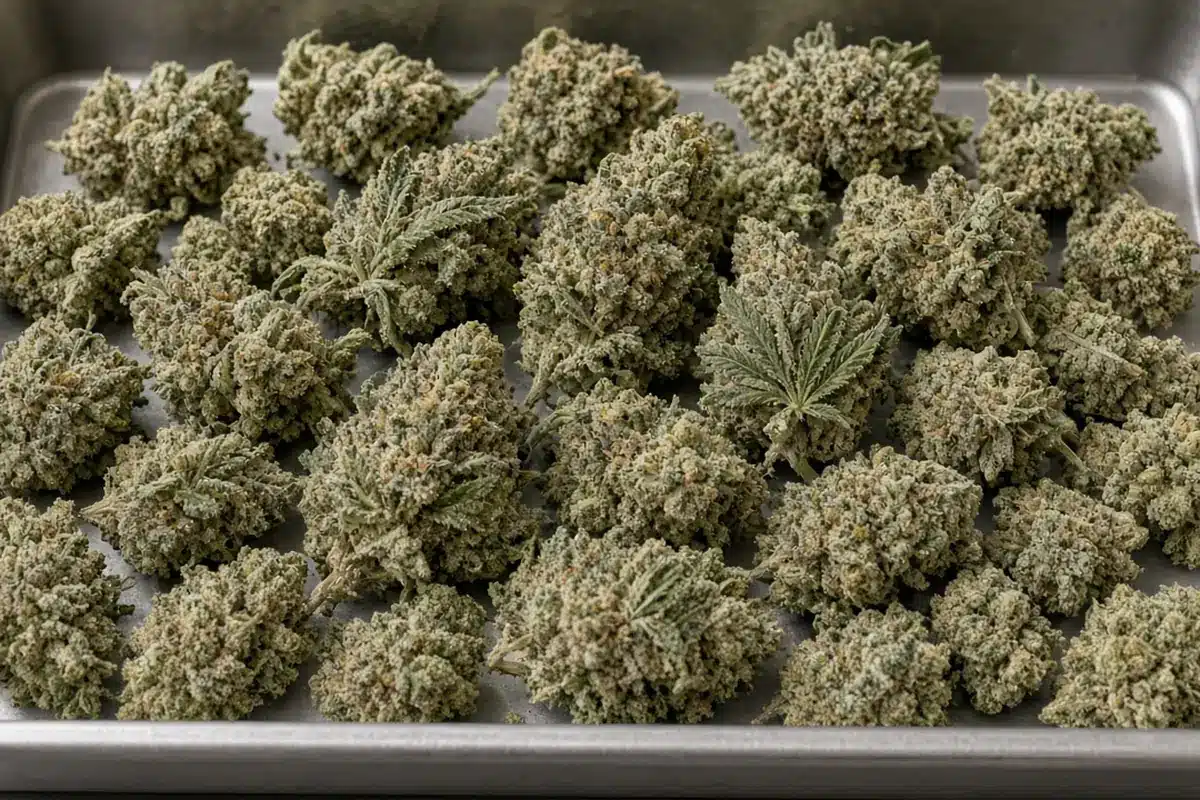
These steps come from the food guides, applied to buds. Always follow your machine’s manual first.
- Read the manual. Minnesota says to follow the manufacturer’s instructions for tray capacity and drying times.
- Spread buds out flat. Minnesota says to spread food evenly, one layer deep. Penn State says pieces of similar size dry at the same rate. Utah State’s guide also recommends small, uniform pieces.
- Consider freezing the trays ahead. Minnesota notes that 48 hours in a household freezer before loading may speed up the process.
- Run the cycle. Arizona says freeze drying usually takes 20 to 40 hours. Penn State gives about 24 to 48 hours.
- Test for doneness. Arizona says that if food is cold to the touch at the end of a cycle, it needs more time. Minnesota suggests checking a sample from each tray, since units can dry unevenly.
- Package right away. Minnesota warns that freeze dried foods absorb moisture easily, even from household humidity. Arizona explains why speed matters here. In a container that isn’t airtight, dried food takes moisture back from the air and spoils.
- Store airtight and dark. Arizona says containers must be airtight and that light should be avoided as much as possible. It adds that dried food keeps best below 60°F and deteriorates much faster above 80 to 90°F. Arizona also suggests taking out as much oxygen as you can, with oxygen absorbers or a vacuum sealer. Penn State compares the options. It says zip top bags and food storage containers suit storage of a few months, while Mylar bags block air and light but need an oxygen absorber and a heat seal.
For storage after any drying method, see our guide to curing and storing cannabis flowers and our post on whether cannabis flower goes bad over time.
Freeze Drying vs Hang Drying
Speed. Freeze drying runs a day or two. Room temperature drying needed roughly four to six days in the University of Vermont drying trial.
Heat. Arizona explains that a dehydrator uses only heat, while a freeze dryer freezes first and then uses a vacuum. Vermont notes that terpenes evaporate easily and that the heaviest losses begin once drying temperatures reach 70°F. A process built on freezing avoids the heat that worries Vermont.
Quality. Utah State says freeze drying keeps the original flavor, texture and nutrients of food better than traditional drying. That is a food finding, so read it as a hint for buds, not proof.
Cost. This is where hang drying wins easily. A line, a fan and a dark room cost very little. Arizona puts home freeze dryers at about $2,500 to $6,000, plus about $1.50 to $3.50 in power per cycle.
Dryness. Minnesota says properly freeze dried foods reach a water activity of about 0.08 to 0.33. Oregon State says hemp flowers in storage are kept at a water activity below 0.65. Those figures suggest freeze dried buds can end up much drier than the storage range Oregon State describes. No source here measured that in cannabis, so check how your buds handle before you jar them.
Upkeep. Arizona says a standard pump needs an oil change every 4 to 5 batches. An oil free pump avoids that but adds about $1,500 to the price.
If you mostly want to slow spoilage of dried buds, freezing is a different job. Our guide on freezing cannabis buds covers it.
Troubleshooting Freeze Drying
Buds feel cold at the end of the cycle. They are not done. Arizona says food that is cold to the touch needs more drying time.
Some trays finish before others. Minnesota says units can process unevenly. Check a sample from every tray.
Freeze dried buds turn soft in storage. They took on moisture. Minnesota warns that freeze dried foods absorb moisture easily, so package them quickly in airtight containers. Utah State stresses immediate packaging to prevent moisture from getting back in.
The machine is too loud for the house. Penn State describes a droning noise and end of cycle beeps. Utah State also notes that some home models are quite loud and that the machines need good ventilation.
Power bills went up. Arizona estimates about $1.50 to $3.50 per cycle.
Sources
- University of Minnesota Extension, Preserving food at home: Freeze drying: https://extension.umn.edu/food/preparing/cooking-at-home/food-preservation/freeze-drying
- Penn State Extension, Let’s Preserve: Freeze Drying: https://extension.psu.edu/lets-preserve-freeze-drying/
- University of Arizona Extension, AZ2097 Basics of Home Freeze Drying: https://extension.arizona.edu/sites/default/files/2025-03/az2097a-2025.pdf
- Utah State University Extension, Freeze drying food at home: https://extension.usu.edu/news/ask-an-expert-freeze-drying-food-at-home-tips-for-safe-successful-results
- Oregon State University Extension, Post harvest processing of hemp flowers: https://extension.oregonstate.edu/catalog/post-harvest-processing-hemp-flowers
- University of Vermont, 2021 Hemp Cannabidiol Drying Trial: https://www.uvm.edu/d10-files/documents/2024-08/2021_Hemp_Cannabidiol_Drying_Trial.pdf
FAQ
Can you freeze dry cannabis at home?
Home freeze dryers exist and can process plant material. The research on them is food research, not cannabis research.
How long does freeze drying take?
About 20 to 48 hours, based on Arizona and Penn State.
Is freeze drying better than hang drying?
It is faster and avoids heat. Hang drying is far cheaper.
How should freeze dried buds be stored?
In airtight containers, out of the light. Minnesota warns that freeze dried foods absorb moisture easily.
How much does a home freeze dryer cost?
Arizona puts the price at about $2,500 to $6,000.