
Evaporative Cooling in Cannabis Greenhouses: Pads, Fans and Swamp Coolers
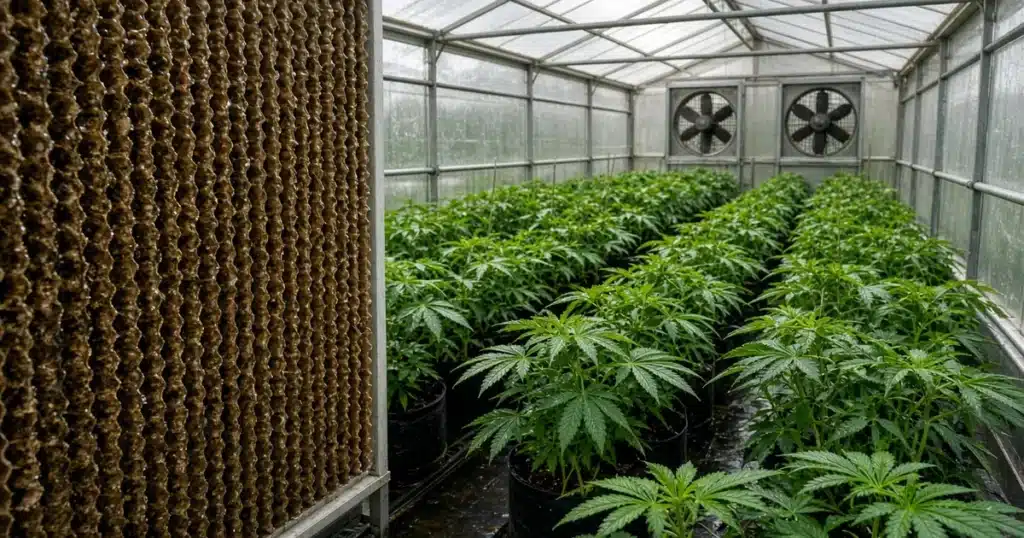
Quick answer: Evaporative cooling pulls outside air through wet pads so evaporating water absorbs heat before the air reaches your plants. UMass Extension says a fan and pad system can cool a greenhouse 10 to 20 degrees F below outdoor temperature and works best in dry climates, though it helps almost anywhere in the US. UF/IFAS Extension adds that the air is coolest right after the pads and warms as it crosses the house, so the fan end runs hotter. Keep doors and gaps closed, keep pads clean and wet and use a swamp cooler for a small freestanding house.
How Does Evaporative Cooling Work?
It takes a lot of heat to turn water into vapor. UMass Extension guidance on fan and pad evaporative cooling notes that raising one pound of water by one degree takes 1 Btu, but turning that same pound into vapor takes about 1,060 Btu. Each gallon evaporated absorbs roughly 8,700 Btu, and exhaust fans carry that warm, moist air outside.
In a typical setup, pads made of aspen fiber or corrugated cellulose sit in one end wall. A pipe along the top keeps them wet, and a gutter below catches the extra water. Fans in the opposite wall pull air through the pads and across the house.
The UF/IFAS publication on fan and pad cooling systems describes the same layout and stresses one rule: all vents and doors must be closed while fans run, so air comes in through the pads and nowhere else.
Does Evaporative Cooling Work in Humid Climates?
It works best where the air is dry. UMass gives a clear example. On a 90 degree F day, outside air at 30 percent humidity can be cooled to about 67 degrees F, but at 70 percent humidity it drops only to about 82 degrees F.
UF explains why. The lowest temperature evaporation alone can reach is the wet bulb temperature, which reflects how much moisture the air already holds. A well run system can bring incoming air within 3 to 4 degrees F of that point. In humid Florida summers, afternoon wet bulb readings often reach 79 to 80 degrees F, which limits how cool the house can get.
For cannabis growers in the dry West, evaporative cooling can be a strong tool. In humid regions it still helps, but expect smaller drops, and pay close attention to humidity during flowering. Our humidity control factors page covers why that matters. Dense flowers that sit in moist air for long stretches invite mold, so plan to cut back on cooling during humid spells in late summer and fall.
Why Is One End of the Greenhouse Hotter?
UF explains that the air is coldest just after the pads. As it moves toward the fans, it picks up heat from sunlight, plants and soil, so a gradient forms with the pad end coolest and the fan end warmest. On sunny summer days, air can warm as quickly as 1 degree F for every 10 feet it travels. The slower the air moves, the larger the rise.
UF adds that the cool air tends to rise at a slight angle as it crosses the house, drifting toward the peak and away from the plants. In long houses, it recommends clear baffles hanging from the roof to just above the crop, spaced about 30 feet apart, to keep cool air at plant level.
Under cover, place heat sensitive plants or young clones nearer the pads, and keep a close eye on plants at the fan end. Our article on cannabis heat stress explains the signs.
Evaporative Cooling at a Glance
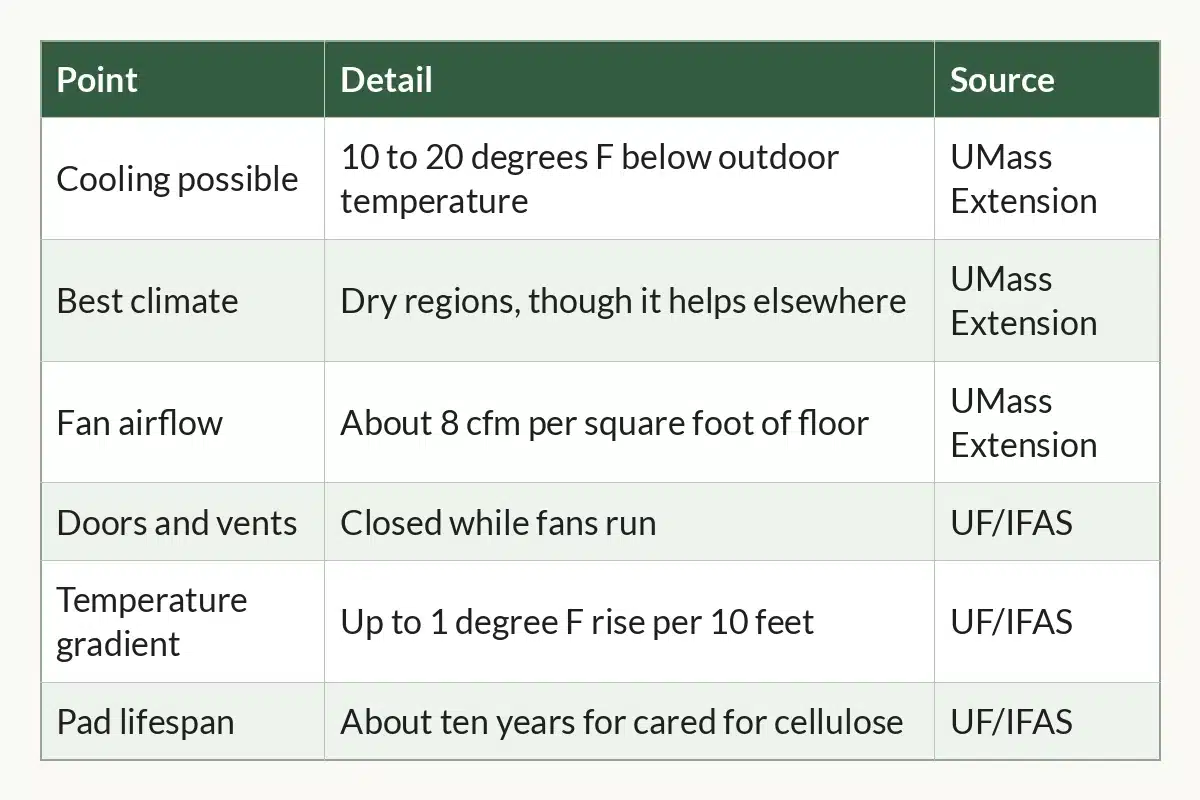
| Point | Detail | Source |
|---|---|---|
| Cooling possible | 10 to 20 degrees F below outdoor temperature | UMass Extension |
| Best climate | Dry regions, though it helps elsewhere | UMass Extension |
| Fan airflow | About 8 cfm per square foot of floor | UMass Extension |
| Doors and vents | Closed while fans run | UF/IFAS |
| Temperature gradient | Up to 1 degree F rise per 10 feet | UF/IFAS |
| Pad lifespan | About ten years for cared for cellulose | UF/IFAS |
How Big Should the Fans and Pads Be?
UMass gives a basic design airflow of 8 cubic feet per minute for every square foot of floor. That rate needs adjusting if the house is unshaded, sits above 1,000 feet in elevation or has less than 100 feet between pads and fans.
Pad area depends on pad type. UMass sizes aspen pads at 150 cfm per square foot of pad, 4 inch cellulose at 250 and 6 inch cellulose at 350. Divide the total fan airflow by one of these numbers to find how much pad you need. UMass also suggests pads between 2 and 8 feet tall for even wetting.
As a worked example from UMass, a 30 by 100 foot house needs about 24,000 cfm of fan capacity, and with 4 inch cellulose pads, that comes to roughly 96 square feet of pad, such as a pad 4 feet high and 24 feet long.
What About Swamp Coolers for Small Greenhouses?
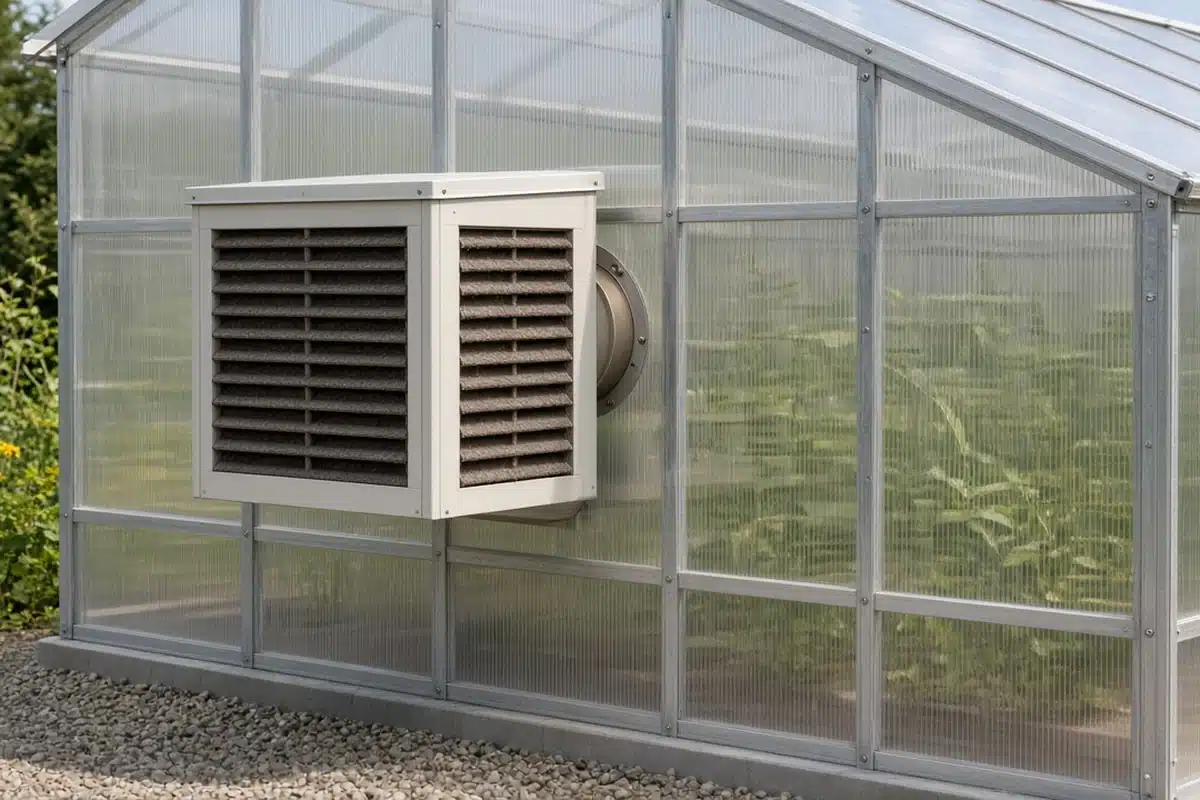
Most hobby cannabis greenhouses are too small for a full pad wall. UMass describes self contained evaporative coolers, often called swamp coolers, with pads and a blower in one box. Most mount outside and blow cooled air in through an opening in a side wall.
UMass suggests a unit rated at 1.2 to 2 times the greenhouse volume in cfm, a little less if the house is shaded. Warm air also needs a way out on the far side, through an open vent, louver or doorway.
Portable coolers on wheels are another option, according to UMass. They need only a hose and an outlet and sit near a door at the end opposite the fans, though several may be needed in hot weather.
How Do You Maintain an Evaporative Cooling System?
UMass and UF both stress upkeep:
- Screen the returning water to catch pad fibers and debris before they clog the pump.
- Flush the sump regularly if your water is high in salts, and add valves or caps to make flushing easy.
- Keep the sump and pipes dark to discourage algae.
- Run fans for half an hour after the water shuts off, which dries the pads and slows algae.
- Keep weeds away from the pad area to reduce clogging.
- Seal gaps in the covering so air does not bypass the pads.
UF notes that cellulose pads with proper care can last about ten years, while aspen pads are prone to algae, rot and compaction.
How Does Evaporative Cooling Compare With Indoor Growing?
Indoor rooms often rely on air conditioning, which removes heat without adding moisture but uses much more power. UF notes that air conditioning a greenhouse usually costs too much to install and run. Evaporative cooling is the practical option for most greenhouse growers. The greenhouse versus indoor comparison covers the broader tradeoffs.
Installing Pads, Fans or a Cooler
- Check your climate. Dry summers give the best results.
- Measure the house. Calculate floor area and volume.
- Size fans or a cooler. Use about 8 cfm per square foot of floor, or 1.2 to 2 times volume for a swamp cooler.
- Size the pads. Divide airflow by the rating for your pad type.
- Plan the airflow path. Pads at one end, fans or an exit at the other.
- Seal the house. Close doors and patch gaps.
- Add controls. Run cooling as the last stage after fans alone fall short.
- Maintain it. Clean screens, flush the sump and dry the pads daily.
Troubleshooting Evaporative Cooling
House stays hot. Air may be leaking in through doors or gaps. Seal openings.
Fan end runs much warmer. The air is moving too slowly. Add fan capacity or baffles.
Humidity climbs too high. Outside air is already moist. UMass suggests a humidistat on the pump.
Pads develop dry streaks. Water flow is too low or the pipe is clogged. Clean holes and check the pump.
Algae grows on pads. The fans stop while the pads are still wet. Run fans after the pump shuts off.
Sources
- UMass Extension, Fan and Pad Evaporative Cooling Systems: https://www.umass.edu/agriculture-food-environment/greenhouse-floriculture/fact-sheets/fan-pad-evaporative-cooling-systems
- UF/IFAS Extension, Fan and Pad Greenhouse Evaporative Cooling Systems (AE069): https://edis.ifas.ufl.edu/publication/AE069
FAQ
How much can evaporative cooling lower greenhouse temperature?
UMass says 10 to 20 degrees F below outside temperature, depending on humidity.
Does it work in humid areas?
It helps, but you get less cooling as outdoor humidity rises.
Can I use a swamp cooler in a small greenhouse?
Yes. Size it at 1.2 to 2 times the house volume in cfm.
Should doors stay open while cooling runs?
No. With the doors open, air slips past the pads.
How long do cooling pads last?
UF says cellulose pads can last about ten years with proper care.


