
Cannabis Heat Stress: Signs, Causes and Fixes
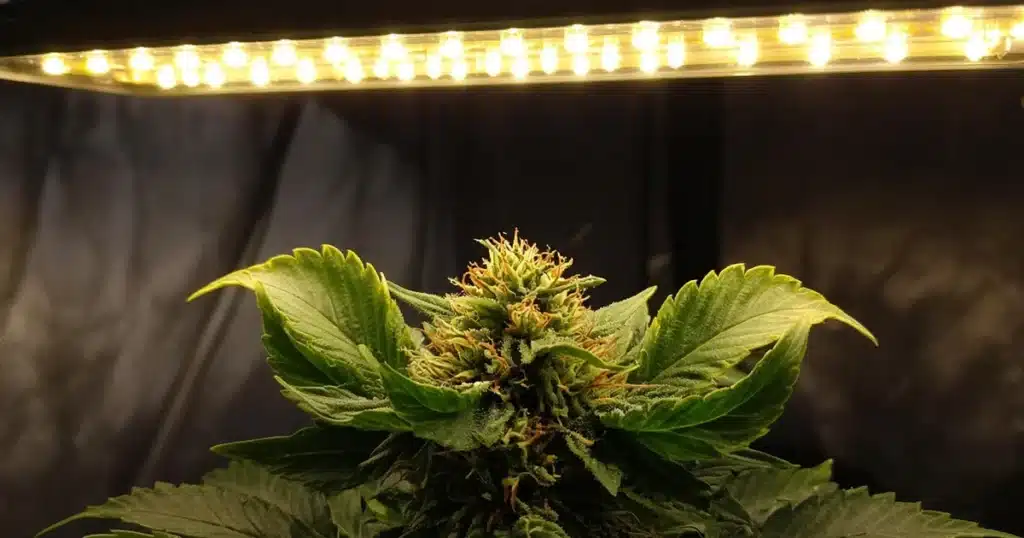
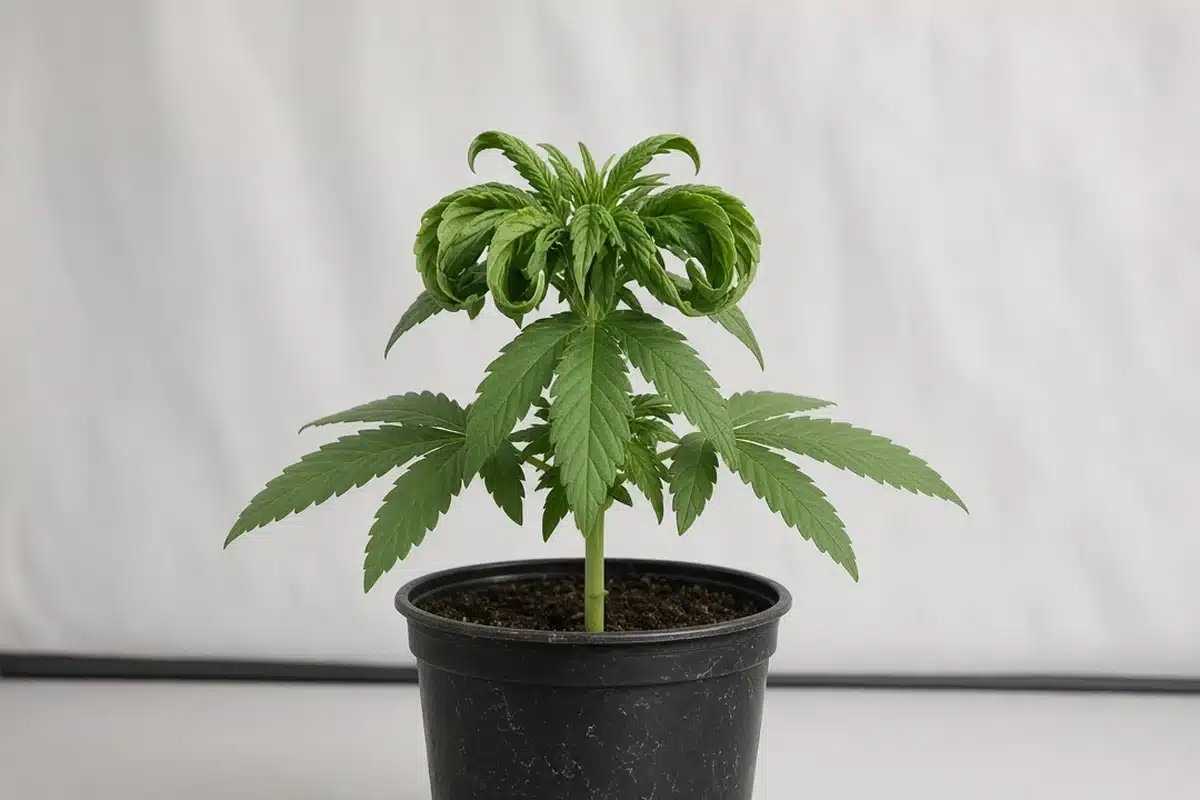
Cannabis heat stress is the damage leaves take when they get hotter than the plant can cool itself. The first signs are upper leaves that cup upward or fold like a taco, edges that look dry, and growth closest to the light that turns pale. Research on cannabis leaves found photosynthesis works best at about 25 to 30 °C (77 to 86 °F) and drops above 30 °C.
What does heat stress look like on cannabis?
Heat stress shows up first at the top of the plant, closest to the lamp. Lower leaves usually look normal. That pattern can help tell heat apart from a feeding problem, though leaf position alone does not confirm the cause.
- Leaf edges curl up and the leaf cups or folds along the midrib.
- Leaf tips look dry or crispy.
- Top leaves or buds turn pale, yellow or white.
- Leaves droop in the afternoon and recover after lights off.
- Buds at the hottest tops may grow looser instead of forming dense clusters.
The timing of the symptoms is a useful clue. If leaves droop during the hottest part of the light period and perk up at night, heat is the likely cause. If they droop all the time, look at watering and roots first.
What temperature is too hot for cannabis?
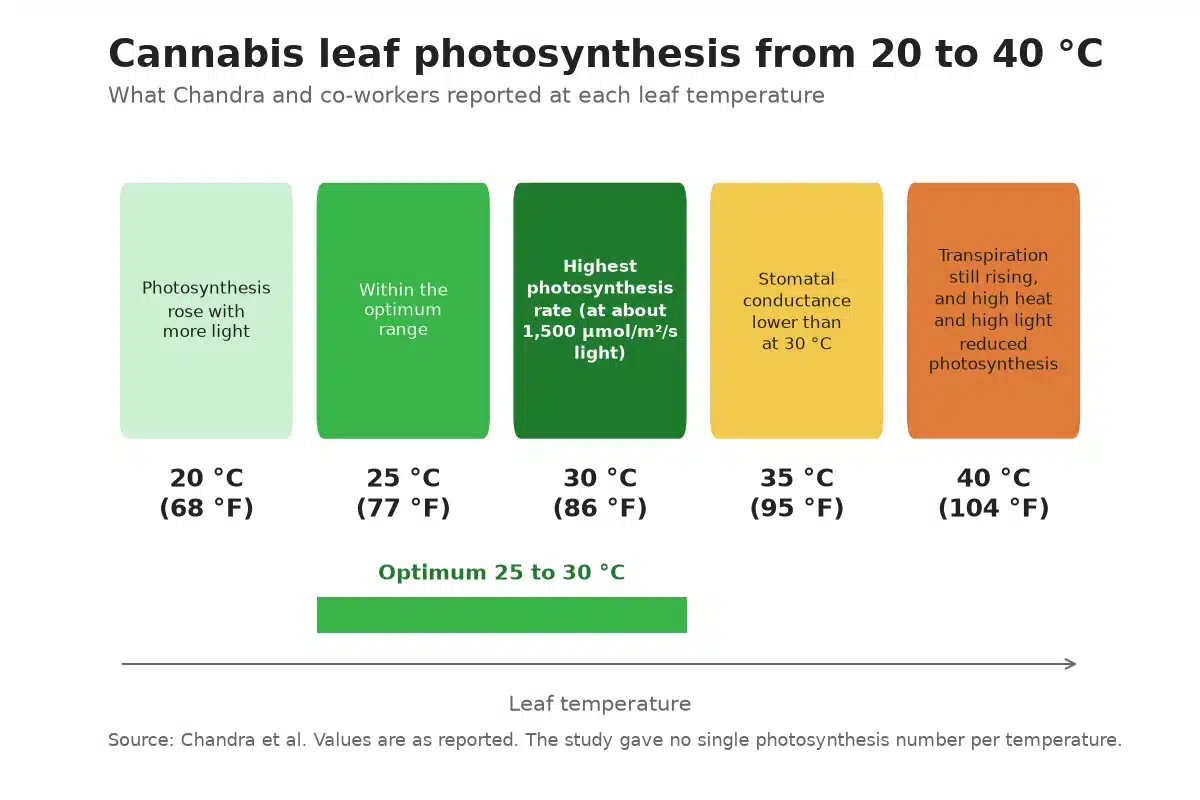
Leaf temperatures above 30 °C (86 °F) start to slow photosynthesis. Chandra and co-workers measured cannabis leaves at 20, 25, 30, 35 and 40 °C and set the optimum at 25 to 30 °C. Above 30 °C, stomatal conductance fell, while water loss through transpiration kept rising up to 40 °C.
| Leaf temperature | What the study reported |
|---|---|
| 20 °C (68 °F) | Photosynthesis rose with more light |
| 25 °C (77 °F) | Within the optimum range |
| 30 °C (86 °F) | Highest photosynthesis rate (at about 1,500 µmol/m²/s light) |
| 35 °C (95 °F) | Stomatal conductance lower than at 30 °C |
| 40 °C (104 °F) | Transpiration still rising, and high heat and high light reduced photosynthesis |
Source: Chandra et al., Physiology and Molecular Biology of Plants, 2008.
Air temperature and leaf temperature are two different readings. A leaf under a strong lamp can run hotter than the room, so measure at canopy height. A thermometer on the tent wall can read fine while the top leaves are already past 30 °C.
Do all plants handle heat the same way?
No. A second study by the same research group tested seven cannabis varieties and found the best temperature for photosynthesis ranged from 25 °C in some to 30 to 35 °C in the most heat-tolerant one. At 40 °C, photosynthesis fell by 16 to 38 percent below each variety’s own best level. Dark respiration, the energy a plant burns in the dark, about doubled as temperature rose from 20 to 40 °C.
| Variety (Chandra et al., 2011) | Best temperature for photosynthesis | Drop in photosynthesis at 40 °C |
|---|---|---|
| HP Mexican | 30 to 35 °C | 16% |
| W1 | 25 to 30 °C | 27% |
| MX | 25 °C | 16% |
| Zolo 15 | About 30 °C | 38% |
Source: Chandra et al., Physiology and Molecular Biology of Plants, 2011.
The practical takeaway is that one plant may shrug off a hot afternoon while its neighbor cups its leaves. Watch each plant rather than assuming the whole room reacts the same way.
Heat also wastes water. In the seven-variety study, pore opening rose with temperature to a peak and then fell at higher temperatures in every variety. Water use efficiency, the sugar a leaf makes for each unit of water it loses, dropped in the heat, and the authors linked that drop to two changes at once: more water lost through transpiration and less photosynthesis. For a grower, a hot canopy means pots dry sooner while growth slows. Check pot weight more often during hot spells instead of watering on the usual schedule.
How do heat, light and CO2 work together?
Heat does not act alone. In the Chandra 2008 study, leaves at 20 to 25 °C kept making more sugar as light rose. At 30 °C, photosynthesis rose only up to about 1,500 µmol/m²/s and then fell at higher light. The authors concluded that high temperature and high light together hurt photosynthesis and water use efficiency.
CO2 changed the picture too. Compared with normal air at 350 ppm, raising CO2 to 750 ppm lifted photosynthesis by about 50 percent and cut transpiration by about 29 percent. Lowering it to 250 ppm cut photosynthesis by about half.
For a home grower, the lesson is simple. A hot room under a strong lamp is the worst mix, because the leaves get more light than they can use while losing water fast. When the canopy runs hot, lowering light intensity often helps as much as cooling the air.
What causes heat stress in a grow?
Most heat stress comes from a light hung too close, a small space with weak air exchange, or a hot summer day. Heat and humidity work together, so check vapor pressure deficit too. The Kind Seed Co VPD chart for cannabis shows how temperature and humidity combine.
- Lamp too close to the canopy.
- Exhaust fan too small for the tent.
- No air moving across the leaves.
- Outdoor heat waves, dark pots in full sun, or dry soil.
The type of lamp matters as well. HPS bulbs give off more infrared heat than LEDs. In a trial at Utah State University, plants under an HPS lamp without a glass shield averaged 0.9 °C warmer at the canopy than plants under LEDs at the same air temperature and light level. That gap is small, but it adds to every other source of heat.
The Utah State team measured canopy temperature with an infrared camera rather than an air thermometer. At home, a handheld infrared thermometer aimed at the top leaves gives a similar leaf reading.
How do you fix cannabis heat stress?
Bring the heat down at the canopy first, then keep the root zone moist. Leaves that already cupped will not flatten again, but new growth should come in normal.
- Raise the light or dim it, then recheck the canopy temperature.
- Size the exhaust to the space. See inline fan CFM for a grow tent.
- Add an oscillating fan so air moves over the leaves.
- Run lights during the cooler night hours in warm months.
- Outdoors, shade pots, use light-colored containers and water early.
- Keep humidity in range. See what affects relative humidity control.
Work through the steps one at a time and give each change a day before the next. That way you can see which fix made the difference.
How should you manage heat at each growth stage?
Seedlings and clones. Young plants have small root systems and dry out quickly. Keep them out of direct lamp heat and check the growing medium often. In one research setup, seeds were germinated at 23 to 25 °C.
Vegetative growth. Plants grow fast and can handle more light, which also means more heat near the tops. University of Guelph trials ran vegetative plants at about 25 °C during the light period. Raise the lamp as plants grow so the tops never close the gap.
Early flowering. After the switch to 12 hours of light, many plants stretch quickly. This is when tops most often grow into the hot zone under the lamp. Check the distance every few days.
Late flowering. Buds are dense and hold heat and moisture. A light-intensity trial kept flowering rooms near 25 °C with about 60 percent relative humidity during the day. Keep air moving through the canopy so the tops do not overheat.
How can you prevent heat stress?
Prevention is mostly measurement. Put a thermometer at canopy height, check it at the warmest time of day, and adjust before leaves show damage. Compact plants such as many autoflower seeds leave more space between the tops and the lamp, which makes heat easier to manage in short tents. Through the first weeks of flowering, when plants stretch toward the light, log canopy temperature each day at the warmest point of the light cycle.
What are common heat stress mistakes?
- Trusting the room thermometer. Readings on the wall or at floor level can be several degrees cooler than the tops.
- Fixing light and heat at once without measuring. Raise the light first, then measure, so you know whether heat or light was the problem.
- Overwatering to compensate. Hot plants use more water, but soggy roots add a new problem. Water when the pot is light, not on a fixed schedule.
- Removing damaged leaves too early. Cupped leaves still make energy for the plant. Remove only leaves that are fully dead.
- Ignoring night temperatures. Plants burn more energy in the dark when it is hot, so a warm night adds to daytime stress.
Sources
- Chandra S, Lata H, Khan IA, ElSohly MA. Photosynthetic response of Cannabis sativa L. to variations in photosynthetic photon flux densities, temperature and CO2 conditions. Physiology and Molecular Biology of Plants. 2008;14(4):299-306. https://pmc.ncbi.nlm.nih.gov/articles/PMC3550641/
- Chandra S, Lata H, Khan IA, ElSohly MA. Temperature response of photosynthesis in different drug and fiber varieties of Cannabis sativa L. Physiology and Molecular Biology of Plants. 2011;17(3):297-303. https://pmc.ncbi.nlm.nih.gov/articles/PMC3550580/
- Westmoreland FM, Kusuma P, Bugbee B. Cannabis lighting: Decreasing blue photon fraction increases yield but efficacy is more important for cost effective production of cannabinoids. PLOS ONE. 2021;16(3):e0248988. https://doi.org/10.1371/journal.pone.0248988
- Punja ZK, Holmes JE. Hermaphroditism in Marijuana (Cannabis sativa L.) Inflorescences: Impact on Floral Morphology, Seed Formation, Progeny Sex Ratios, and Genetic Variation. Frontiers in Plant Science. 2020;11:718. https://pmc.ncbi.nlm.nih.gov/articles/PMC7329997/
- Moher M, Llewellyn D, Jones M, Zheng Y. Light intensity can be used to modify the growth and morphological characteristics of cannabis during the vegetative stage of indoor production. Industrial Crops and Products. 2022. Preprint opened and checked: https://pdfs.semanticscholar.org/98d2/4468c4b9cb43abd4da11e7ad25bc7a9c4a94.pdf
- Rodriguez-Morrison V, Llewellyn D, Zheng Y. Cannabis Yield, Potency, and Leaf Photosynthesis Respond Differently to Increasing Light Levels in an Indoor Environment. Frontiers in Plant Science. 2021;12:646020. https://pmc.ncbi.nlm.nih.gov/articles/PMC8144505/
FAQ
Can cannabis recover from heat stress?
Yes, in most cases. Leaves that already cupped or bleached stay damaged, but the plant keeps growing once the canopy cools. New leaves should come in flat and green within several days. Remove only leaves that are fully dead, since damaged leaves still make some energy for the plant.
Is 90 °F too hot for cannabis?
90 °F is about 32 °C, which is above the 25 to 30 °C range where cannabis leaves photosynthesized best in testing. A short spike may cause little harm, but long periods at that temperature slow growth. Raise the light, add airflow or run lights at night to bring the canopy down.
How is heat stress different from light burn?
Both show up at the top of the plant, so they are easy to mix up. Heat stress usually brings cupped, curled leaves and drooping, while light burn shows as bleached, white or yellow tops that stay firm. Often both happen together, because a lamp that is too close adds light and heat.
Does heat stress lower bud quality?
Heat during flowering can give airy buds or thin spires, a pattern growers call foxtailing. High heat also speeds water loss through the leaves, so plants dry out faster. Keeping the canopy near 25 to 30 °C during bloom is the simplest way to protect bud structure.


