
Harvesting Cannabis in the Rain
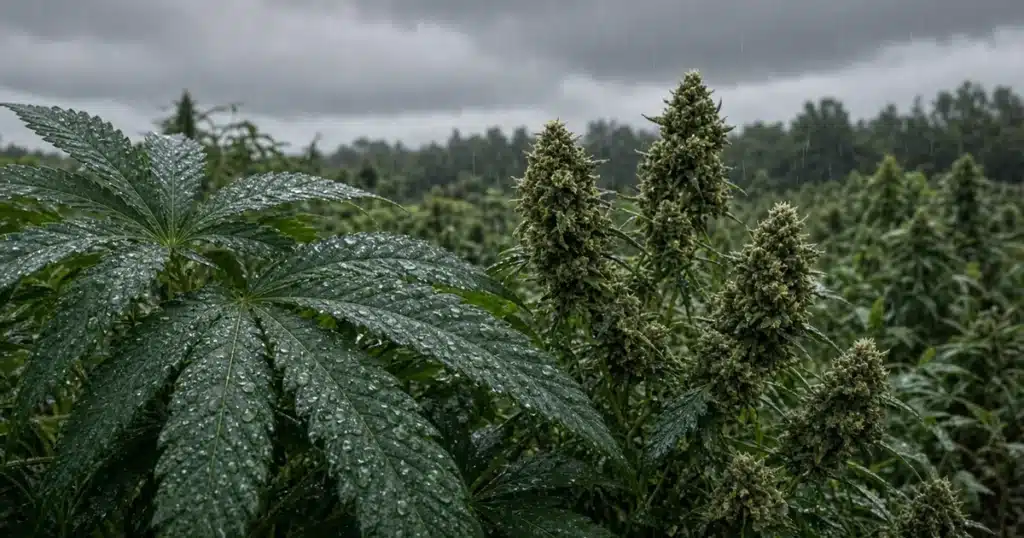
Quick answer: If your plants are ready and more wet weather is coming, cutting in the rain can be the safer choice. UVM Extension says weather and pest risk often push harvest earlier in cooler regions, and UF/IFAS says gray mold strikes flower buds first in humid conditions. Shake off surface water, get the branches indoors and dry them in moving air with humidity at 60 percent or less, as NC State advises for hemp.
Should You Harvest Cannabis When It Rains?
It depends on two things: how ready the plants are and what the forecast holds.
Dry plants are easier to handle. The UVM Extension guide to hemp for flower production says trimming buds and stripping leaves can be easier on freshly harvested plants that have had no water for the past two days. If a dry spell is due soon, waiting for it makes sense.
But waiting has risks too. The UVM Extension 2022 harvest date report says outdoor growing brings challenges from weather and pest pressure. It adds that the risk of frost or crop loss can often hasten the need to harvest in the Northeast and other cooler or erratic weather regions. The report’s discussion goes further. It says cold, wet fall weather and hard frosts often decide harvest timing in the Northeast, and it concludes that saving part of a crop beats losing all of it to weather or disease.
Disease is the main worry in wet weather. The UF/IFAS Extension hemp disease guide says gray mold is one of the common hemp diseases in Florida because of high humidity, and that flower buds are the first to be blighted.
One common claim needs care. The University of Missouri Extension does say that delaying harvest raises the risk of mold, but that line is in its section on grain hemp grown for seed, not flower. It is a useful hint, not direct evidence for buds.
So the call comes down to a trade. If the plants are ready and the rain will last, cutting wet and drying well may beat leaving ready buds in the weather. Our post on preparing outdoor cannabis for storms covers the steps before the weather hits.
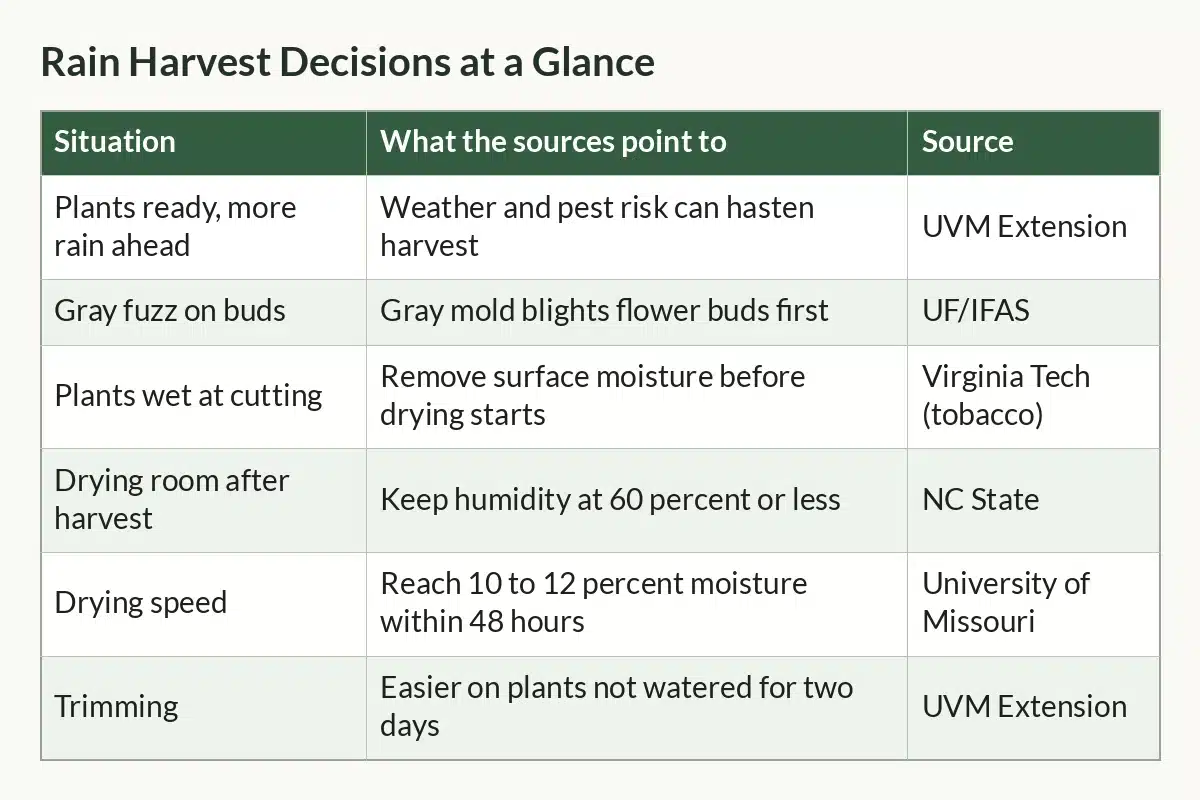
Rain Harvest Decisions at a Glance
| Situation | What the sources point to | Source |
|---|---|---|
| Plants ready, more rain ahead | Weather and pest risk can hasten harvest | UVM Extension |
| Gray fuzz on buds | Gray mold blights flower buds first | UF/IFAS |
| Plants wet at cutting | Remove surface moisture before drying starts | Virginia Tech (tobacco) |
| Drying room after harvest | Keep humidity at 60 percent or less | NC State |
| Drying speed | Reach 10 to 12 percent moisture within 48 hours | University of Missouri |
| Trimming | Easier on plants not watered for two days | UVM Extension |
How to Harvest Wet Cannabis Plants
- Confirm the plants are ready. Rain doesn’t change readiness. Our guide on whether your marijuana is ready for harvest covers the signs.
- Check the buds for gray mold. UF/IFAS says flower buds are the first part blighted. Its guide lists gray or grayish white growth on buds as the sign to look for. In severe cases, it adds, the mold can girdle stems and cause them to break.
- Cut whole branches. UVM says harvested plants can be hung whole or divided into branches for drying.
- Shake off surface water. Herb guides like the National Center for Home Food Preservation say to gently shake herbs to remove excess moisture before drying. For a different leaf crop, the Virginia Tech tobacco curing guide says to remove all surface moisture before curing begins.
- Get the branches indoors quickly. UVM says plants can hang indoors in a space like a shed or barn, with little direct sunlight and with airflow and humidity kept under control.
- Space the branches apart. UVM says good ventilation is the key to a successful dry. It suggests setting up a series of fans that run continuously.
Our post on how to deal with wet weed covers more on buds that come in damp.
How to Dry Buds After a Rain Harvest
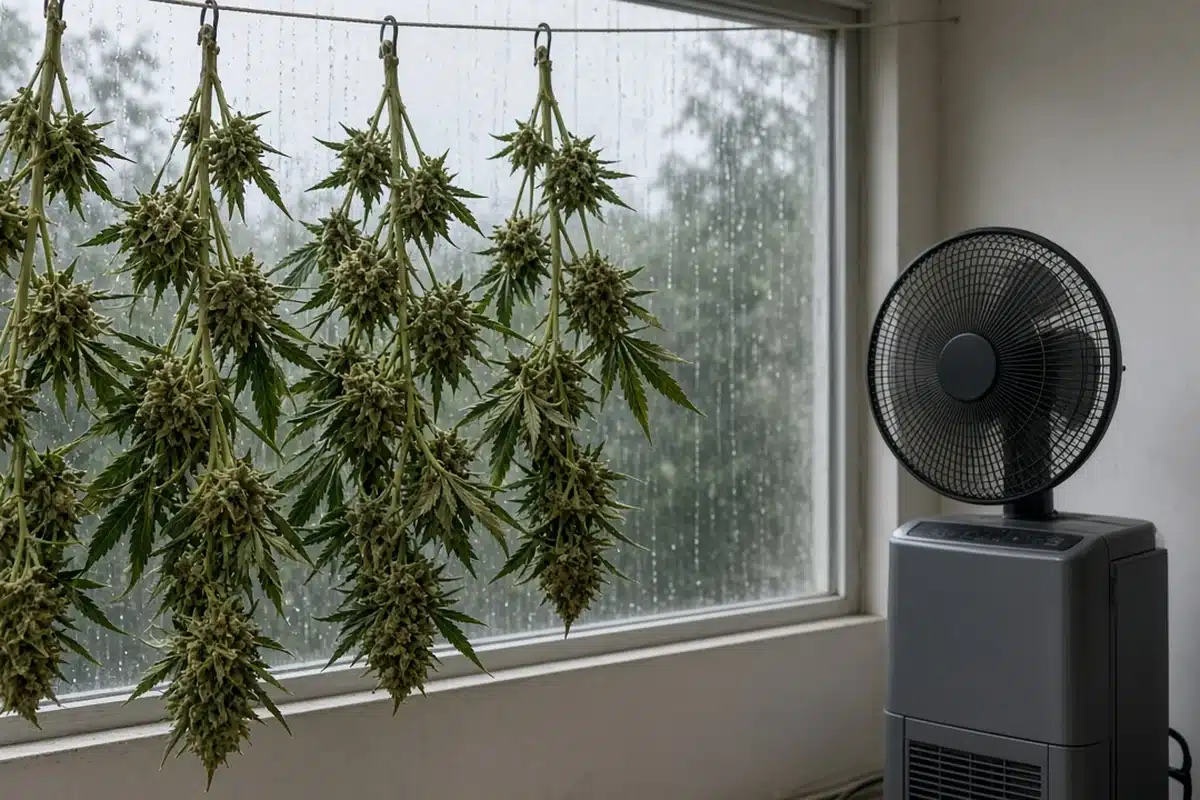
Wet branches carry extra water into the drying room, so humidity control matters more than usual.
NC State Extension says growers have had success drying hemp in buildings or barns when they were able to keep the airflow good and the humidity at 60 percent or less. It also warns that once hemp is dry, it has to stay dry. If it takes on moisture again, it may mold.
Missouri gives a speed target for barn drying. MU says to dry CBD hemp to 10 to 12 percent moisture within 48 hours to prevent mold.
Dehumidifiers help in damp weather. The UVM Extension Ag Engineering guide says some growers use dehumidifiers to lower the humidity of drying air, and that they work at low temperatures. It adds that a simple box fan can circulate the air. It stresses that air circulation still matters with a dehumidifier running, because the air has to be mixed and flowing over the plants to dry them well. The guide rates household dehumidifiers at about 30 to 70 pints of water a day, which works out to roughly 30 to 70 pounds of water pulled from the crop.
Some processors cut plants apart for safety. UVM says some may cut a plant to make sure the center dries completely, reducing the risk of mold. UVM also lists breaking plants down into individual branches as a standard way to prepare them for drying.
Keep heat moderate. NC State says it would keep added heat at 100°F or lower when drying hemp, at least until more research is done.
How to Spot Bud Rot Before You Cut
Gray mold is the bud rot UF/IFAS describes on hemp flowers. Here is what its guide lists:
- Gray or grayish white growth on buds. UF/IFAS says the fungus shows gray or grayish white mycelia and spores on buds, leaf stems and stems.
- Buds first. It says flower buds are the first part of the plant to become blighted.
- Stem damage in severe cases. UF/IFAS notes girdling and breaking of the stem, along with dieback, as disease severity increases.
UF/IFAS also notes that rain splash spreads spores for several other hemp diseases, and that leaf wetness encourages infection. That is one reason wet weather near harvest gets growers worried.
UF/IFAS adds that the gray mold fungus survives in the soil as hardened structures and becomes infectious when warm, wet conditions return. It also notes that labeled control options for hemp diseases are almost nonexistent, which makes prevention and quick drying the practical tools for a home grower. Use only products labeled for your crop and state.
Troubleshooting a Wet Harvest
The drying room humidity climbs after you hang wet branches. Add more airflow, a dehumidifier or both. NC State’s working target is 60 percent or less. UVM adds that plants could take 3 to 14 days to dry fully, depending on airflow, humidity and temperature.
Buds still feel damp after two days. MU’s barn target is 10 to 12 percent moisture within 48 hours. Space the branches out more and improve airflow. UVM Ag Engineering explains why airflow matters. Damp air around the buds has to be moved out and replaced with drier air.
Trimming wet plants is slow and messy. UVM says trimming is easier on plants that haven’t had water for two days. UVM notes that plants can be dried before trimming, so you can hang now and trim later.
Some buds show gray fuzz. UF/IFAS says gray mold blights buds first. Check the other buds in the batch closely for the same gray growth. UF/IFAS adds that the spores are splashed by rain and blown by wind onto plants, so a wet harvest calls for a close look.
Dried buds turn soft again. NC State says dried hemp can absorb moisture and mold. Keep it in a dry space. UVM’s storage advice is a cool, dark place with low humidity and an airtight container.
Sources
- UVM Extension, Industrial Hemp for Flower Production: https://www.uvm.edu/d10-files/documents/2024-06/2020_Hemp_101.pdf
- UVM Extension, 2022 Hemp Flower Harvest Date: https://www.uvm.edu/d10-files/documents/2024-08/2022_Hemp_Flower_Harvest_Date.pdf
- University of Florida IFAS Extension, PP379 Field Guide to Hemp Diseases: https://ask.ifas.ufl.edu/publication/PP379
- University of Missouri Extension, MX79 Harvesting Industrial Hemp: https://extension.missouri.edu/publications/mx79
- NC State Extension, Hemp Harvest Timing and Drying: https://hemp.ces.ncsu.edu/hemp-harvest-timing-and-drying/
- National Center for Home Food Preservation (University of Georgia), Drying Herbs: https://nchfp.uga.edu/how/dry/herbs
- Virginia Tech, Curing Tobacco (2025 Tobacco Agronomy): https://www.arec.vaes.vt.edu/content/dam/arec_vaes_vt_edu/southern-piedmont/2025-tobacco-agronomy/07%20Curing%202025.pdf
- UVM Extension Ag Engineering, Drying and Curing Herbs and Flowers (Hops, Hemp, and Everything Else!): https://blog.uvm.edu/cwcallah/2021/02/23/drying-and-curing-herbs-and-flowers-hops-hemp-and-everything-else/
FAQ
Is it OK to harvest cannabis in the rain?
It can be. UVM says weather risk often hastens harvest, and dry handling can come after the cut.
Should I rinse or dry the plants before hanging?
Shake off surface water. Herb and tobacco guides both call for removing surface moisture first.
Will rain wash the trichomes off?
The sources here don't address that question for living plants.
How fast should rain soaked buds dry?
MU gives a barn target of 10 to 12 percent moisture within 48 hours for CBD hemp.
What humidity should the drying room be?
NC State says 60 percent or less, with good airflow.
Does waiting through a rainy week raise mold risk?
UF/IFAS ties gray mold to high humidity. MU's delayed harvest mold warning is for grain hemp.


