
Leggy Cannabis Seedlings: Causes and Quick Fixes
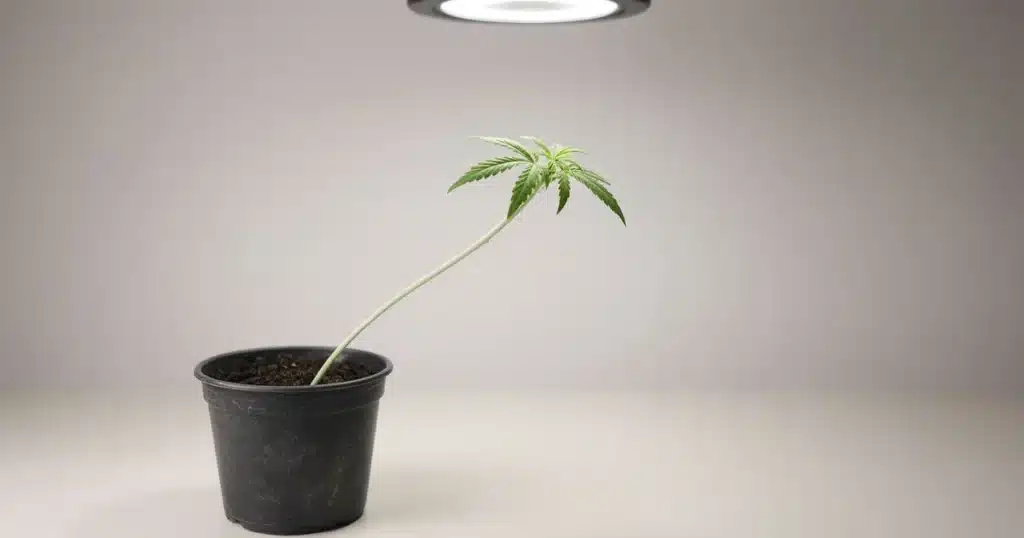
Leggy cannabis seedlings have long, thin stems with small leaves far apart, and they often lean or fall over. The usual cause is too little light, so the seedling stretches to reach it. Heat and crowding add to the problem. Most leggy seedlings can be saved by giving more light and burying part of the stem when you repot.
What causes leggy seedlings?
| Cause | Sign | Fix |
|---|---|---|
| Light too weak or far | Stems lean toward the light | Move the light closer, step by step |
| Window light only | Seedlings bend toward the glass | Move them under a grow light |
| Warm, humid dome | Fast, soft growth | Vent the dome, lower heat |
| Crowded tray | Seedlings shade each other | Space them out |
| Uneven light over the tray | Edge seedlings lean toward the middle | Add a fixture or rotate the tray |
| Late move under light | Stretch right after sprouting | Put sprouts under light as soon as they break soil |
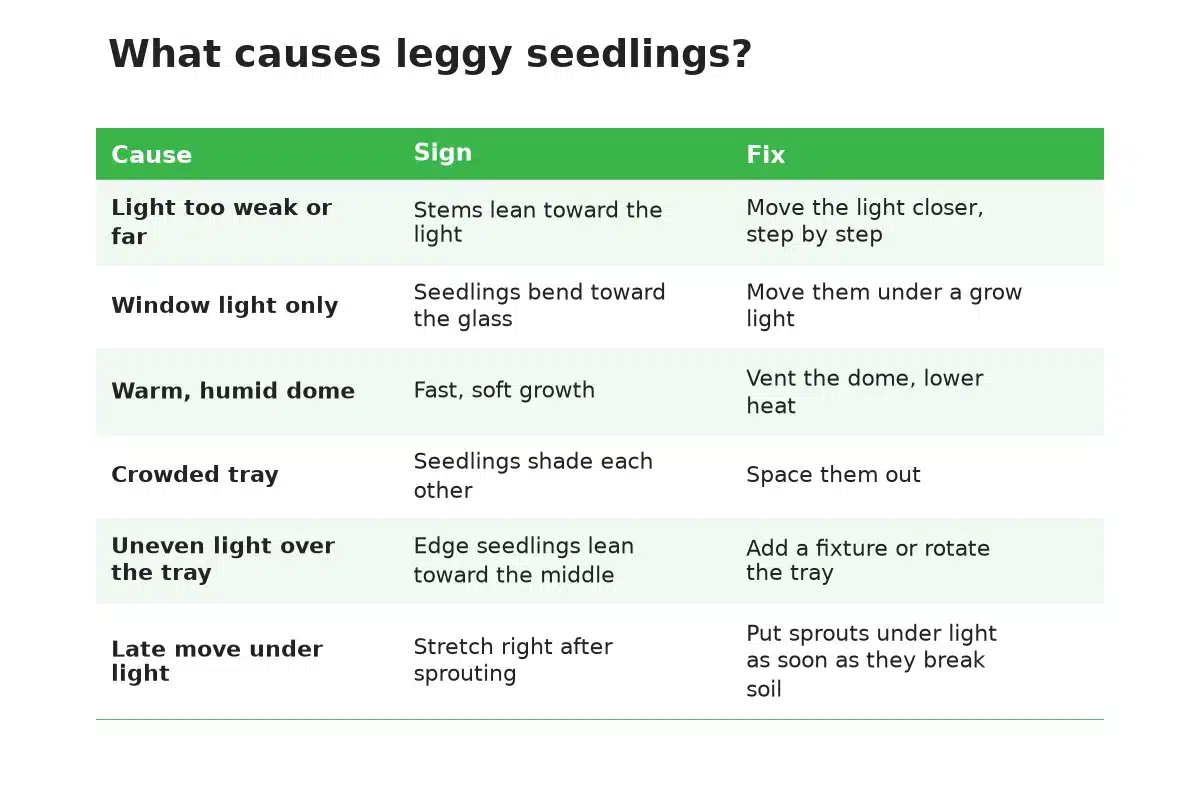
Grower checklist. Light hours matter too. See seedling light schedule.
Light sits at the top of that list because it is the usual cause. A seedling leaning hard toward the lamp is asking for more of it. University of Maryland Extension notes that natural light from a window is seldom enough for strong seedling growth, and that stems usually stretch and lean toward the light.
How much light do seedlings need?
University extension guidance for seedlings grown indoors gives some useful starting points. These figures come from general seedling advice for vegetables and garden plants, so treat them as a starting range and watch how your own plants respond.
| Setting | Extension guidance |
|---|---|
| Fluorescent tubes, University of Maryland | 1 to 2 inches above the seedlings |
| Fluorescent fixtures, Iowa State | 4 to 6 inches from the seedlings |
| LED fixtures, Iowa State | About 8 to 12 inches from the plants |
| Hours of light per day, both | 14 to 16 hours |
| Day temperature after sprouting, Maryland | 65 to 70°F |
| Night temperature after sprouting, Maryland | 55 to 60°F |
Sources: University of Maryland Extension. Iowa State University Extension.
Strong LEDs vary a lot in output, so the maker’s height chart for seedlings is the best first setting. Then adjust from what the leaves tell you. Stretching means bring the light closer. Pale, bleached or crispy tops mean back it off. For cannabis-specific distances, see LED light distance.
Iowa State also advises hanging lights from adjustable chains or cables so you can raise them as plants grow. Another trick from the same page is to set trays on blocks you can remove, which lowers the plants instead of raising the light.
Why weak light makes stems stretch
University of New Hampshire Extension explains the reason plainly. A seed that sprouts in low light behaves as if it is under a canopy of competing leaves, so it stretches its stem to reach the sun. The result is a thin plant with lots of space between the leaves.
The same fact sheet frames light as a daily total, called the Daily Light Integral or DLI. Its run time examples assume seedlings want about 12 moles of light per square meter per day. Two things matter for reaching that total: how strong the light is at plant height, and how long it runs.
Distance changes strength fast. In one test described by UNH, an LED light bar needed 8 hours a day to meet seedling needs when hung 8 inches above the crop, but 16 hours a day when hung 20 inches above it. In that example, raising the light by a foot meant the plants needed twice as many hours to get the same light.
Lamp type and run time trade off against each other too. UNH notes that most seedlings can reach transplant size under T8 fluorescent shop lights kept less than a foot above the tops, but only with about 22 hours of light a day. A high-quality horticultural LED might reach the same daily total in about 10 hours, while a cheap one could need more hours than a day holds. Without a PAR meter, the seedlings are the gauge. A stem that keeps stretching means the daily total is still too low.
One more point from UNH is worth knowing before you start fixing. Once a stem has stretched, adding light will not shrink it back down. Better light stops further stretch. That is why burying the stem is the real fix for height that is already there.
How to tell if light is the problem, step by step
- Look at the angle. Seedlings that all lean the same way are chasing a light source.
- Look at the gaps. Long bare stem between the seed leaves and the first true leaves points to low light in the first days.
- Check the edges of the tray. If edge plants stretch more than the middle, the light does not cover the whole tray.
- Check the distance against the maker’s chart and against the extension ranges above.
- If you have a light meter, measure at seedling height, not at the fixture.
- Lower the light or raise the tray a little, then check again the next day for pale or bleached tops.
How do you fix a leggy seedling?
- Raise the light intensity or lower the light. Move it in small steps over a few days and watch the leaves.
- When repotting, set the seedling deeper, with soil up to just under the first leaves. Maryland Extension advises planting so the leaves and growing point sit only slightly above the soil line, since most of the stem can be buried.
- Firm the mix gently around the stem and water lightly.
- Support a flopping stem with a small stake or a twist of soft tie.
- Add gentle airflow so the stem firms up.
- Do not overwater a stretched seedling.
Burying part of the stem at transplant leaves less weak stem above the soil, so the seedling ends up shorter and sturdier.
Stage by stage: what to do and when
Day of sprouting. As soon as the seedling breaks the surface, it needs light. A sprout left in the dark or on a dim shelf for even a short time can stretch fast. Take the dome lid off or open its vents once the seedlings are up.
First week. This is when most stretch happens. Keep light at the right distance and check the plants twice a day. If the seed coat sticks on the leaves, helmet head from Kind Seed Co walks through it.
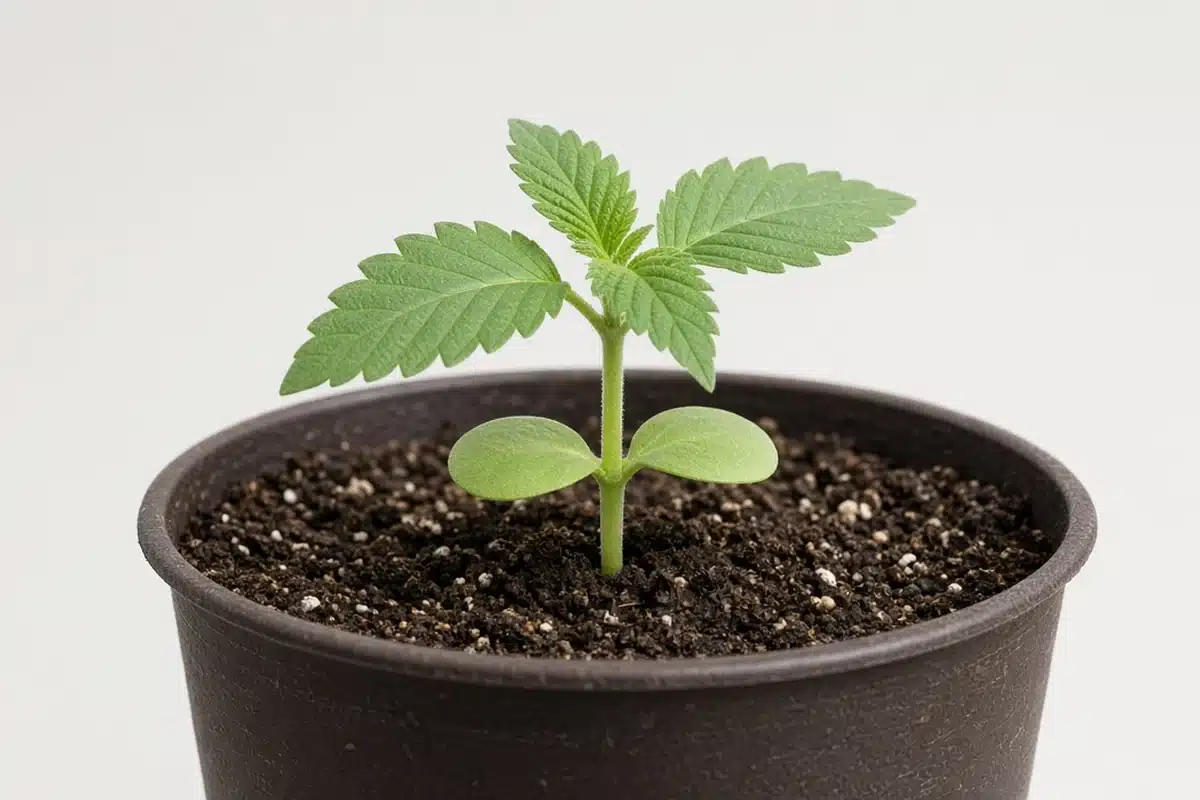
First true leaves. The first serrated leaves above the round seed leaves are a sign the seedling is ready to move up a pot size. Maryland Extension notes this is the ideal time to transplant young seedlings, while they are small and there is little danger of setback from root shock. It is also the best time to bury a stretched stem.
After transplant. Keep the light close and the room comfortably warm, not hot. A light brush across the tops with your hand each day can help, and the same extension page says this helps control height and increase stockiness.
Ready to grow on. The aim is a short, sturdy plant. Maryland Extension describes the ideal transplant as about as wide as it is high.
Watering and feeding a stretched seedling
A thin stem is easy to damage and slow to dry out around. Maryland Extension advises waiting until the top of the mix is nearly dry before watering, and keeping the mix moist, not wet. Saturated mix stops roots growing and invites damping-off fungi such as Pythium, Phytophthora and Rhizoctonia, which can kill a whole tray quickly.
Hold back on feeding too. The same page notes most potting mixes carry enough fertilizer for a seedling’s first 5 to 6 weeks, and young seedlings are easily damaged by too much. Extra feed does not fix stretch. Light does.
How do you prevent it next time?
Get sprouts under light right away, keep the light close enough without burning, and give each seedling space. Make sure the light covers the whole tray evenly so edge plants do not lean in. Watch for hot spots too. University of New Hampshire Extension warns that the ballast area of a fluorescent fixture can run much hotter than the rest of the tube. Stretch happens fast in the first week, so check seedlings morning and evening.
Common mistakes with leggy seedlings
- Starting seedlings on a windowsill. Window light is rarely strong enough and pulls stems sideways.
- Raising the light "just in case". A light set too high is the most common cause of stretch.
- Leaving the dome on too long. Trapped heat and moisture speed up soft growth.
- Watering a flopped seedling heavily. Soggy mix around a weak stem invites rot.
- Feeding to toughen it up. Strong feed can burn young roots and does nothing for stretch.
- Waiting too long to repot. Leaving seedlings in the starter tray too long is one of the most common mistakes, according to Maryland Extension.
Is a leggy seedling ruined?
No. Once light is fixed and the stem is buried, most leggy seedlings grow normally.
Sources
- University of Maryland Extension. Care of Vegetable Seedlings. Updated February 20, 2023. https://www.extension.umd.edu/resource/care-vegetable-seedlings
- Iowa State University Extension and Outreach, Yard and Garden. How do I set up supplemental lights for my seedlings? Updated December 6, 2024. https://yardandgarden.extension.iastate.edu/faq/how-do-i-set-supplemental-lights-my-seedlings
- University of New Hampshire Extension. Growing Seedlings Under Lights [Fact Sheet]. https://extension.unh.edu/resource/growing-seedlings-under-lights-fact-sheet
FAQ
Can you bury a leggy cannabis seedling deeper?
Yes. Cannabis stems can root along the buried part, so planting deeper when you repot gives the seedling a shorter, sturdier stance. Keep soil just below the first leaves and avoid packing it hard. Water lightly afterward so the deeper soil does not stay soggy.
How close should a light be to seedlings?
It depends on the light. Extension guidance puts fluorescent tubes a few inches above seedlings and many LEDs about 8 to 12 inches away. Follow the maker's seedling height and move the light in small steps. Stretching means more light is needed, while pale or crispy tops mean too much.
Do fans help leggy seedlings?
Gentle airflow helps stems firm up and lowers humidity around the seedlings. Keep it soft, so the seedlings sway slightly rather than bend hard. A fan still does not replace better light, which is the main fix for stretched seedlings, so use the two together for the best result.
How many hours of light do seedlings need?
University extension guidance for indoor seedlings suggests 14 to 16 hours of light a day on a timer. Many cannabis growers run longer schedules for seedlings. Whatever schedule you use, the light must be strong and close enough, because more hours of weak light will not stop stretching.
Can heat make seedlings leggy?
Warm, humid conditions speed up soft growth, which can make stretching worse, especially under weak light. Vent humidity domes once seedlings are up and keep the space comfortably warm, not hot. Fixing light and heat together gives the best result, since a dome can trap both warmth and moisture.


