Marijuana laws by state map for 2027
Cannabis law in the United States is a patchwork. Federal law still treats most marijuana as a controlled substance, while each state decides for itself whether adults can buy, possess or grow it. That is why a map is the fastest way to get your bearings. This guide sorts every state into three broad groups going into 2027, explains what changed at the federal level in 2026 and shows you where to look next for the details that matter to home growers 21 and older.
This is a snapshot as of late October 2026. It does not include the results of the November 3, 2026 election, which we will add once results are certified.
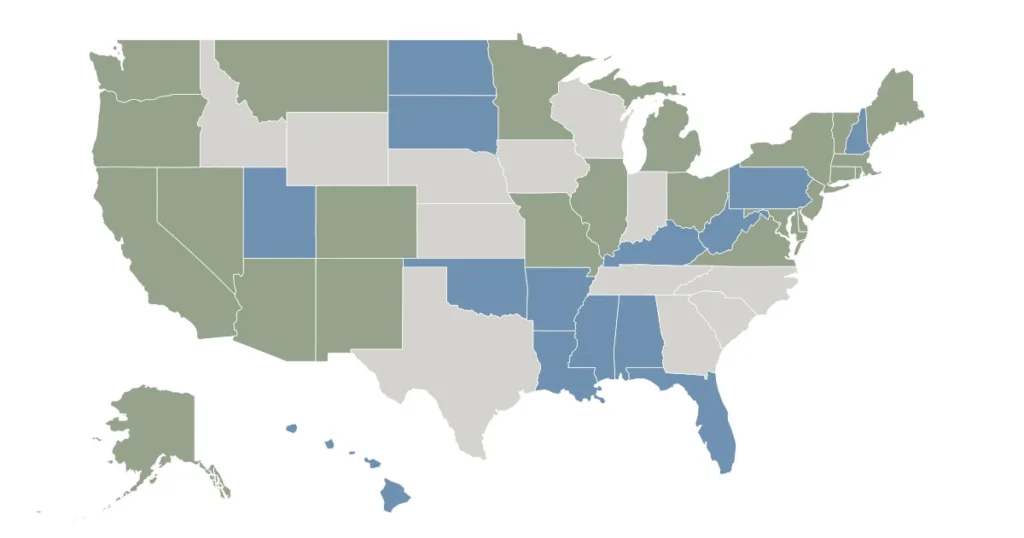
How to read the map
We group states into three categories.
- Adult use. Adults 21 and older can legally possess cannabis, and most of these states also allow some home growing. These states also run medical programs.
- Medical only. Registered patients can access cannabis through a state program, but adult use is not legal.
- Restricted. No full medical program. Some of these states allow low THC or CBD products for specific patients, while others allow almost nothing.
The categories are broad on purpose. Two adult use states can have very different rules on plant counts, public view, locking and possession, so always read the state rule before you plant.
Adult use states going into 2027
As of late October 2026, 24 states and the District of Columbia allow adult use.
| Region | Adult use states |
|---|---|
| West | Alaska, Arizona, California, Colorado, Montana, Nevada, New Mexico, Oregon, Washington |
| Midwest | Illinois, Michigan, Minnesota, Missouri, Ohio |
| Northeast | Connecticut, Maine, Massachusetts, New Jersey, New York, Rhode Island, Vermont |
| Mid Atlantic and South | Delaware, Maryland, Virginia |
| Federal district | District of Columbia |
No new state has legalized adult use since Delaware, Minnesota and Ohio in 2023. Several states saw bills or ballot pushes in 2025 and 2026, but none had taken effect by late October 2026. For a look back at how the most recent states got there, read our post on the most recent states to legalize recreational marijuana.
Being an adult use state does not automatically mean home growing is allowed. Washington, for example, still does not allow adult home growing, and Delaware and New Jersey have also not allowed it for adults. Our guide to the legal requirements for growing weed plants in your state breaks down plant limits state by state.
Medical only states
Most of the remaining states run a medical program. Common examples include Pennsylvania, Florida, Oklahoma, Louisiana, Arkansas, Utah, Mississippi, Alabama, Kentucky, West Virginia, North Dakota, South Dakota, New Hampshire and Hawaii. Each sets its own qualifying conditions, registration process, product types and fees. A few let patients grow at home, such as Oklahoma, while most do not.
Some programs are very new. Alabama opened its first medical dispensary in June 2026, and Kentucky launched its program in 2025. Others, like Florida, are large and mature.
Restricted states
A handful of states have no full medical program. Some allow narrow low THC oil access for listed conditions, and others allow only hemp derived products. South Carolina, for example, still has no medical program after its Compassionate Care Act stalled again in the 2025 to 2026 session. Idaho remains one of the strictest states in the country.
If you live in a restricted state, buying cannabis seeds for home growing does not make growing legal. Check the rules where you live before you do anything.
What changed federally in 2026
The biggest federal shift came on April 28, 2026. The Justice Department issued an order placing FDA approved marijuana products and marijuana products regulated under a state medical license into Schedule III of the Controlled Substances Act. All other marijuana, including adult use products, remains in Schedule I for now.
A broader DEA hearing on moving all marijuana to Schedule III ran in June and July 2026. That process was paused in the fall, with briefing set to close on November 5, 2026. After that, an administrative judge issues a recommendation and the DEA makes a final decision. In plain terms, nothing about home growing changed federally in 2026, and state law still decides what you can do at home.
What to watch in 2027
- Ballot results. We will update this map after the November 2026 results are certified.
- State sessions. Most legislatures meet from January through spring. Watch for home grow bills, plant limit changes and new medical programs.
- Federal rescheduling. A DEA decision on full Schedule III could arrive in 2027 but would not legalize adult use on its own.
- Seed rules. Federal treatment of cannabis seeds is also shifting, so read our seed rule explainer before you order.
How to use this map as a grower
- Find your state category.
- Read your state rule on plant counts and where plants can be grown.
- Check city or county rules, plus lease or HOA limits.
- Confirm the rule on the state agency or statute page on the day you plant.
For product picks once you know your rules, browse seeds by state on our USA seeds page. For quantities you can carry or store, see our possession limits by state guide.
Grow legally and responsibly
Home cultivation is only legal in some states, and each state sets its own plant limits, locking rules and rules about whether plants can be visible from a public place. You must be 21 or older to buy seeds from Kind Seed Co, and you should grow only where your state and city allow it. Check your state rules in our guide to the legal requirements for growing weed plants in your state before you plant. Federal treatment of cannabis seeds is also changing, so read our December 11 2026 seed rule explainer before you order. Keep plants and harvested flower locked away from children, pets and visitors, and never drive after using cannabis. This article is general information. It is not legal advice and it is not medical advice.
Frequently asked questions
How many states have legal recreational marijuana in 2027?
As of late October 2026, 24 states and Washington, D.C. allow adult use. This count does not yet include any November 2026 ballot results.
Is marijuana federally legal now?
No. Since April 2026, state licensed medical marijuana and FDA approved products are in Schedule III, but adult use marijuana remains in Schedule I under federal law.
Can I grow cannabis in every adult use state?
No. Most adult use states allow some home growing, but a few, including Washington, Delaware and New Jersey, do not allow adult home grows.
Does a medical card let me grow at home?
Only in some states. Oklahoma is one example where patients can grow, but most medical only states do not allow home cultivation.
Final thoughts
A state map is the starting point, not the final answer. Use it to see which group your state is in, then read the actual state rule on plant counts, public view and locking before you plant. Federal change in 2026 helped medical programs on paper, but state law still decides what you can grow at home. We will update this page after the November 2026 results are final.
Ready to start
Browse the full range in the Kind Seed Co shop or go straight to usa. Kind Seed Co sells only to adults 21 and older. Always follow the cannabis laws where you live.