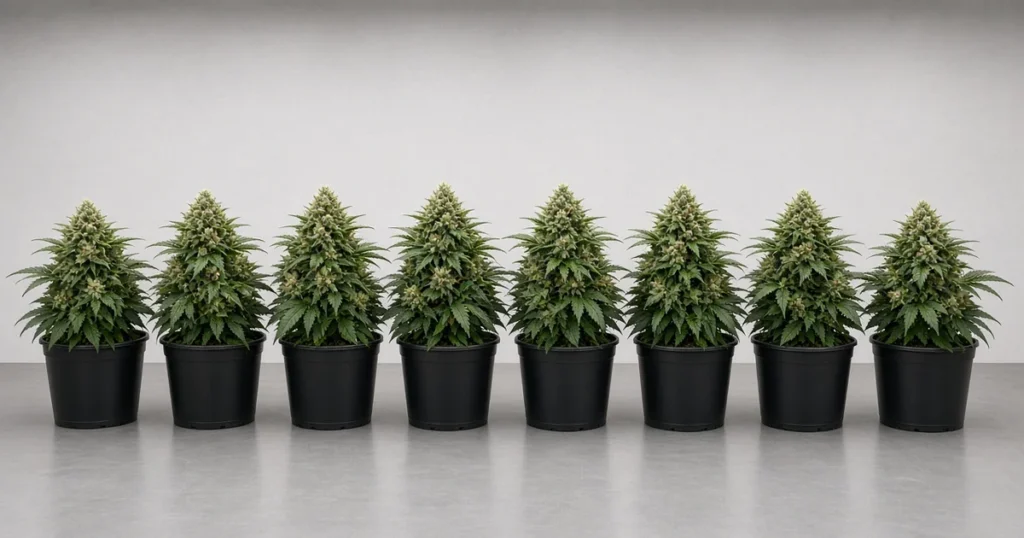
8 Sativa Autoflower Strains to Grow at Home

A sativa autoflower pairs sativa-leaning genetics with ruderalis, so the plant flowers by age instead of waiting for shorter days. That makes it a good fit for growers who want a taller, airier plant without managing a light change. This guide compares eight sativa-leaning autos from the Kind Seed catalog in one table, explains how autoflowering works with help from university Extension research, and gives a numbered plan for growing one well.
Every figure in the table below is breeder-stated. It comes from the specification table on each product page. Your own results will depend on your light, your pot size, your climate and your care. Before you plant, check your state’s home grow law.
What makes an autoflower different
Most cannabis is photoperiod sensitive. University of Georgia Extension explains that most hemp cultivars “will flower when exposed to day lengths of fewer than approximately 13 to 14 hr.” Indoor growers copy that cue by switching the lights to a 12 hour schedule. Outdoors, the plant waits for late summer.
An autoflower skips that step. UGA Extension describes “autoflowering (day neutral) cultivars that will initiate flowering a certain number of days after seeding, regardless of the day length.” In plain terms, the clock starts at seeding, the day you plant the seed.
Oregon State University Extension adds a useful timing benchmark from hemp research: “Autoflower varieties are generally ripe to harvest around 75 days after planting, while full-season types require closer to 120 days.” OSU also notes that the shorter season and smaller plants “reduce their demand for water.” These are hemp findings, not trials on drug type cannabis, but the biology of day neutral flowering is the same idea.
What sativa-leaning means here
Sativa and indica are loose labels. Breeders use “sativa” to describe a plant that tends to grow taller, with longer spaces between bud sites and narrower leaves. When that sativa side is crossed with ruderalis, the result is usually a plant that is still more compact than a full size sativa, but airier than an indica auto. We picked strains whose product pages list the family as sativa ruderalis, with one hybrid noted below.
How we picked these eight
We kept the list to sativa-leaning autos with a live Kind Seed product page, so you can read the full specification table for each one. We did not rank them by effect, and we make no effect claims. We sorted the table by the breeder-stated flowering time, so the quickest finishers come first.
Sativa autoflowers compared
| Strain | Breeder-stated flowering time | Breeder-stated height | Breeder-stated indoor yield | Breeder-stated outdoor yield | Breeder-stated THC |
|---|---|---|---|---|---|
| Blue Dream Auto | 7 to 9 weeks | Average | 1.0 to 1.3 oz per sq ft (300 to 400 g per m²) | 3.5 to 7 oz (100 to 200 g) per plant | Up to 13% |
| Green Crack Auto | 7 to 9 weeks | Average | 1.8 to 2.0 oz per sq ft (550 to 600 g per m²) | 4.2 to 7 oz (120 to 200 g) per plant | Up to 20% |
| Super Lemon Haze Auto | 8 to 9 weeks | Average | 1.8 to 2.0 oz per sq ft (550 to 600 g per m²) | 4.2 to 7 oz (120 to 200 g) per plant | Up to 20% |
| AK47 Auto | 8 to 10 weeks | Not listed | 1.0 to 1.3 oz per sq ft (300 to 400 g per m²) | 7 to 10.6 oz (200 to 300 g) per plant | Up to 18% |
| Sour Diesel Auto | 9 to 10 weeks | Short | 1.1 to 1.5 oz per sq ft (350 to 450 g per m²) | 3.5 to 7 oz (100 to 200 g) per plant | Up to 23% |
| Pineapple Express Autoflower | 9 to 10 weeks | Not listed | Not listed | Not listed | Up to 20% |
| Amnesia Haze Auto | 10 to 12 weeks | Short | 0.8 to 1.1 oz per sq ft (250 to 350 g per m²) | 7 to 10.6 oz (200 to 300 g) per plant | Up to 20% |
| Jack Herer Auto | 10 to 12 weeks | Short | 1.0 to 1.3 oz per sq ft (300 to 400 g per m²) | 5.3 oz (150 g) per plant | Up to 20% |
Note on Pineapple Express Autoflower: its product page lists the family as hybrid ruderalis rather than sativa ruderalis, and it gives no yield figures. We kept it because many growers search for it alongside sativa autos.
Notes on each strain
Blue Dream Auto. Lineage is listed as Blue Dream x Ruderalis. It ties for the quickest finish on this list, with the lowest listed THC of the eight. Listed aromas are fruity, berry and vanilla.
Green Crack Auto. Listed lineage is Afghani x Skunk #1 x Ruderalis. It pairs a 7 to 9 week flowering window with one of the highest indoor yield ranges here. Listed aromas are citrus, woody and earthy.
Super Lemon Haze Auto. Listed lineage is Super Lemon Haze x Ruderalis. Its product page lists citrus, lemon and spice aromas, with an average height.
AK47 Auto. Listed lineage is AK-47 x Lowryder. It has one of the larger outdoor yield ranges listed on the page.
Sour Diesel Auto. It carries the highest listed THC on this list and a short height, which suits small tents. Listed aromas are diesel, sour and lemon.
Pineapple Express Autoflower. The product page gives a 9 to 10 week flowering time and THC up to 20%, and lists it as a hybrid.
Amnesia Haze Auto. It has the longest listed flowering window here, at 10 to 12 weeks, so plan for a longer run.
Jack Herer Auto. Listed lineage is Haze x NL x Shiva Skunk x Ruderalis. It also runs 10 to 12 weeks, with a short listed height.
How to grow a sativa autoflower: step by step
- Pick a strain for your space. Strains listed as short suit smaller tents. Strains listed as average height need more room. Check the expected final height against your tent before you plant.
- Start in the final pot. Autoflowers run on a fixed clock, so a transplant setback costs time you cannot get back. Many growers start the seed directly in its final container.
- Set a steady light schedule. Indoors, an autoflower does not need a 12 hour switch. Keep one schedule from seed to harvest.
- Plant outdoors on your own timeline. OSU Extension notes that because autoflowers “do not require the day-length cue in late August to commence flowering, they can be planted earlier in the year.” Plant after your last frost.
- Train gently and early. Sativa-leaning autos can stretch in early flower, depending on the strain. Use light low stress training in the first few weeks rather than heavy pruning.
- Water by need, not by habit. Lift the pot to judge weight and let the top inch or two dry before watering again. See our guide on DLI for autoflowers to match light and water demand.
- Watch the calendar, then the plant. Use the breeder-stated window as a guide, then judge harvest by the plant itself, using our autoflower grow guide.
Troubleshooting sativa autoflowers
The plant stayed tiny. Common causes are a late transplant, a pot that is too small, or early stress. Because the clock keeps running, an auto rarely catches up. Start the next one in its final pot.
It is too tall for the tent. Sativa-leaning autos can stretch in early flower. Raise the light if you can, bend the top gently, and choose a strain listed as short next time.
Flowering seems to run long. Flowering windows are breeder-stated estimates. Strains listed at 10 to 12 weeks, like Amnesia Haze Auto and Jack Herer Auto, can run past what you expect. Check trichomes before you cut.
Leaves are yellowing in mid flower. Some fading late in flower is normal. Early or patchy yellowing can point to pH trouble, so see our guide on pH and cannabis before you add more feed.
Buds are airy. Airy buds are common in sativa-leaning plants, but low light makes it worse. Check light intensity at the canopy before you blame the genetics.
Seed guarantee
For White Label seeds, our germination guarantee covers up to 3 months, 100 seeds or less, White Label only. Pineapple Express Autoflower is a 42 Fast Buds USA listing and its page shows no germination guarantee.
Where to go next
Browse our full sativa autoflower category, or read 11 facts about growing sativa plants.
Sources
- Oregon State University Extension, EM 9628 Planning a drought-resilient hemp crop (https://extension.oregonstate.edu/catalog/em-9628-planning-drought-resilient-hemp-crop)
- University of Georgia Extension, Bulletin 1530 Industrial Hemp Production in Georgia (https://fieldreport.caes.uga.edu/publications/B1530/industrial-hemp-production-in-georgia/)
- Kind Seed product page specification tables for each strain (breeder-stated), read 2026-10-16
FAQ
What is a sativa autoflower?
A sativa autoflower crosses sativa-leaning genetics with ruderalis. It flowers by age rather than by day length, so it does not need a 12 hour light switch to start flowering.
How long does a sativa autoflower take?
On this list, breeder-stated flowering times run from 7 to 9 weeks up to 10 to 12 weeks. Oregon State Extension notes autoflower hemp is generally ripe around 75 days after planting. That is a hemp finding, not a trial on drug type cannabis.
Which sativa autoflower finishes fastest?
Blue Dream Auto and Green Crack Auto have the shortest breeder-stated flowering time on this list, at 7 to 9 weeks.
Do sativa autoflowers need a special light schedule?
No. University of Georgia Extension says autoflowering cultivars start flowering a set number of days after seeding regardless of day length. Keep one steady schedule from seed to harvest.
Can I grow sativa autoflowers outdoors?
Yes. Oregon State Extension notes autoflowers do not need the late summer day length cue, so they can be planted earlier in the year.