Spectrum Tuning Grow Light Guide: Adjustable Channels and When They Matter
The short answer
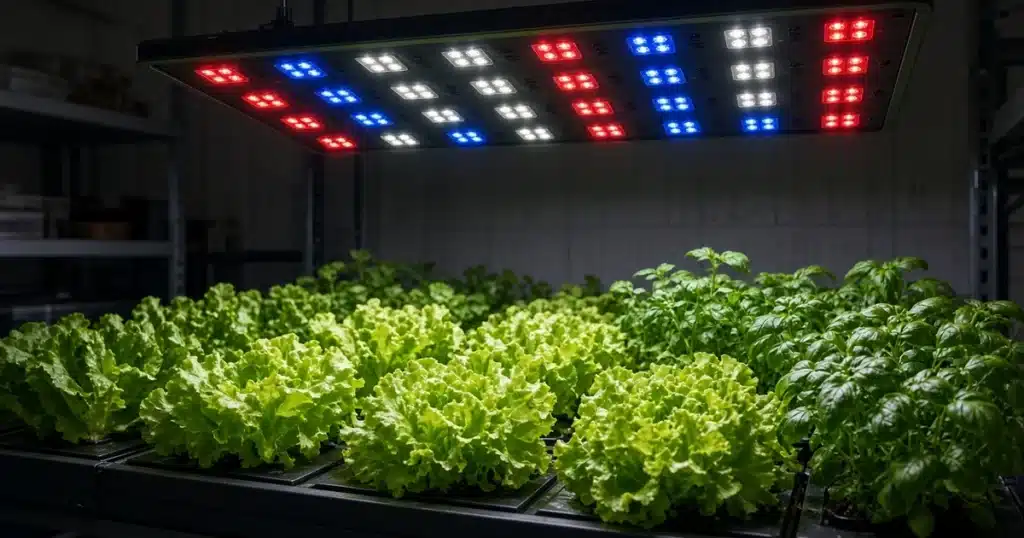
A spectrum tuning grow light has separate channels, such as blue, red or far red, that you can adjust. Extension resources note that spectrum can change plant shape and growth, but total light intensity still drives most growth. Tunable lights matter most for growers who run careful recipe runs for specific crops.
Tunable fixtures sound advanced. For many home growers, a good fixed spectrum light works just as well. Here is when the extra control earns its price.
How do tunable spectrum lights work?
A standard LED fixture uses a fixed mix of diodes. The spectrum stays the same at every brightness level.
A tunable fixture groups its diodes into channels, and each channel has its own dimmer. You might have a white channel, a red channel, a blue channel and a far red channel.
Turn one channel up or down and the color of the light changes. A controller, app or set of knobs lets you set each level.
The University of Missouri Extension guide to understanding grow lights explains how plants use different parts of the spectrum. Red and blue light drive most photosynthesis. Other colors play roles in plant shape and timing.
What does each channel do?
Blue light tends to hold plants compact, and leaves may be thicker and stems shorter.
Red light drives photosynthesis efficiently. Many fixtures are heavy in red for that reason.
Far red light sits just past what people see well. It can cause stems to stretch and leaves to expand. Mixed with red, it can affect flowering timing in some plants.
White light combines many colors. It makes plants look natural and lets you spot problems by eye.
| Channel | Typical effect | Notes |
|---|---|---|
| Blue | More compact plants | Too much can slow growth |
| Red | Drives photosynthesis | Core of most grow spectra |
| Far red | Stretching and leaf expansion | Effects vary by crop |
| White | Natural look, broad use | Helps you see plant health |
Sources: University of Missouri Extension, Resource Innovation Institute, University of Vermont Extension.
Our post on how light wavelengths affect plant compounds looks at spectrum research in more depth.
When does adjusting spectrum matter?
Spectrum matters most when you want a specific plant shape or timing. Commercial growers use it to hold seedlings compact or speed certain crops.
The Resource Innovation Institute lighting guide discusses spectrum as one factor in commercial lighting design. It still puts intensity, uniformity and efficacy at the center.
For most home growers, the light level matters more than the exact mix. A plant under too little light won’t grow well no matter what color that light is.
Tunable lights help when you grow different crops in one space over a year. Leafy greens, flowering plants and seedlings each respond to different mixes.
What are the trade offs?
Tunable fixtures cost more. Extra channels mean more drivers and controls.
Some channels are less efficient than others. Turning up a low efficiency channel can lower overall output per watt.
They take time. Finding the right setting means changing one thing and watching plants for weeks.
The University of Vermont Extension tips for choosing grow lights suggest starting with efficacy, coverage and price. Extra features come after the basics.
Our guide to choosing the right LED lights for your grow explains how to compare fixtures.
How do you dial in a setting?
Start with the maker’s default. Most fixtures ship with a balanced mix.
Adjust only one channel per round. If you change two, you won’t know which caused the result.
Hold total intensity steady when you change color. Otherwise, you’re comparing brightness, not spectrum.
Write down what you change and when. Note plant height, leaf color and growth rate.
Give each change at least a couple of weeks. Plants respond slowly.
How to: step by step
- Learn which channels the fixture offers.
- Start with the maker’s default setting.
- Change one channel at a time.
- Hold total light intensity steady while comparing.
- Record plant height, color and growth.
- Stick with the setting that works for your crop.
Our post on the process of light to energy in plants explains how plants turn light into growth.
Troubleshooting
Plants stretch. Far red or low blue is too high. Lower far red or raise blue.
Plants stay stunted. Blue is too high or overall light is low. Raise red or total output.
No visible change. Changes are too small or too short. Adjust further and wait longer.
Hard to see leaf color. The mix is heavy in red or blue. Turn up white while you inspect plants.
Higher power bill. A low efficiency channel is high. Check output per watt for each channel.
Spectrum control is a fine tuning tool on top of good basics. Kind Seed Co carries cannabis seeds for growers ready to dial in a new light.
Sources
- Controlled environment agriculture: understanding grow lights (G6987), University of Missouri Extension, Controlled environment agriculture
- Lighting for controlled environment agriculture, best practices guide, Resource Innovation Institute, Lighting for controlled environment agriculture
- Tips for choosing grow lights, University of Vermont Extension, Tips for choosing grow lights
FAQ
Do home growers need tunable lights?
Most do not. A good fixed spectrum light with enough intensity grows most home crops well.
Is full spectrum the same as tunable?
No. Full spectrum means a broad mix of colors. Tunable means you can change the mix.
Does blue light make plants shorter?
Often, yes. More blue tends to hold plants compact, though effects vary by crop.
Do tunable lights cost more to run?
It depends on the settings. Some channels make less light per watt than others.
How long should I wait after a change?
Give plants at least a couple of weeks before judging a new setting.