
VPD Chart for Cannabis: Vapor Pressure Deficit Explained
Vapor pressure deficit (VPD) is the gap between how much water vapor the air could hold at its temperature and how much it holds now. FAO calls it an accurate indicator of the air’s drying power. Because it combines temperature and humidity in one number, a VPD chart lets cannabis growers see both settings together.
What Is Vapor Pressure Deficit?
FAO Irrigation and Drainage Paper 56 defines VPD as the difference between the saturation vapor pressure and the actual vapor pressure of the air, and calls it an accurate indicator of the air’s evaporative capacity (FAO-56). Relative humidity is a ratio of the same two pressures at the same temperature, so RH and VPD describe the same air in different ways. For the humidity side, see humidity control.
How Do You Calculate VPD?
First find saturation vapor pressure from air temperature in °C with FAO-56 equation 11: e° = 0.6108 × exp(17.27 × T ÷ (T + 237.3)), in kPa (FAO-56). Then multiply by (1 − RH), with RH as a decimal, to get VPD. At 75°F (23.9°C), e° is about 2.96 kPa, so at 50% RH the VPD is about 1.48 kPa. The chart below uses air temperature as leaf temperature, which is a simplification.
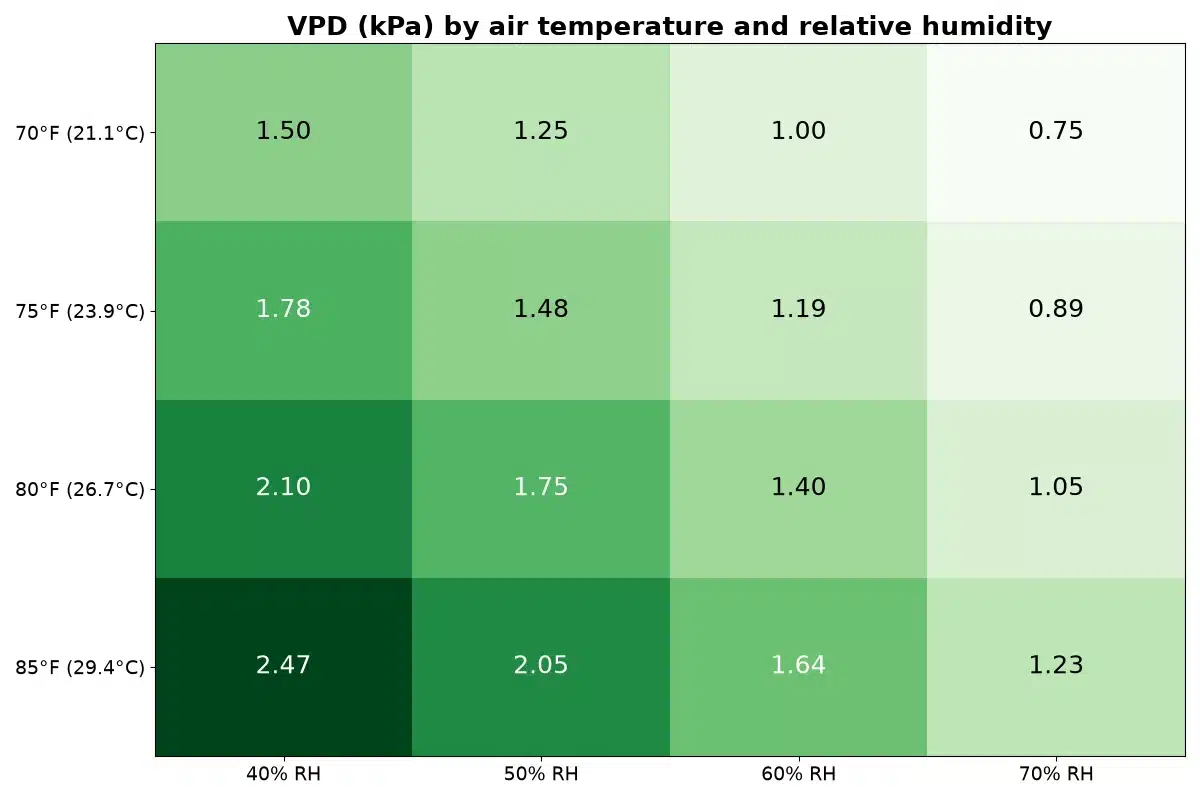
Computed with FAO-56 equation 11 for saturation vapor pressure, then VPD = e° × (1 − RH). Air temperature is used as leaf temperature.
Data for this chart:
| Air temperature | 40% RH | 50% RH | 60% RH | 70% RH |
|---|---|---|---|---|
| 70°F (21.1°C) | 1.50 | 1.25 | 1.00 | 0.75 |
| 75°F (23.9°C) | 1.78 | 1.48 | 1.19 | 0.89 |
| 80°F (26.7°C) | 2.10 | 1.75 | 1.40 | 1.05 |
| 85°F (29.4°C) | 2.47 | 2.05 | 1.64 | 1.23 |
How Do Temperature and Humidity Change VPD?
Warmer air has a higher saturation vapor pressure, so at the same RH a warmer room has a higher VPD. In the chart, 50% RH gives about 1.25 kPa at 70°F but 2.05 kPa at 85°F. Raising RH lowers VPD at any temperature. Both settings depend on your grow-room climate.
How Do Growers Use a VPD Chart?
Growers read across from their room temperature and along to their RH to see the resulting VPD, then adjust heating, cooling or humidity to move it. Leaves lose water through stomata, and FAO describes VPD as a measure of how strongly the air draws water. The chart is a calculation tool and does not set a target for any growth stage.
Sources
Some sources below studied hemp or other crops, or give general garden guidance, rather than studying drug-type cannabis. Their findings are reported as results for those crops or settings.
The FAO equations above do the math on this VPD page, which Kind Seed Co provides as general growing information.
FAQ
Is VPD the same as relative humidity?
No. FAO-56 defines relative humidity as the ratio of actual to saturation vapor pressure, while VPD is the difference between them. Two rooms at the same RH can have different VPDs if their temperatures differ, because warm air has a higher saturation vapor pressure than cool air.
Why does the chart use air temperature for leaves?
FAO-56 equation 11 gives saturation vapor pressure from a temperature, and this chart plugs in air temperature for simplicity. Leaf temperature can differ from air temperature, so treat the chart values as estimates. A leaf-based calculation would put measured leaf temperature into the same equation.
What units is VPD measured in?
VPD is a pressure, and FAO-56 gives vapor pressures in kilopascals (kPa). The chart on this page uses kPa for VPD and gives air temperature in °F with °C in brackets, since the FAO-56 equation takes temperature in degrees Celsius.
How do you read the VPD chart?
Find your room temperature in the left column and your relative humidity across the top, then read the cell where they meet. At 80°F and 60% RH, for example, the computed VPD is about 1.40 kPa. Moving to a higher RH column lowers the value, and moving to a warmer row raises it.


