
Inline Fan Size for a Grow Tent: How to Work Out CFM
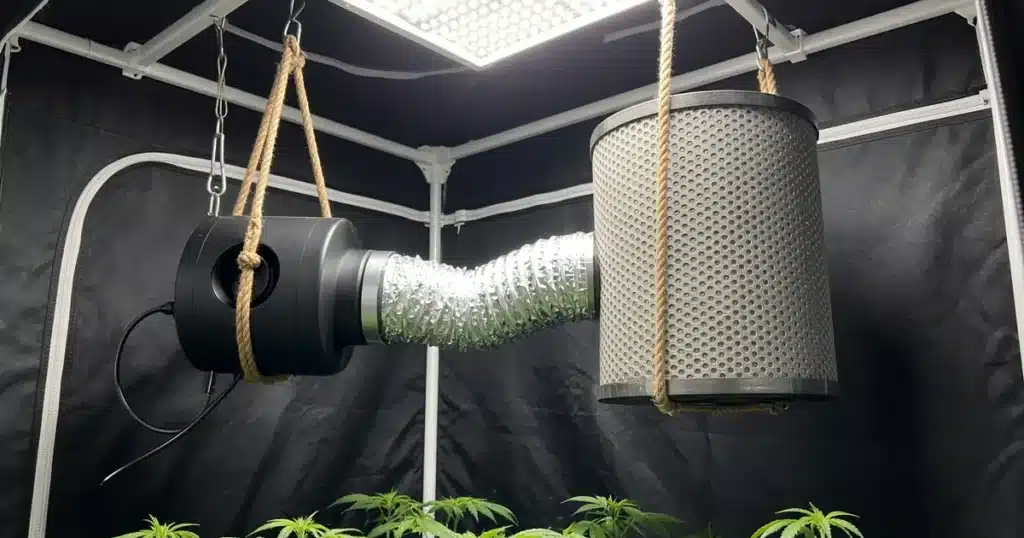
To size an inline fan for a grow tent, multiply the tent’s length, width and height in feet to get its volume in cubic feet. A fan rated at that many cubic feet per minute (CFM) swaps the air about once a minute, the UMass Extension rate for summer greenhouses. Filters and ducting reduce real airflow.
How Do You Calculate CFM for a Grow Tent?
Multiply length × width × height in feet. A 4 × 4 × 6.5 ft tent holds 104 cubic feet, so a fan moving 104 CFM changes the air once per minute. UMass Extension sizes greenhouse fans for one air exchange per minute, using floor length and width with a standard 8-foot height rather than the actual height (UMass Extension). For the rest of the build, see our grow tent setup guide.
How Many Air Exchanges Does a Grow Tent Need?
UMass Extension sizes greenhouse fans for one volume air exchange per minute for summer ventilation. It lists 3/4 of a volume per minute for houses not used in summer and 1/4 for winter (UMass Extension). This is a greenhouse rule. Applied to a tent, one exchange per minute is a starting point, not a cannabis research result.
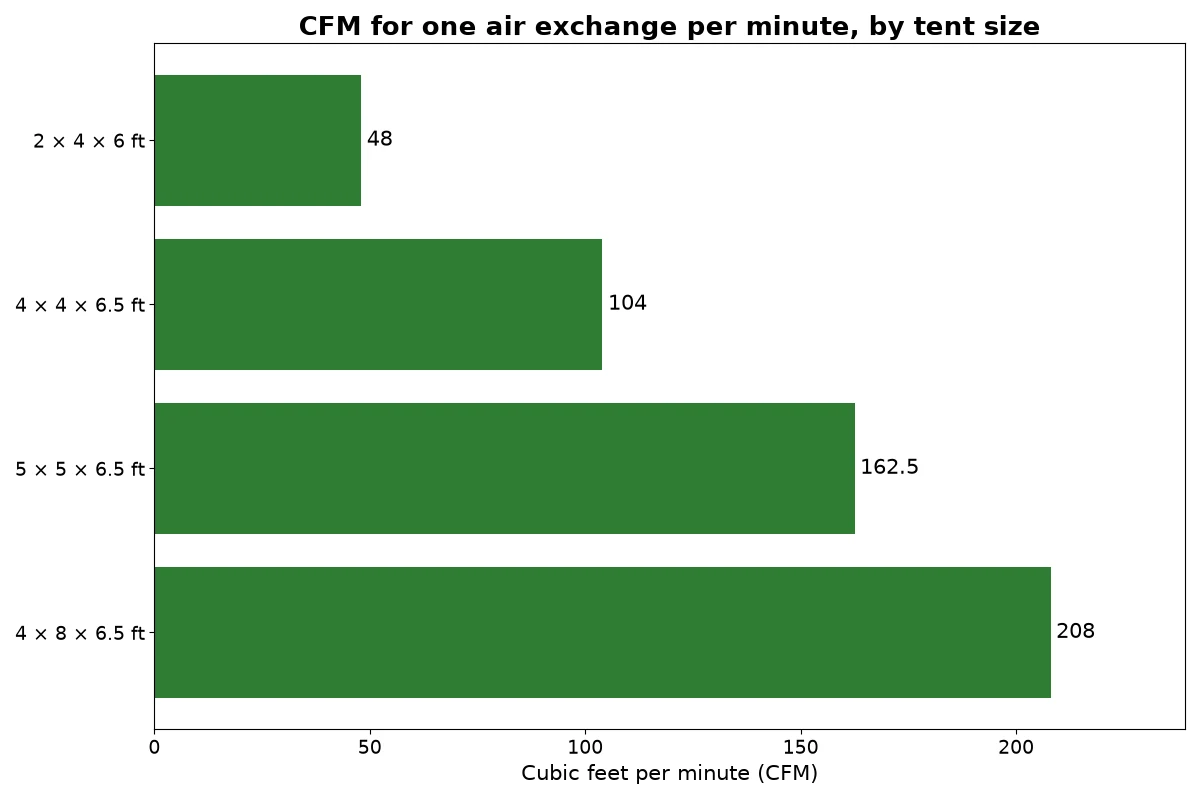
Computed as length × width × height. One exchange per minute is a UMass Extension greenhouse rule for summer ventilation, applied here as a starting point. Filter and duct losses vary by product.
Data for this chart:
| Tent size (ft) | Volume (cu ft) | CFM for 1 exchange per minute | Basis |
|---|---|---|---|
| 2 × 4 × 6 | 48 | 48 | Computed, UMass greenhouse rule |
| 4 × 4 × 6.5 | 104 | 104 | Computed, UMass greenhouse rule |
| 5 × 5 × 6.5 | 162.5 | 162.5 | Computed, UMass greenhouse rule |
| 4 × 8 × 6.5 | 208 | 208 | Computed, UMass greenhouse rule |
Do Carbon Filters and Ducting Change Fan Size?
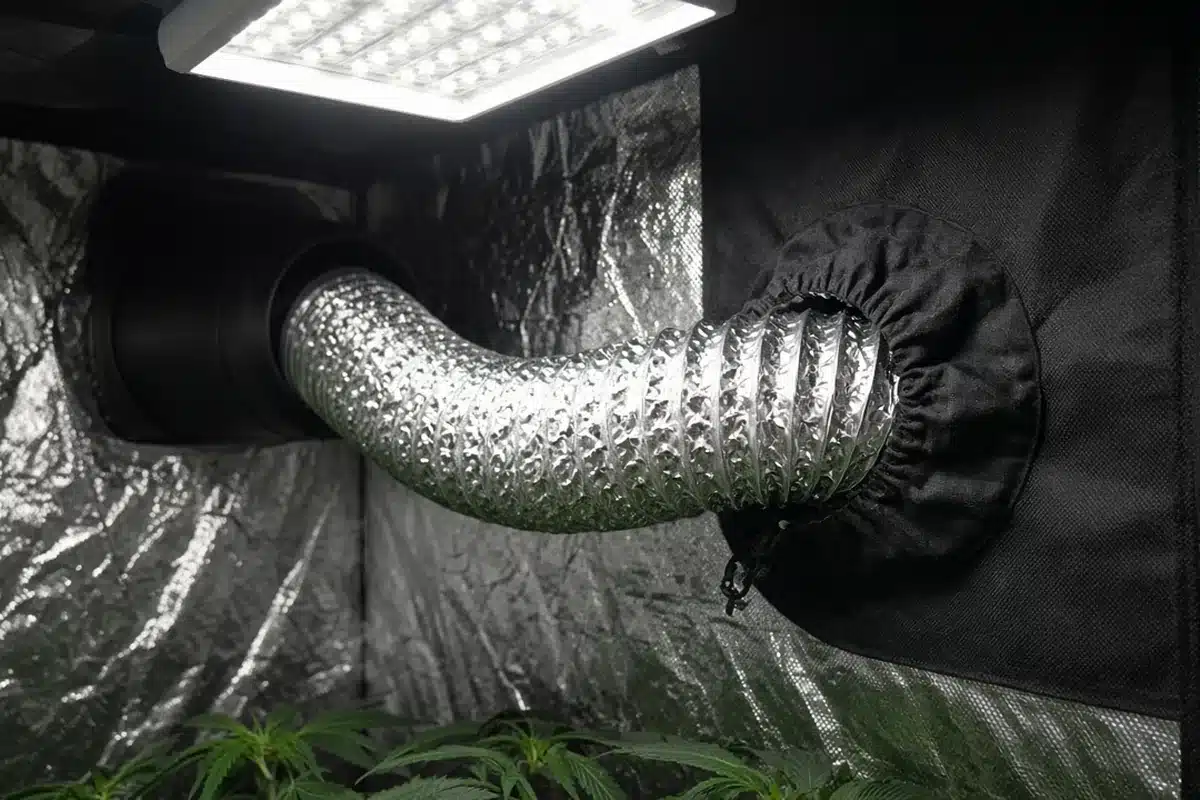
In grower practice, a carbon filter, long duct runs and bends all cut the airflow a fan delivers compared with its rated CFM. Many growers therefore choose a fan with more capacity than the bare tent volume and turn it down with a controller. The loss depends on the filter and duct, so check the product details. See our DIY carbon filter guide.
How Big an Inline Fan Do I Need for My Tent?
Treat the tent volume from the chart above as a rough starting point for one air change a minute. The UMass rule is for greenhouses, so leave headroom for your filter, ducting and lights. A 2 × 4 × 6 ft tent needs about 48 CFM, and a 4 × 8 × 6.5 ft tent about 208 CFM. Exhaust also helps with odor control when paired with a filter.
Sources
Some sources below studied hemp or other crops, or give general garden guidance, rather than studying drug-type cannabis. Their findings are reported as results for those crops or settings.
The UMass rule above is the starting point for this fan sizing page, general growing information from Kind Seed Co.
FAQ
Is a bigger inline fan always better?
Not by itself. UMass Extension recommends several rates of ventilation because needs change with the season, using two-speed fans or multiple fans, and controllers rather than a single-stage thermostat. A fan sized with some headroom and run below full speed gives a similar range of rates in a tent.
Should the inline fan run all the time?
UMass Extension notes that ventilation needs vary by season and recommends several ventilation rates with two-stage thermostats, temperature controllers or a computer system. That points to matching fan speed to conditions rather than running at one fixed speed. Many tent growers use a controller for the same reason.
Can a fan speed controller help?
UMass Extension says energy savings and better control come from two-stage thermostats, temperature controllers or computer systems rather than a single-stage thermostat. A speed controller on an inline fan does a similar job in a tent, letting one fan cover low and high ventilation needs.
Where does the one-exchange-per-minute rule come from?
It comes from the UMass Extension greenhouse ventilation sheet, which sizes fans for one volume air exchange per minute to a height of 8 feet in summer. The sheet says this gives an 8 to 10°F rise from intake to fan. It is a greenhouse rule, used here as a starting point.


