
Regular vs Feminized Seeds: Which Is Better to Grow?
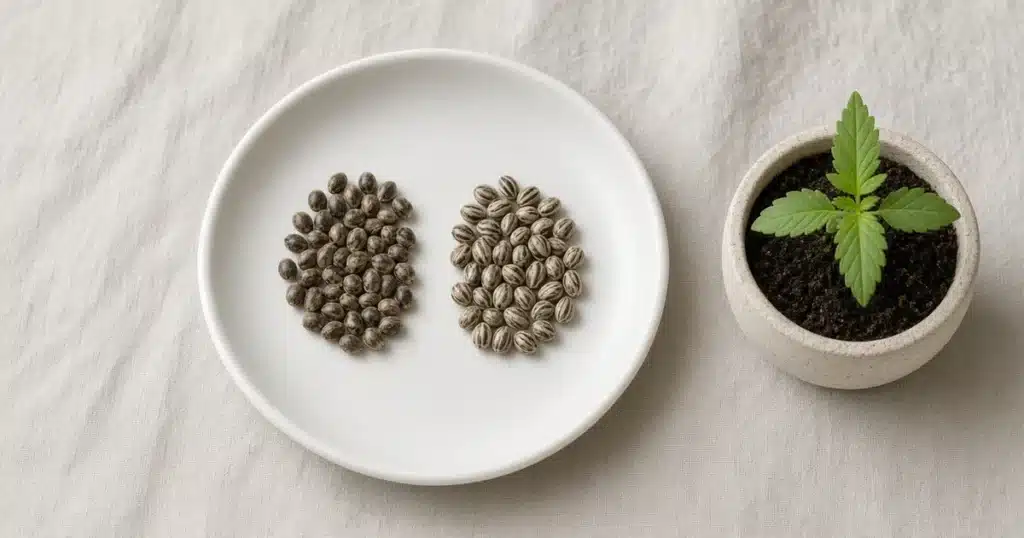
If you are buying seeds, one of the first choices is regular or feminized. Regular seeds grow into a natural mix of male and female plants. Feminized seeds are bred to grow females. Neither one is better in every case. The right choice depends on your space, your time and whether you want to make your own seeds. This guide explains how each type is made, what each means for your grow, and how to handle male plants. It uses hemp research from University of Georgia Extension and Cornell University. Check your state’s home grow law before you plant, including any plant count limits.
Why the sex of the plant matters
Cannabis plants are usually either male or female. Only females produce the buds most growers want. Males make the pollen. If pollen reaches a female, she puts energy into seeds instead of flowers. Cornell University hemp researchers explain that “pollination decreases the value of material,” diluting cannabinoids and “resulting in unmarketable seeded material for smokable flower products.”
What regular seeds are
Regular seeds are made the old fashioned way: a male pollinates a female. The seeds grow into males and females in roughly equal numbers, though the split varies by batch. University of Georgia Extension describes hemp growers who “experimented with growing a crop from nonfeminized (regular) seed and culling the male plants in the field,” noting that “while the initial costs are significantly lower, the labor costs associated with regularly removing male plants” add up.
What feminized seeds are
Feminized seed is made by breeders, not by the grower who plants it. UGA explains that “hemp seeds are feminized by treating female plants with colloidal silver or silver thiosulfate and subjecting them to a reduced (12-hr/12-hr day/night) lighting schedule.” That treated female then produces pollen, which is used to pollinate other females, “producing a high percentage of female seeds.” This is a breeding step done on parent plants by seed producers. You do not need to treat your own plants with anything to grow feminized seeds.
UGA adds a caution: “In some cases, growers have reported that the feminization process has not been successful and they have been left with an even split of male and female plants.” Feminized seeds raise your odds a lot, but you should still watch your plants.
Quick comparison
| Factor | Regular seeds | Feminized seeds |
|---|---|---|
| Expected sex | Mixed male and female | Mostly female |
| Plants to start for a set number of females | More | Fewer |
| Need to identify males | Yes, every plant | Still check, but rarely needed |
| Good for breeding your own seeds | Yes | Limited |
| Fit for small spaces and plant limits | Harder | Easier |
Planning math: how many seeds to start
Say you want four flowering plants. With feminized seed, you might start four or five, allowing for a seed that does not sprout. With regular seed, expect about half to be male, so you might start eight to ten to end up with four females. That is double the pots, soil, light space and time in veg before you know which plants to keep. Plant count rules differ by state. Where your state caps how many plants you may grow and counts seedlings or unsexed plants toward that cap, those extra plants may count too, which can make regular seed hard to use in a small home grow. Check how your state counts plants before you start.
Stability and vigor
Some growers like regular seeds because they come from a natural cross between a male and a female, with no treatment step. Other growers report that well made feminized seeds grow just as vigorously, though that is grower experience rather than research. In practice, the breeder and the genetics matter more than whether the pack is regular or feminized. Read the breeder’s description of flowering time, height and stability before you choose.
Which should you choose?
Choose feminized if you have limited space, a tight plant count, or want every plant to count toward a harvest. This fits many small home grows.
Choose regular if you want to breed, want males for making your own seed, or enjoy working with traditional genetics. You will need room and time to grow extra plants and spot males.
How to grow regular seeds: step by step
- Start more plants than you need. Expect roughly half to be male. Only do this if your state’s plant count allows the extra plants.
- Label each plant. Number every pot so you can track it.
- Watch for preflowers. Photoperiod plants usually show their sex after several weeks of veg, at the nodes where branches meet the stem.
- Look for pollen sacs or pistils. Males form small round sacs on short stalks. Females form a small calyx with white pistils.
- Remove males early. Take males out of the grow space before the sacs open, unless you are deliberately breeding. Slip a plastic bag loosely over the plant first so any early pollen stays contained while you move it.
- Clean up. Wipe surfaces and change clothes after handling males so you do not carry pollen to females.
- Keep watching females. Stress can cause some females to form pollen sacs late in flower.
How to grow feminized seeds: step by step
- Start only the number you want to flower.
- Keep the environment steady. Avoid light leaks, heat spikes and big feeding swings, which can stress plants into making pollen sacs.
- Check nodes weekly in flower. Remove any stray pollen sacs before they open. Cover the branch with a small plastic bag first so pollen does not spread.
Storing seeds until you plant
Whichever type you buy, store seeds in a cool, dark, dry place in a sealed container until you are ready. Heat, light and moisture shorten seed life. Label the container with the strain, type and date. When you are ready to plant, start a few at a time rather than the whole pack, so you have backups if a seedling fails.
Troubleshooting
I cannot tell if a plant is male or female yet. Wait another week and check the nodes with a magnifier. See our guide on detecting early female plant signals.
A feminized plant grew pollen sacs. Look for stress such as light leaks or heat. Bag the branch, then remove the sacs carefully, or bag and remove the plant if there are many.
My females have seeds in them. Pollen got in from a male, a stressed plant or outside. See our guide on how to tell if a female has been pollinated.
Half my regular seeds were male and I lost space. That is to be expected with regular seed. Next time, start seeds in small pots and sex them before moving females to final containers.
Related guides
See feminized vs autoflowering seeds and F1, F2 and F3 seeds to round out your seed choice.
Sources
- Cornell University Hemp Program, Triploid Pollen-challenge Trials. https://hemp.cals.cornell.edu/resources/reports-factsheets/2022-cornell-hemp-field-day-handouts/triploid-pollen-challenge-trials/ (opened 2026-10-16)
- University of Georgia Extension, Bulletin 1530, Industrial Hemp Production in Georgia. https://fieldreport.caes.uga.edu/publications/B1530/industrial-hemp-production-in-georgia/ (opened 2026-10-16)
What is the difference between regular and feminized cannabis seeds?
Regular seeds grow into a mix of male and female plants. Feminized seeds are bred to grow mostly female plants, which are the ones that produce buds.
Why are feminized seeds recommended for beginners?
Because almost every plant should be female, you can start only the plants you plan to flower and skip the work of finding and removing males.
When is it better to use regular seeds?
Regular seeds suit growers who want to breed their own seeds or keep male plants. They also suit growers who prefer traditional genetics and have room for extra plants.
Can feminized seeds produce male plants?
It can happen. University of Georgia Extension notes that some hemp growers have had feminization fail. Stress can also cause female plants to form pollen sacs.
How do I know if a plant is male?
Look at the nodes where branches meet the stem. Males form small round pollen sacs on short stalks. Females form a small calyx with white pistils.


