
F1, F2 and F3 Cannabis Seeds Explained
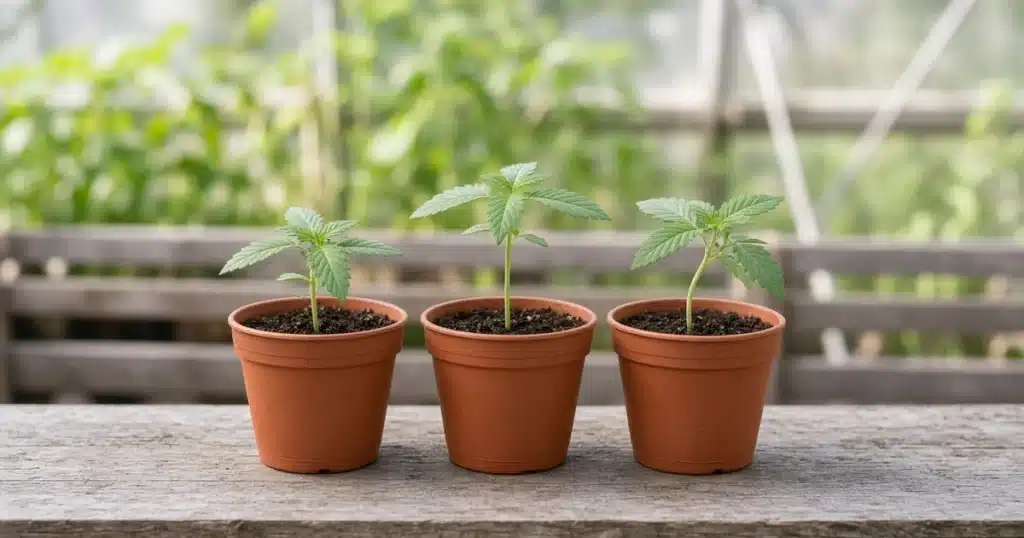
If you have seen “F1” or “F2” on a seed listing and wondered what it means, you are not alone. These labels come from plant breeding, and they tell you how a batch of seeds was made and how alike the plants are likely to be. This guide explains each generation in plain terms, shows you how to read a seed label, and covers what to expect in your garden. It draws on seed saving guides from five university Extension services. Before you plant anything, check your state’s home grow law.
What the “F” stands for
The F stands for filial, which simply means a generation of offspring. University of Georgia Extension describes it this way in its seed saving bulletin, which says “the ‘F1’ refers to the first filial generation.” Each number after the F counts one more generation of breeding from the original cross.
The idea is the same in tomatoes, corn and cannabis. Extension guides use vegetables as examples, and the same basic generation terms apply to cannabis.
F1 seeds: the first cross
To make true F1 seed, a breeder starts with two parent lines that are each very uniform, then crosses them. South Dakota State University Extension explains that “all of the first generation of plants from this cross will contain the exact same two sets of genes (one from each line) and thus will be identical to each other.”
That is one reason F1 plants are so often prized. SDSU adds that these progeny “usually display ‘hybrid vigor.'” That describes vegetable crops, so read it as a tendency. Results vary and nothing is guaranteed.
One caution for cannabis growers: the word F1 is sometimes used loosely in seed marketing. A true F1 needs two highly inbred parents. If the parents were not stable lines, the plants in the pack can still vary. Read the breeder’s description, and read uniformity claims as a goal rather than a promise.
F2 seeds: the shuffle
F2 seed comes from crossing two F1 plants, or from letting F1 plants pollinate each other. University of Maine Cooperative Extension puts it clearly: “F1 hybrids are not true-breeding: seed produced by the hybrid, which is known as the F2 generation, will produce a population of plants displaying traits covering the full genetic range of the two parents of the F1 hybrid.”
In practice, an F2 pack can give you tall plants and short ones, early finishers and late ones, and a range of smells. University of Maryland Extension says seed from F1 plants “will not produce plants identical to the F1 hybrid,” and instead “one will see a wide range of characteristics expressed.”
That variety is a problem if you want ten matching plants. It is an opportunity if you enjoy hunting for a standout plant, which is why breeders often grow out F2 populations.
F3 and beyond: selecting toward stability
Breeders keep selecting the plants they like and crossing them again. UMaine notes that “the amount of variation decreases with each subsequent generation and selection of desirable plant traits.” Over several generations of careful selection, a line can become more stable and predictable.
Stability takes real time. In vegetables, a University of Missouri bulletin describes about six generations of selection before a tomato line is treated as a fixed parent. Cannabis lines vary, so a label alone cannot tell you how stable a given F3 or F5 is.
F1 vs F2 vs F3 at a glance
| Generation | How it is made | What to expect | Best for |
|---|---|---|---|
| F1 | Two uniform parent lines crossed | Plants are alike when parents are truly inbred, and often vigorous | Growers who want even, predictable plants |
| F2 | Two F1 plants crossed | Wide variation in height, timing and aroma | Pheno hunters and breeders |
| F3 and later | Selected F2 plants crossed again | Variation narrows with each round of selection | Growers who want a known type with some character |
How to choose and grow each generation: step by step
- Decide what you want. If you need an even canopy in a small tent, an F1 or a well selected later generation is the easier path. If you want to find one special plant, F2 is more interesting.
- Read the full label. Look for the generation, whether the seeds are feminized, autoflowering or regular, and the breeder’s stated flowering time and height range.
- Plan for spread. With F2 seed, leave extra room. Plants may finish at different times and reach different heights.
- Grow more than you keep. With variable seed, start a few more plants than you need so you can choose the best ones. This only works if your state’s plant count allows it.
- Label every plant. Give each seedling a number and keep notes on vigor, stretch, smell and finishing time.
- Compare under the same conditions. Keep light, pot size and feeding the same for every plant so the differences you see come from genetics, not the setup.
- Keep your notes handy. If you plan to clone a winner, your notes tell you which plant to keep.
Can you save seed from your own plants?
You can make seed by pollinating a female with a male, but the result depends on what you started with. SDSU warns that “you should not save seed from F1 or hybrid plants if you want to be certain that the plants grown from that seed will be the same as their parents.” Seed from an F1 plant is, by definition, F2 seed, with all the variety that brings. Pollination also fills your buds with seeds, which lowers the quality of smokable flower, so most home growers who want consistent plants buy fresh seed or take clones instead.
Troubleshooting F1, F2 and F3 grows
My “F1” plants all look different. The parents may not have been fully inbred, or the label may be used loosely. Note the differences, keep the plants you like, and buy from breeders who describe their parent lines.
My F2 plants finished weeks apart. That is normal for F2. Harvest each plant when it is ready rather than all at once. Check each one up close before you cut.
One plant stretched far taller than the rest. Use low stress training to bend it, or move it to the edge of the tent. Next time, top tall phenotypes early.
I found a great plant but cannot get the same one from seed. Seed will not copy it exactly. Take cuttings from that plant before you flip it to flower, and keep a mother plant if your state allows it.
My saved seeds produced weak plants. Seed from hybrids often loses vigor. University of Missouri IPM explains that “hybrid vigor only last one generation.” Start with fresh seed for your next run.
Where to go next
If you are still choosing between seed types, see our guides to feminized vs autoflowering seeds and regular vs feminized seeds. Once your plants are up, our trichome guide helps you time the harvest on each phenotype.
FAQ
What does F1 mean on cannabis seeds?
F1 means first filial generation. It is the first cross between two parent lines. When both parents are truly uniform, F1 plants are very similar to each other and often vigorous.
Are F2 cannabis seeds bad?
No. F2 seeds are not bad, they are just less predictable. Plants from an F2 pack can vary a lot in height, flowering time and aroma, which suits growers who like to hunt for a standout plant.
Is F1 better than F2 for beginners?
Usually, yes. A true F1 tends to give more even plants, which makes light height, training and harvest timing simpler in a small space.
What does F3 mean on seeds?
F3 seeds come from crossing selected F2 plants. Variation tends to narrow with each round of selection, but how stable a line is depends on how carefully the breeder selected it.
Can I save seeds from my F1 plants?
You can, but the seeds will be F2 and will not grow into copies of the parent. Extension seed guides advise against saving seed from hybrids if you want the next plants to match. Take a cutting instead if you want to keep a plant.
Sources
- South Dakota State University Extension, Saving Seed: Will the seed produce plants similar to the plant it was collected from?. https://extension.sdstate.edu/saving-seed-will-seed-produce-plants-similar-plant-it-was-collected (opened 2026-10-16)
- University of Maine Cooperative Extension, Bulletin #2750, An Introduction to Seed Saving for the Home Gardener. https://extension.umaine.edu/publications/2750e/ (opened 2026-10-16)
- University of Maryland Extension, Vegetables Not True to Type. https://www.extension.umd.edu/resource/vegetables-not-true-type (opened 2026-10-16)
- University of Georgia Extension, B1486, Variety Selection and Seed Saving for Organic Growers. https://extension.uga.edu/publications/detail.html?number=B1486&title=variety-selection-and-seed-saving-for-organic-growers (opened 2026-10-16)
- University of Missouri IPM, Why Not Save Hybrid Seeds?. https://ipm.missouri.edu/MPG/2014/8/Why-Not-Save-Hybrid-Seeds/ (opened 2026-10-16)


