Why the seed exclusion matters for breeders and seed banks
General information only, not legal advice. Kind Seed Co sells only to adults 21 and older.
The section 781 seed exclusion is the part of the new federal hemp definition that removes viable seeds of high THC cannabis from the hemp category. It matters to breeders and seed banks because, since 2018, much of the seed trade has relied on the idea that cannabis seeds were hemp under federal law. Under Public Law 119-37, Division B, section 781, viable seeds from a Cannabis sativa L. plant that exceeds 0.3 percent total THC, including THCA, are excluded from hemp. Under Public Law 119-103 that exclusion is scheduled to take effect on December 11, 2026. The change may affect shipping and banking options open to seed banks and breeders, but nothing is set in stone yet. Lawyers for the hemp and CBD industries are actively working on problems and planning solutions. Here is what the provision says, why it changes the landscape, and the questions breeders and seed sellers are now asking their lawyers.
The text in question
The amended definition at 7 U.S.C. 1639o says hemp “does not include any viable seeds from a Cannabis sativa L. plant that exceeds a total tetrahydrocannabinols concentration (including tetrahydrocannabinolic acid) of 0.3 percent in the plant on a dry weight basis.”
According to the Congressional Research Service (In Focus IF13136), items excluded from the hemp definition are treated under the Controlled Substances Act rather than as hemp once the change takes effect.
Why this is a bigger shift than it looks
The test moves to the parent plant. Seeds themselves carry very little THC. A January 2022 DEA letter said seed within the 0.3 percent delta-9 limit met the hemp definition. The new text skips the seed and asks about the plant it came from. For drug type cannabis genetics, the parent plant is almost always above 0.3 percent total THC.
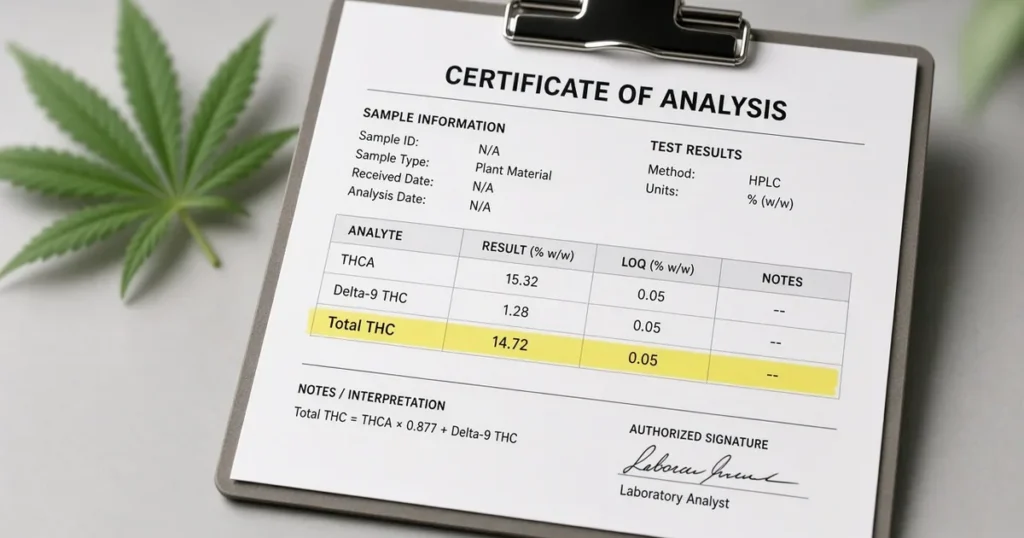
The measure is total THC. Counting THCA closes the gap between delta-9 readings and real cannabinoid content. We explain the measure in what total THC means in the new federal hemp definition.
It is in the statute. The 2022 position was an agency letter. The new rule is written by Congress into federal law, which is harder to reinterpret.
How the old and new approaches compare
| Point | 2022 DEA letter approach | Section 781 approach |
|---|---|---|
| Source | Agency letter | Federal statute |
| What is tested | The seed | The parent plant |
| Measure | Delta-9 THC | Total THC, including THCA |
| Typical result for drug type seed | Often treated as hemp | Excluded from hemp if the parent is above the limit |
The table is a plain summary of the statute and the CRS reading. It is not a legal opinion on any product.
Who is affected
- Seed banks that sell drug type genetics to adults in legal states.
- Breeders who make and distribute crosses, feminized lines or autoflower lines.
- Home growers who buy seeds, since the federal status of what they buy changes.
- Hemp farmers to a lesser degree. CRS notes the new definition expressly includes industrial hemp grown for fiber, grain, oil and similar uses.
What stays the same
State law. Each state still sets its own cannabis rules, including home grow limits and, in some states, licensed nurseries or seed programs. The federal change does not repeal state laws, and state laws do not override federal law.
Industrial hemp seed. Hemp grown for grain or fiber, and seed for those crops, is treated separately under the definition. Certified hemp seed programs run through state agriculture departments are a different track from drug type genetics.
Non viable seed. The exclusion targets viable seeds. The federal marijuana definition at 21 U.S.C. 802(16) has long excluded sterilized seed that cannot germinate.
Questions breeders and seed banks are raising with counsel
We are not going to tell anyone how to structure around the rule. These are the questions we see the industry asking lawyers, listed so readers understand the scope of the change:
- How does the rule apply to seeds made before December 11, 2026?
- What records show a parent plant’s total THC, and who must keep them?
- How do state licensed programs interact with the federal exclusion?
- What changes for payment processors, platforms and advertising policies?
- How do interstate shipping rules apply once seeds are no longer hemp?
- What happens to genetics libraries and breeding stock?
- How should a business plan for a possible further delay or repeal?
Only a qualified attorney who knows the facts can answer those for a specific business.
Will Congress change it again?
Possibly. CRS lists H.R. 7024, H.R. 7010 and S. 3686, which would delay the new definition for two more years, and H.R. 6209, which would repeal it. CRS also notes the House passed FY2027 agriculture bill did not include a further delay. None of those bills was law when we wrote this. Anyone in the seed business should be watching congress.gov closely.
Why it matters for preservation of genetics
Breeders have spent decades stabilizing landraces and modern crosses. Seeds are how those genetics survive. A federal rule that treats viable seed from high THC plants as a controlled substance raises real questions for seed libraries, preservation projects and university research. Some of those groups operate under registrations or state licenses. Others will need to find out where they stand.
That is not an argument for ignoring the rule. It is a reason the industry is paying close attention and why many voices are pressing Congress on the issue.
What home growers should take from this
- Know that the federal status of cannabis seeds is scheduled to change on December 11, 2026.
- Read your own state’s home grow law, which still controls what you may grow at home.
- Follow primary sources rather than social posts.
- Ask an attorney if you have specific questions.
For the plain yes or no version, read are cannabis seeds hemp under federal law after December 11 2026. For state basics, visit our USA seed law hub.
Sources
- 7 U.S.C. 1639o, as amended by Public Law 119-37, Division B, section 781
- Public Law 119-103, section 2019
- Congressional Research Service, In Focus IF13136 (congress.gov)
- 21 U.S.C. 802(16)
- DEA Drug and Chemical Evaluation Section letter, January 2022
Learn more
Browse our marijuana seeds catalog for adults 21 and older where home growing is legal under state law, or visit the Kind Seed Co shop. This article is not legal advice.
FAQ
What is the section 781 seed exclusion?
It is the provision in Public Law 119-37 that removes viable seeds from Cannabis sativa L. plants above 0.3 percent total THC from the federal hemp definition.
When does it take effect?
It is scheduled for December 11, 2026, under Public Law 119-103.
Does it affect hemp grown for grain or fiber?
CRS notes the new definition expressly includes industrial hemp grown for fiber, grain, oil and similar uses.
Can a state license override the exclusion?
State law and federal law are separate. A state license does not change the federal definition. Ask counsel how the two interact for your case.
Is the rule final?
It is enacted law with a scheduled date, but bills to delay or repeal it are pending. Check congress.gov for current status.