7 Ways to Protect Marijuana Plants From Pests

The best pest control is prevention. Start clean, check your plants every week, and act early with the gentlest control that works. Here are seven ways to protect your plants: start with clean soil, quarantine new plants, use companion plants, welcome natural predators, fence and screen, check every week, and spray only when needed.
Indoor grows are not pest free. Fungus gnats and spider mites are common trouble in tents, and they spread fast in a warm, still room. Outdoor plants face a wider range of insects, plus larger animals. Either way, the same approach works. Extension guides call it integrated pest management, or IPM. UVM Extension sums it up as “Management, not eradication,” with monitoring, cultural, mechanical and biological controls, and “Sensible chemical control as a last resort.”
Know the common cannabis pests
You can’t control a pest you haven’t identified yet. These are the pests home growers run into most often.
| Pest | Signs | Where to look | First response |
|---|---|---|---|
| Spider mites | Fine pale speckling, webbing | Undersides of leaves | Confirm with a hand lens, remove the worst leaves |
| Aphids | Sticky leaves, clusters of small soft insects | Stems and new growth | Wipe or rinse off, encourage predators |
| Thrips | Silvery streaks, tiny black specks | Upper leaf surfaces | Sticky cards, remove damaged leaves |
| Fungus gnats | Small flies over wet soil | Soil surface | Let topsoil dry, sticky cards |
| Whiteflies | Tiny white insects that fly up when disturbed | Undersides of leaves | Sticky cards, remove infested leaves |
| Caterpillars and budworms | Holes in leaves or buds, droppings | Inside colas | Hand pick, remove damaged bud |
Spider mites are easy to miss until the damage spreads. Virginia Tech Extension notes that the twospotted spider mite is “usually found on the undersides of plant leaves,” and that “Feeding injury to plants causes white stippling marks on leaves.” Aphids tend to gather on stems and fresh growth. Utah State University Extension advises growers to “Inspect the undersides of leaves and along stems throughout the growing season.”
Not a pest: mold that looks like pest damage. Powdery mildew and botrytis, also called bud rot, are fungal diseases, not pests. Powdery mildew shows up as white powder on leaves. Bud rot turns the inside of a cola brown and mushy, and it often follows caterpillar damage. Treat them as a disease problem with airflow, humidity control and removal of affected material. For help with humidity, see https://kindseed.com/what-factors-affect-relative-humidity-control-for-cannabis/.
Prevention: clean start, healthy plants, quarantine and screens
The BC government’s guide for homegrown cannabis puts it simply: “It is easier to keep pests numbers low rather than responding to an outbreak.”
Start every grow with sterilized potting mix and clean tools. Do not reuse old potting mix, since it can carry eggs and larvae. Change your clothes after working in an outdoor garden before you go into an indoor grow.
Keep plants healthy. Stressed plants attract more pests, and overwatering in particular keeps the topsoil wet, which fungus gnats love. See our guide to overwatering at https://kindseed.com/overwatering-cannabis-prevention-diagnosis-and-solutions/. Feed with care, too. The BC IPM manual advises growers to “Manage nutrients to avoid flushes of lush vegetative growth,” because soft, nitrogen heavy growth is easy for pests to feed on.
Quarantine anything new. Virginia Tech Extension says, “If planting indoors, it is of the utmost importance to quarantine the plants to ensure that they are free of aphids.” Keep new clones and plants well apart from your grow until you have checked them closely.
Indoors, screen your intake vents. The BC IPM manual recommends you “Use insect netting to screen vented areas.”
Weekly monitoring routine
- Quarantine any new clone or plant away from the grow before it joins other plants.
- Once a week, check leaves from the top, middle and bottom of each plant, both sides, with a hand lens.
- Hang yellow sticky cards to monitor flying insects and check them weekly.
- Push a raw potato wedge into the soil for a day to check for gnat larvae.
- If you find pests, remove the worst leaves, then pick the gentlest control that fits the pest.
- Write down what you found and what you did, then check again within a few days.
The BC common pests guide notes that “Yellow sticky traps attract flying insects,” and suggests “placing a raw potato wedge in the soil for 24 hrs” to check for gnat larvae. Your notes matter as much as the checks. Over a few weeks, they show whether a problem is growing or fading.
The 7 ways to protect your plants
1. Start with clean soil. Use fresh, sterilized potting mix and clean pots. Old mix and dirty containers are an easy way to bring eggs and larvae into a new grow.
2. Quarantine new plants. Keep clones and new plants apart until you have checked them with a hand lens over several days. One infested clone can start a problem for the whole room.
3. Use companion plants. Outdoors, many growers plant marigolds, basil, mint, garlic or onions nearby to help confuse or deter some insects. Results vary, so treat companion plants as one layer of protection, not a fix. See https://kindseed.com/companion-plants-when-growing-marijuana/.
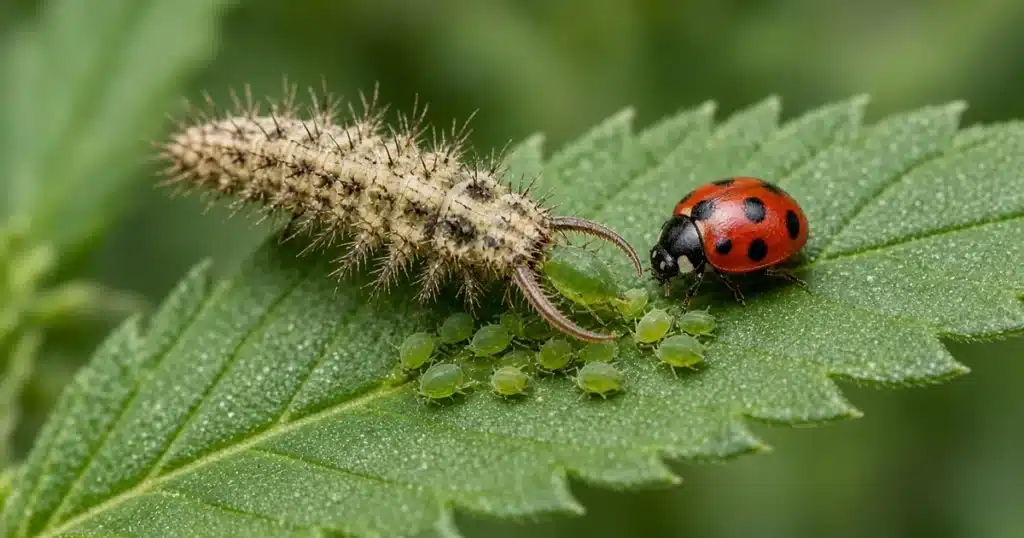
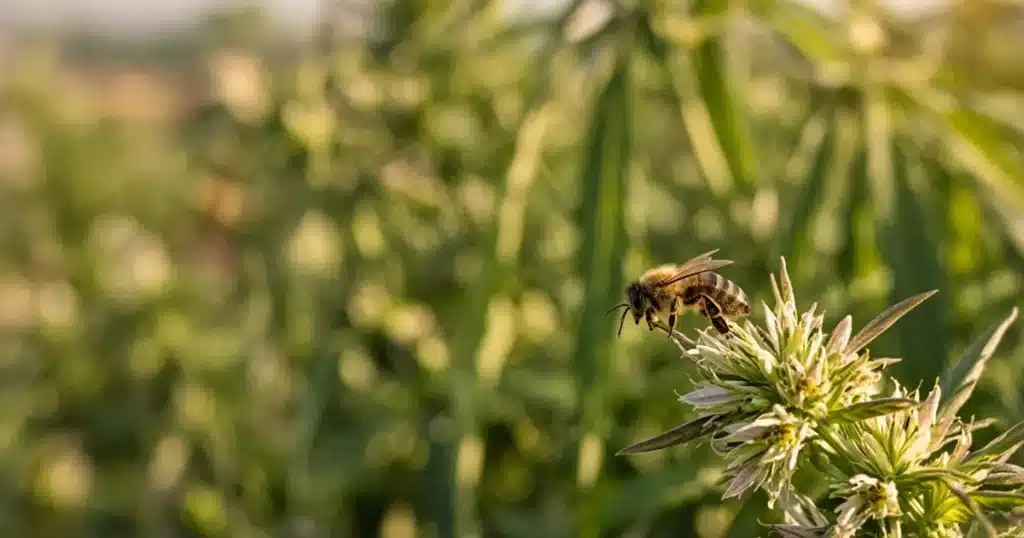
4. Welcome natural predators. Ladybugs, lacewings and predatory mites eat many soft bodied pests. Utah State University Extension advises growers to “Encourage natural enemies.” UVM Extension lists Neoseiulus fallacis for spider mites and Aphidoletes for aphids. Beneficial nematodes are another common option for gnat larvae in soil. Colorado State University warns that “the misuse of miticides can lead to the development of resistant mite populations,” which is one more reason to lean on biological control when you can. Outdoors, pollinators matter too, see https://kindseed.com/what-roles-do-bees-play-in-outdoor-cannabis/.
5. Fence and screen. Outdoors, a fence keeps out deer, rabbits and other larger animals. Indoors, insect netting over vents and a closed door keep flying pests out.
6. Check every week. Follow the routine above. Early detection makes problems easier to manage.
7. Spray only when needed. If you decide to use a spray, follow its label and your state’s rules. Hose or wipe off soft bodied insects first. Many growers stop spraying once buds form, since anything you spray can stay on the flowers. Pruning crowded growth also helps airflow and makes pests easier to spot, see https://kindseed.com/a-guide-to-cannabis-defoliation/.
Indoor vs outdoor pest pressure
Indoors, the main risks are pests that thrive in warm, still air and damp soil. Spider mites and fungus gnats lead the list. Because there are few natural predators in a tent, a small problem can grow quickly. Quarantine, clean media, screened vents and weekly checks are your best tools.
Outdoors, plants face more kinds of insects, including caterpillars and aphids, and larger animals. They also have help from natural predators. Fences, companion plants and encouraging beneficial insects play a bigger role outside.
Troubleshooting
| Sign | Likely cause | What to do |
|---|---|---|
| Fine speckling and webbing under leaves | Spider mites | Confirm with a hand lens, remove heavily infested leaves, choose a control labeled for the use |
| Sticky leaves, clusters on stems | Aphids | Hose or wipe off, release aphid predators, check new growth |
| Small flies over wet soil | Fungus gnats | Let topsoil dry, sticky cards, beneficial nematodes |
| Holes in buds, brown mush inside colas | Caterpillars, often followed by bud rot, a fungal disease | Hand pick, remove damaged bud, improve airflow |
| White powder on leaves | Powdery mildew, a disease and not an insect pest | Remove affected material and improve airflow |
Once you find pests, isolate the affected plant if you can, remove the worst damage and pick the gentlest control that fits. Then check again within a few days. If the problem keeps coming back, look at the conditions that invited it, such as wet soil, still air or crowded growth.
Sources: Virginia Tech Extension ENTO 349 (https://ext.vt.edu/content/dam/pubs_ext_vt_edu/ENTO/ento-349/ENTO-349.pdf). Utah State University Extension, Hemp and Cannabis Aphid (https://extension.usu.edu/planthealth/ipm/notes_ag/hemp-cannabis-aphid). Colorado State University, Twospotted Spider Mite (https://agsci.colostate.edu/agbio/ipm-pests/twospotted-spider-mite/). UVM Extension, Arthropod Pests in Hemp (https://www.uvm.edu/d10-files/documents/2024-06/Arthropod_pests_in_hemp.pdf). Government of British Columbia, IPM for homegrown cannabis, common pests guide and IPM manual. City and County of Denver, cannabis IPM best practices.
FAQ
What is the most common pest on indoor cannabis?
Spider mites and fungus gnats are two of the most common indoor pests. Spider mites do well in warm, dry conditions, and fungus gnats breed in wet soil. Quarantine, clean media and weekly checks help keep both down.
How do I know if I have spider mites?
Look for fine pale speckling on leaves and, in bigger outbreaks, thin webbing. Check the undersides of leaves with a hand lens to confirm. Remove heavily infested leaves and choose a control labeled for the use.
Do companion plants really keep pests away?
They can help as one layer of protection outdoors. Many growers plant marigolds, basil, mint or garlic nearby. Results vary, so combine companion plants with weekly checks, clean soil and natural predators.
Should I use neem or soap sprays in flower?
Always follow the product label and your state’s rules. Many growers stop spraying once buds form, because anything you spray can stay on the flowers. In flower, lean on hand removal, sticky cards, airflow and predators instead.
How often should I check plants for pests?
Check at least once a week. Look at leaves from the top, middle and bottom of each plant, both sides, with a hand lens. Check your sticky cards at the same time and write down what you find.