Beneficial Insects For Cannabis: Match Predator To Pest
Quick answer: The best beneficial insects for cannabis are the ones that match the pest you actually have. Lady beetles and aphid parasitoids go after aphids. Predatory mites and the spider mite destroyer lady beetle feed on mites. Lacewing larvae and minute pirate bugs eat a wide range of small, soft bodied pests. Confirm the pest first, then pick the predator, and stop broad spectrum sprays before you release.
What Beneficial Insects Do
The UC Statewide IPM Program says the important natural enemies of insect and mite pests are predators, parasitoids and pathogens. Predators, such as lady beetles and lacewing larvae, eat many prey during their lives. Parasitoids, such as tiny wasps, lay eggs in or on a single pest, and the young feed on it until it dies. Pathogens are diseases of insects.
Natural enemies already live in most outdoor gardens, whether you notice them or not. Buying and releasing them is one tool, but keeping the ones you have is just as important. UC IPM advises conserving natural enemies by avoiding broad spectrum insecticides.
Which Predator Fits Which Pest
| Beneficial | Main prey | Source |
|---|---|---|
| Convergent lady beetle | Aphids | UC IPM |
| Spider mite destroyer lady beetle (Stethorus) | Spider mites | UC IPM |
| Neoseiulus predatory mites | Mites and thrips | UC IPM |
| Phytoseiulus predatory mites | Mites only | UC IPM |
| Green lacewing larvae | Mites, aphids, mealybugs, thrips and other soft bodied insects | UC IPM |
| Minute pirate bugs | Aphids, mites, thrips, whiteflies and more | UC IPM |
| Aphidius parasitic wasps | Aphids | UC IPM |
| Encarsia formosa parasitic wasp | Whiteflies | UC IPM |
| Mealybug destroyer | Mealybugs, aphids and scales | UC IPM |
| Stratiolaelaps soil mites and Dalotia rove beetles | Fungus gnat larvae | UC IPM fungus gnat pages |
For help confirming the pest, see our guide to aphids on cannabis leaves.
Lady Beetles
Lady beetles are the best known beneficial of all, but the common kind sold for release has a catch. UC IPM says purchased convergent lady beetles naturally disperse, and most will fly away from the release site within 1 or 2 days even if aphids are plentiful. Each adult can still eat about 100 aphids per day before it leaves.
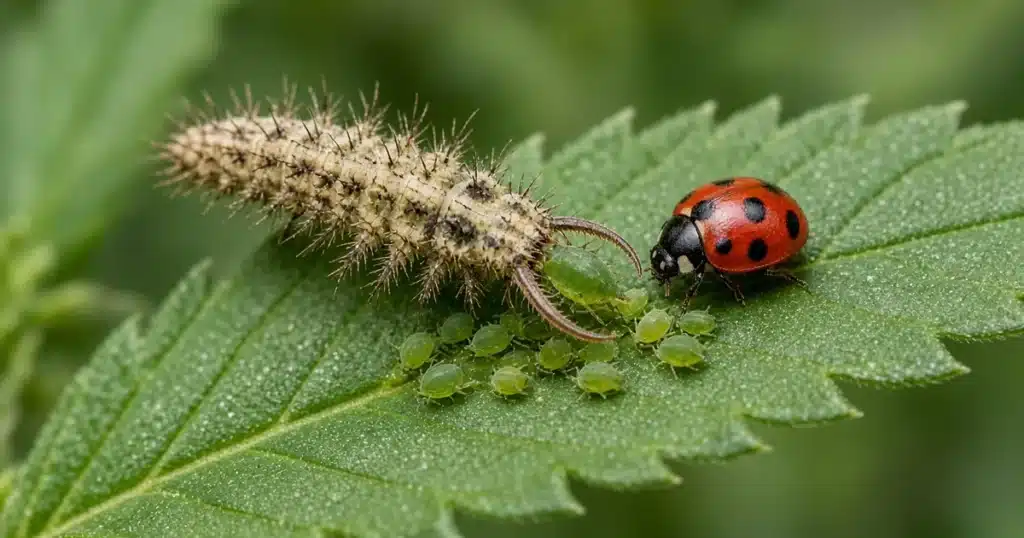
What you will see: UC IPM says lady beetle larvae are active, have six long legs and resemble tiny alligators. Convergent larvae grow up to 1/4 inch long and are blackish with orange blotches.
Green Lacewings
UC IPM says green lacewings prey on mites and many soft bodied insects, including aphids, leafhoppers, mealybugs and thrips. The larvae do most of the feeding and resemble tiny alligators. An adult female lays about 100 to 300 eggs.
What you will see: UC IPM describes the larvae as about 1/2 inch long or less and commonly cream, tan or yellowish, and the eggs as pale yellowish green or white, each laid on the end of a silken stalk.
Predatory Mites
Predatory mites are tiny, fast moving mites that hunt pest mites. UC IPM lists Neoseiulus species as predators of mites and thrips, and Phytoseiulus species as predators of mites only. That makes them a better fit for mite problems than general predators.
Parasitic Wasps
Parasitic wasps are tiny. UC IPM lists Aphidius wasps as parasitoids of aphids and Encarsia formosa as a parasitoid of whiteflies. The female lays an egg inside the pest, and the young wasp develops inside it.
Soil Predators for the Root Zone
Most aphid and mite predators work above ground. For pests in the soil, UC IPM says Hypoaspis, also called Stratiolaelaps, is a predatory mite adapted to the upper layers of moist soil that preys on fungus gnat larvae. The UC IPM floriculture guide adds that these mites and the rove beetle Dalotia coriaria can be bought and released according to the supplier. Colorado State University also names Stratiolaelaps scimitus among the soil dwelling predators of root aphids. For more on soil pests, read our guide to fungus gnats in cannabis pots, and for worm like soil allies, see our nematodes guide.
How to Release Beneficial Insects
- Confirm the pest. Use a hand lens and check leaf undersides so you know exactly what you are fighting.
- Pick the matching predator. Use the chart above, since a predator that does not eat your pest will not help.
- Stop broad spectrum sprays first. UC IPM says avoiding broad spectrum insecticides helps conserve natural enemies.
- Read the label and your state’s rules. Follow the product label, and check that any pesticide is allowed for cannabis in your state.
- Release in the late evening. UC IPM suggests wetting plants first and releasing lady beetles in the late evening to slow their dispersal.
- Spread them out. Place predators across the canopy or soil surface near the pests, not in one spot.
- Follow the supplier’s directions. The UC IPM floriculture guide says soil predators can be purchased and released according to the supplier.
- Recheck and release again if needed. Look for predators, eggs and pest numbers each week, and plan repeat releases, since many predators leave or die off once prey runs low.
Troubleshooting
The lady beetles were gone in a day. That is normal for purchased convergent lady beetles. UC IPM says most fly away within 1 or 2 days even when aphids are plentiful. Release them in the late evening after wetting the plants.
Pest numbers keep rising after release. The predator may not match the pest, or it was released too late. Recheck the ID and compare it with the chart.
Predators died after a spray. Many sprays harm natural enemies, which is why UC IPM advises avoiding broad spectrum insecticides. Check the label for effects on beneficials and space sprays away from releases.
Soil predators did not seem to work. Soil mites need moist soil, as UC IPM notes. Very dry mix may limit them. Check the moisture and the supplier’s directions.
You cannot find the predators you released. Many are tiny or work at night. Look for signs such as lacewing eggs on silken stalks, alligator shaped larvae or falling pest numbers.
Frequently Asked Questions
What are the best beneficial insects for cannabis?
The best ones match your pest. UC IPM lists lady beetles and Aphidius wasps for aphids, Neoseiulus and Phytoseiulus predatory mites for mites, Encarsia formosa for whiteflies and the mealybug destroyer for mealybugs. Green lacewing larvae and minute pirate bugs feed on many soft bodied pests, so they suit mixed problems.
Are ladybugs a good beneficial insect for cannabis?
They help with aphids, but they leave fast. UC IPM says most purchased convergent lady beetles fly away within 1 or 2 days after release, even if aphids are plentiful. For mites, UC IPM lists a different lady beetle, the spider mite destroyer, Stethorus. See our guide to spider mites.
When is the best time to release beneficial insects on cannabis?
Release them as soon as you confirm the pest and while numbers are still low. For lady beetles, UC IPM suggests wetting plants first and releasing them in the late evening to slow their dispersal. Stop broad spectrum sprays before release, and follow the supplier’s directions for other predators.
Can beneficial insects for cannabis be used with sprays?
Only with care. UC IPM advises avoiding broad spectrum insecticides to conserve natural enemies. Even soft sprays can harm some beneficials. Colorado State University says insecticidal soap affects both beneficial and pest mites. Read the label, check your state’s rules and avoid spraying where predators are working.
Do beneficial insects work indoors in a grow tent?
Some can. The UC IPM floriculture guide covers releasing soil predators such as Stratiolaelaps mites and Dalotia rove beetles in greenhouse crops, according to the supplier. Indoors, match the predator to the pest, keep the soil moist enough for soil predators and recheck weekly, since many predators die off once prey runs low.
Sources
- UC Statewide IPM Program, Natural Enemies Gallery: https://ipm.ucanr.edu/natural-enemies/
- UC Statewide IPM Program, Green Lacewings: https://ipm.ucanr.edu/natural-enemies/green-lacewings/
- UC Statewide IPM Program, Convergent Lady Beetle: https://ipm.ucanr.edu/natural-enemies/convergent-lady-beetle/
- UC Statewide IPM Program, Pest Notes: Fungus Gnats: https://ipm.ucanr.edu/home-and-landscape/fungus-gnats/
- UC Statewide IPM Program, Floriculture and Ornamental Nurseries: Fungus Gnats: https://ipm.ucanr.edu/agriculture/floriculture-and-ornamental-nurseries/fungus-gnats/
- Colorado State University, Rice Root Aphid extra information (PDF): https://webdoc.agsci.colostate.edu/hempinsects/PDFs/Rice%20Root%20Aphid%20extra%20info.pdf
- Colorado State University Extension, Insect Control: Insecticidal Soap: https://extension.colostate.edu/resource/insect-control-insecticidal-soap/